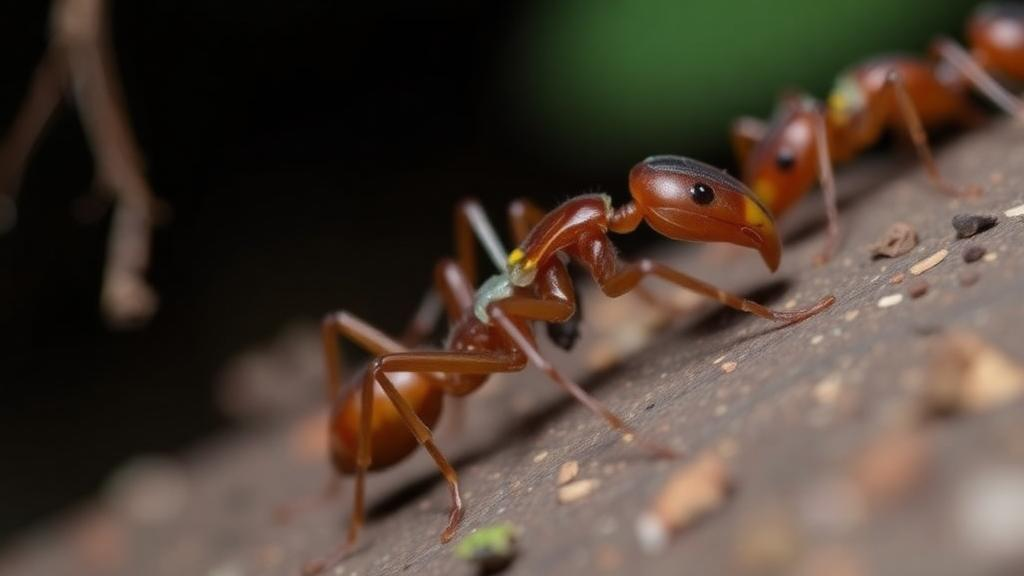
Deep in the leaf litter of southern China’s subtropical forests, an entire radiation of tiny, mite-hunting ants has been hiding in plain sight. A comprehensive taxonomic revision published in the Deutsche Entomologische Zeitschrift has reclassified the ant genus Myrmecina in China, recognizing 28 valid species where only 17 were previously documented — and eleven of them are entirely new to science. The discovery, led by researchers affiliated with Guangxi Normal University and the Institute of Zoology of the Chinese Academy of Sciences, more than doubles the known Chinese diversity of a genus that most people have never heard of, and it firmly establishes China as the world’s richest country for this peculiar lineage of soil-dwelling predators.
Myrmecina is not your average ant. Described by Curtis in 1829, the genus is morphologically distinctive in ways that make it a favorite subject for myrmecologists with a taste for the strange. Workers are small, monomorphic, and equipped with a cylindrical petiole that lacks the dorsal node typical of most myrmicine ants. Their heads bear paired longitudinal carinae along the ventrolateral margins, and their mandibles are subtriangular with well-developed apical and subapical teeth. But the most striking thing about them is ecological: Myrmecina ants are specialized predators of oribatid mites, the armored, slow-moving arachnids that dominate the soil fauna of forest floors worldwide. This dietary specialization has shaped their evolution, and it means that every Myrmecina species is a thread in the intricate food web that recycles nutrients beneath our feet.
The genus has a distribution spanning the Holarctic, Southeast Asia, and northeastern Australia, with 106 valid species currently recognized worldwide. Southeast Asia was long considered the global hotspot — a landmark revision by Okido and colleagues in 2020 described 40 new species from the region in a single stroke. But China occupies a unique biogeographic position at the interface of the Palearctic and Oriental realms, and its Myrmecina fauna had been chronically undersampled. Early records from Forel in 1912 and Wheeler in 1921 documented only scattered occurrences. Studies through the 2000s by Zhou, Huang, and their colleagues gradually pushed the count to nine species, and a 2022 paper by Liu and coauthors added three more from Yunnan, bringing the total to seventeen. The new revision demonstrates that even that figure was a dramatic underestimate.
The breakthrough came from intensive sampling campaigns across southern China, particularly in the provinces of Shaanxi, Yunnan, Guangxi, and Hainan, and in the autonomous region of Xizang. Collectors sifted through leaf litter and soil in secondary forests, often at considerable elevation, extracting the tiny workers from the debris. The specimens were deposited in the Insect Collection at Guangxi Normal University in Guilin and the Institute of Zoology in Beijing, and the researchers subjected them to detailed morphometric analysis using a KEYENCE VHX-6000 3D digital microscope. Measurements — head length, head width, scape length, petiolar dimensions, total length — were recorded in millimeters and rounded to two decimal places, following the morphological standards established by Bolton in 1975. Line drawings were produced digitally, and the resulting illustrated identification key now covers all 28 Chinese species.
The eleven new species carry names that reflect both their anatomy and the people who found them. Myrmecina carinolateralis, from Motuo in Xizang, is distinguished by coarse longitudinal carinae on the lateroventral surface of its head and needle-like propodeal spines. Myrmecina flavipeda, whose name means yellow-footed, was collected in Guangxi and Guangdong and is notable for its robust propodeal spines and unusually large propodeal spiracle. Myrmecina globicephala — the spherical-headed ant — is perhaps the most visually distinctive of the new taxa: its head is rounded in full-face view, a shape unique among Chinese congeners, and it lacks the eumetanotal spines present in most relatives. Myrmecina hirsuta, from Qiandaohu in Zhejiang, is the hairy one, covered in dense, long erect hairs and sporting exceptionally large eyes composed of 37 to 40 ommatidia — far more than the tiny eye clusters of most of its relatives, some of which have as few as four.
The remaining new species are equally revealing of the genus’s morphological breadth. Myrmecina jiachengi, named for collector Jiacheng Zhang, was found in Shaanxi at an elevation recorded at 5,560 meters in the type series data, and it is unique among Chinese Myrmecina in bearing coarse reticulate sculpture across nearly its entire head and mesosoma, where its relatives display longitudinal striae, rugae, or smooth surfaces. Myrmecina laevidorsa, from Guangxi, takes the opposite approach: its mesosomal dorsum is completely smooth and shining, and its eyes are reduced to a mere four to six ommatidia. Myrmecina planiclypea, also from Guangxi, has a flat, straight clypeal margin lacking the median denticle seen in close relatives. Myrmecina rugosodorsum, from Chongqing, bears irregular rugae across its mesosomal dorsum. Myrmecina shanyii honors Professor Shanyi Zhou, a renowned Chinese myrmecologist, while Myrmecina shixui is named for collector Shixu Sun; both were found with rugose antennal scapes, a rare trait shared by only one other Chinese species. Finally, Myrmecina subuncinata, from the mountains of Hainan, has propodeal spines that taper and curve upward into semicircular hooks — an intermediate form between the strongly hooked spines of some congeners and the weakly hooked spines of others.
The revision did more than add species; it cleaned up a century of taxonomic confusion. Myrmecina sinensis, originally described by Wheeler in 1921 as a subspecies of the European Myrmecina graminicola, was confirmed as a valid species, consistent with its earlier elevation based on diagnostic clypeal and sculptural characters. The status of Myrmecina striata, described by Emery in 1889 from Myanmar, emerged as a persistent problem: the original description lacks diagnostic clarity, no verified Chinese specimens match the type material, and yet the species has been cited from China in dozens of published records involving at least fifteen different institutions. The authors took the pragmatic route, flagging the Chinese records as dubious rather than deleting the species outright — a decision that preserves the existing literature while clearly signaling to future workers that confirmation is required.
The numbers tell a striking biogeographic story. With 28 species, China now records more Myrmecina diversity than any other country in the region — Vietnam has six, Thailand four, Malaysia five, and Indonesia five. The concentration in southern China, especially Yunnan, Guangxi, and Hainan, likely reflects the region’s complex topography, its climatic heterogeneity, and its position straddling two great biogeographic realms. The genus also displays remarkable morphological variation within China: antennal segmentation ranges from the standard twelve segments down to eleven in Myrmecina pauca, the only Chinese species with the reduced count; propodeal spines range from hooked in M. hamula to upturned in M. subuncinata; and sculpturing spans everything from the reticulate armor of M. jiachengi to the polished mesosoma of M. laevidorsa.
There is a conservation dimension to all of this, and it is not trivial. Several of the newly described species — M. hirsuta, M. globicephala, and M. shanyii among them — are known from single localities, which renders them inherently vulnerable to habitat loss. Because Myrmecina ants prey on oribatid mites, they occupy a specific functional niche in soil ecosystems, and their decline could ripple through the nutrient-cycling processes that keep forest floors functioning. The authors recommend targeted surveys in understudied regions such as Sichuan and Fujian, and genetic barcoding of type specimens to resolve the taxonomic uncertainties that morphology alone cannot settle.
Indeed, the study’s most forward-looking conclusion may be its acknowledgment of the limits of morphology-based taxonomy. Species delimitations in Myrmecina currently rest almost exclusively on anatomical characters, a practice that risks confusing intraspecific variation with genuine species differences. The authors point to recent successes elsewhere in ant systematics — ultraconserved-element phylogenomics resolving deep relationships in ectaheteromorph ants, and a genomic reassessment of the New World genus Dorymyrmex that redefined its species limits — and argue that a comparable combination of phylogenomics and cuticular-hydrocarbon profiling is now needed to test the validity of the morphology-based species within Chinese Myrmecina. For now, though, the message is clear: beneath the leaf litter of China’s forests, biodiversity is accumulating faster than science can catalog it, and a genus of mite-hunting ants just became eleven species richer overnight.
Subject of Research: Taxonomic revision of the ant genus Myrmecina in China with description of eleven new species
Article Title: Synopsis of the ant genus Myrmecina Curtis, 1829 from China ( Hymenoptera , Formicidae , Myrmicinae ), with description of eleven new species
Article References: Gu, Z., Zhang, C., Du, C., & Chen, Z. (2025). Synopsis of the ant genus Myrmecina Curtis, 1829 from China (Hymenoptera, Formicidae, Myrmicinae), with description of eleven new species. Deutsche Entomologische Zeitschrift, 72(2), 395-448. https://doi.org/10.3897/dez.72.162491
Image Credits: AI Generated
Keywords: Myrmecina, ants, taxonomy, new species, China, entomology, biodiversity, Formicidae, leaf litter, oribatid mites, biogeography, species discovery
News Source: Drew Townsend. (October 17, 2026). Eleven New Ant Species Discovered in China’s Hidden Forest Floors. Scienmag.