• HOME
  • NEWS
  • EXPLORE
    • CAREER
      • Companies
      • Jobs
    • EVENTS
    • iGEM
      • News
      • Team
    • PHOTOS
    • VIDEO
    • WIKI
  • BLOG
  • COMMUNITY
    • FACEBOOK
    • INSTAGRAM
    • TWITTER
Thursday, February 5, 2026
BIOENGINEER.ORG
No Result
View All Result
  • Login
  • HOME
  • NEWS
  • EXPLORE
    • CAREER
      • Companies
      • Jobs
        • Lecturer
        • PhD Studentship
        • Postdoc
        • Research Assistant
    • EVENTS
    • iGEM
      • News
      • Team
    • PHOTOS
    • VIDEO
    • WIKI
  • BLOG
  • COMMUNITY
    • FACEBOOK
    • INSTAGRAM
    • TWITTER
  • HOME
  • NEWS
  • EXPLORE
    • CAREER
      • Companies
      • Jobs
        • Lecturer
        • PhD Studentship
        • Postdoc
        • Research Assistant
    • EVENTS
    • iGEM
      • News
      • Team
    • PHOTOS
    • VIDEO
    • WIKI
  • BLOG
  • COMMUNITY
    • FACEBOOK
    • INSTAGRAM
    • TWITTER
No Result
View All Result
Bioengineer.org
No Result
View All Result
Home NEWS Science News

Bending an organic semiconductor can boost electrical flow

Bioengineer by Bioengineer
December 3, 2019
in Science News
Reading Time: 2 mins read
0
IMAGE
Share on FacebookShare on TwitterShare on LinkedinShare on RedditShare on Telegram

Rutgers-led research could benefit next-generation electronics
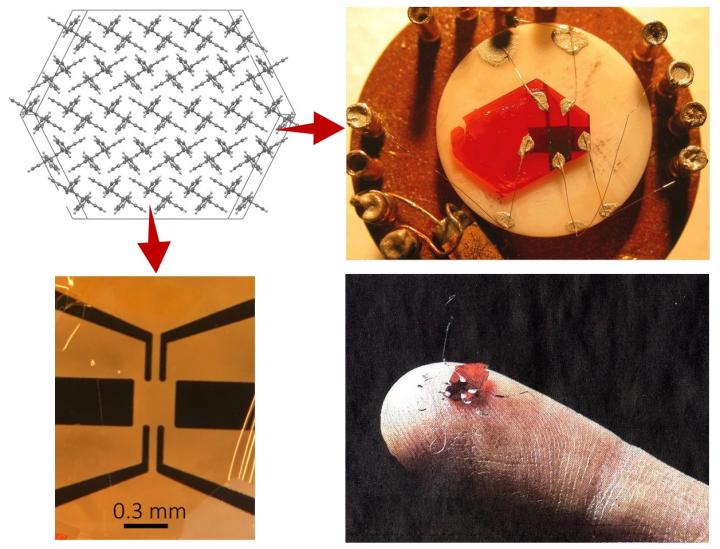
IMAGE

Credit: Vitaly Podzorov/Rutgers University-New Brunswick


p>Slightly bending semiconductors made of organic materials can roughly double the speed of electricity flowing through them and could benefit next-generation electronics such as sensors and solar cells, according to Rutgers-led research.

The study is published in the journal Advanced Science.

“If implemented in electrical circuits, such an enhancement – achieved by very slight bending – would mean a major leap toward realizing next-generation, high-performance organic electronics,” said senior author Vitaly Podzorov, a professor in the Department of Physics and Astronomy in the School of Arts and Sciences at Rutgers University-New Brunswick.

Semiconductors include materials that conduct electricity and their conductivity can be tuned by different external stimuli, making them essential for all electronics. Organic semiconductors are made of organic molecules (mainly consisting of carbon and hydrogen atoms) that form light, flexible crystals called van der Waals molecular crystals. These novel materials are quite promising for applications in optoelectronics, which harness light and include flexible and printed electronics, sensors and solar cells. Traditional semiconductors made of silicon or germanium have limitations, including cost and rigidity.

One of the most important characteristics of organic and inorganic semiconductors is how fast electricity can flow through electronic devices. Thanks to progress over the last decade, organic semiconductors can perform roughly 10 times better than traditional amorphous silicon transistors. Tuning semiconductors by bending them is called “strain engineering,” which would open a new avenue of development in the semiconductor industry if implemented successfully. But until now, there were no conclusive experimental results on how bending organic semiconductors, including those in transistors, may affect the speed of electricity flowing in them.

The Rutgers-led study reports the first such measurement, and a 1 percent bend in an organic transistor can roughly double the speed of electrons flowing through it.

The lead author is Hyun Ho Choi, a former post-doctoral researcher in the Podzorov Group who is now at Gyeongsang National University in Korea. Hee Taek Yi, another former post-doctoral researcher, is a coauthor. Scientists at the University of Tokyo; University of Massachusetts Amherst; and Pohang University of Science and Technology in Korea contributed to the study.

Media Contact
Todd Bates
[email protected]
848-932-0550

Original Source

https://news.rutgers.edu/bending-organic-semiconductor-can-boost-electrical-flow/20191126#.XeU8WOhKi70

Related Journal Article

http://dx.doi.org/10.1002/advs.201901824

Tags: Atomic/Molecular/Particle PhysicsElectrical Engineering/ElectronicsEnergy/Fuel (non-petroleum)MaterialsNanotechnology/MicromachinesSuperconductors/SemiconductorsTechnology/Engineering/Computer Science
Share12Tweet8Share2ShareShareShare2

Related Posts

Prolonged PDA Exposure Raises Late Kidney Injury Risk

February 5, 2026
Tackling Energy Modeling Challenges in Developing Nations

Tackling Energy Modeling Challenges in Developing Nations

February 5, 2026

Unveiling the Clinical Significance of Unique Brain Functional Connectomes in Major Depressive Disorder

February 5, 2026

Breakthrough Stem Cell Therapy Shows Promise for Parkinson’s Disease

February 5, 2026
Please login to join discussion

POPULAR NEWS

  • Robotic Ureteral Reconstruction: A Novel Approach

    Robotic Ureteral Reconstruction: A Novel Approach

    81 shares
    Share 32 Tweet 20
  • Digital Privacy: Health Data Control in Incarceration

    63 shares
    Share 25 Tweet 16
  • Study Reveals Lipid Accumulation in ME/CFS Cells

    57 shares
    Share 23 Tweet 14
  • Breakthrough in RNA Research Accelerates Medical Innovations Timeline

    53 shares
    Share 21 Tweet 13

About

We bring you the latest biotechnology news from best research centers and universities around the world. Check our website.

Follow us

Recent News

Prolonged PDA Exposure Raises Late Kidney Injury Risk

Tackling Energy Modeling Challenges in Developing Nations

Unveiling the Clinical Significance of Unique Brain Functional Connectomes in Major Depressive Disorder

Subscribe to Blog via Email

Success! An email was just sent to confirm your subscription. Please find the email now and click 'Confirm' to start subscribing.

Join 73 other subscribers
  • Contact Us

Bioengineer.org © Copyright 2023 All Rights Reserved.

Welcome Back!

Login to your account below

Forgotten Password?

Retrieve your password

Please enter your username or email address to reset your password.

Log In
No Result
View All Result
  • Homepages
    • Home Page 1
    • Home Page 2
  • News
  • National
  • Business
  • Health
  • Lifestyle
  • Science

Bioengineer.org © Copyright 2023 All Rights Reserved.