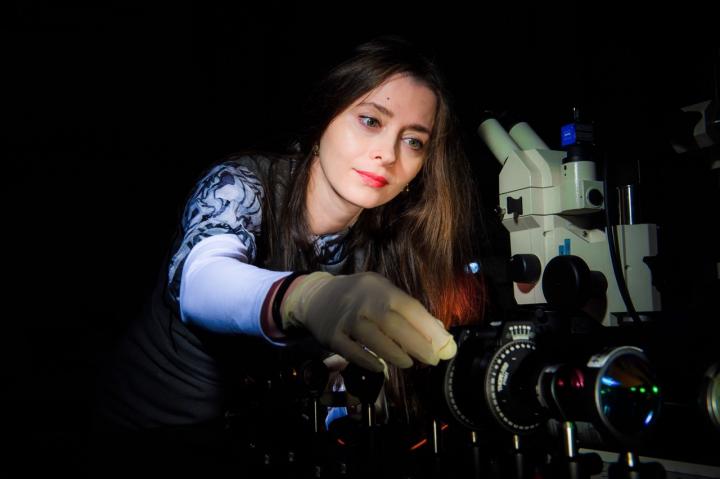
Credit: Dani Machlis, Ben-Gurion U.
BEER-SHEVA, Israel – July 22, 2019 – Ben-Gurion University of the Negev (BGU) researchers have developed a new chip device that offers superior identification of miniscule blood residues for forensic applications.
Criminologists use luminol to identify microscopic blood drops, as well as low hydrogen peroxide concentrations, proteins and DNA. These are all invisible to the naked eye but become visible through a chemical reaction known as “chemiluminescence.” Detecting biological residues using this method is cost effective and advantageous since the detected signal does not depend on an external light source.
The BGU microfluidic chip not only increases the chemiluminescent intensity severalfold, but also prolongs the glow time of luminol, enabling the detection of much smaller blood samples in a forensic scene. The chip device was developed by BGU Prof. Alina Karabchevsky, head of BGU’s Light-on-a-Chip Group, a member of the BGU Unit of Electro-Optical Engineering and the Ilse Katz Institute for Nanoscale Science and Technology.
The innovation combines the use of luminol with gold or silver nanospheres in a specially designed microfluidic device that increases the detection limit by amplifying chemiluminescent light emission and facilitating imaging in the chip.
“Our findings open the door to new integrated microfluidic chips,” said Prof. Karabchevsky. “Practical implementation of this discovered effect will include further superior chemiluminescence-based sensors for forensic science, research in biology and chemistry, and no-source opto-chemical lasers.”
“Identifying trace quantities of blood can increase the efficiency and accuracy of a forensic investigation of a crime scene but requires more sensitive detectors than those that are currently available,” says Netta Cohen, chief executive officer of BGN Technologies. “We are looking for partners to further develop this promising patented invention.”
###
About BGN Technologies
BGN Technologies is the technology company of Ben-Gurion University of the Negev, Israel. The company brings technological innovations from the lab to the market and fosters research collaborations and entrepreneurship among researchers and students. To date, BGN Technologies has established over 100 startup companies in the fields of biotech, high-tech, and cleantech as well as initiating leading technology hubs, incubators and accelerator. Over the past decade, it has focused on creating long-term partnerships with multinational corporations such as Deutsche Telekom, Dell-EMC, IBM, PayPal, and Bayer, securing value and growth for BGU as well as for the Negev region. For more information, visit the BGN Technologies website.
About American Associates, Ben-Gurion University of the Negev
American Associates, Ben-Gurion University of the Negev (AABGU) plays a vital role in sustaining David Ben-Gurion’s vision: creating a world-class institution of education and research in the Israeli desert, nurturing the Negev community and sharing the University’s expertise locally and around the globe. As Ben-Gurion University of the Negev (BGU) looks ahead to turning 50 in 2020, AABGU imagines a future that goes beyond the walls of academia. It is a future where BGU invents a new world and inspires a vision for a stronger Israel and its next generation of leaders. Together with supporters, AABGU will help the University foster excellence in teaching, research and outreach to the communities of the Negev for the next 50 years and beyond. Visit vision.aabgu.org to learn more.
AABGU, which is headquartered in Manhattan, has nine regional offices throughout the United States. For more information, visit http://www.
Media Contact
Andrew Lavin
[email protected]