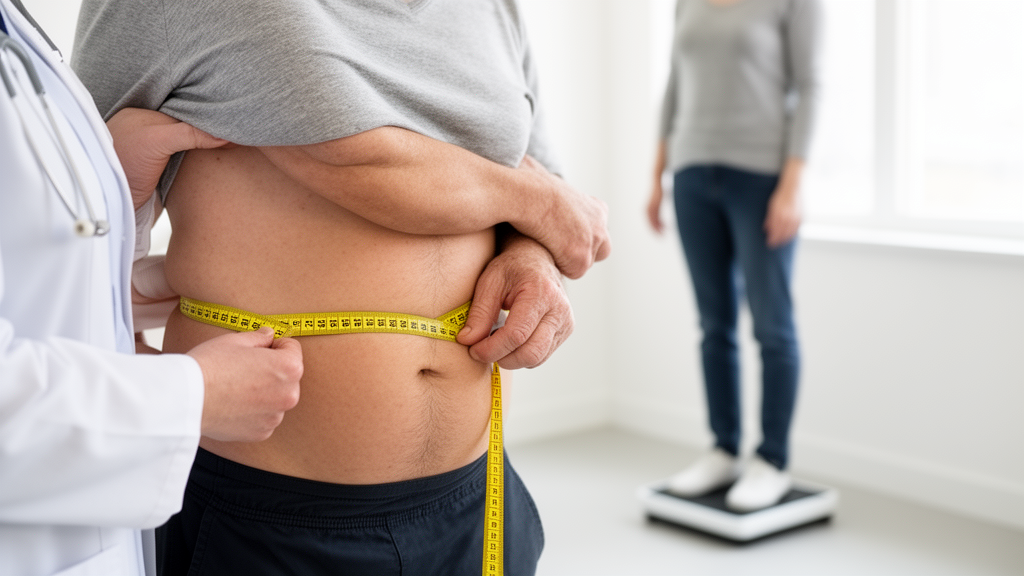
For decades, the body mass index has been the first number a clinician reaches for when weighing a patient’s metabolic risk. Cheap, universal, and easy to calculate, the ratio of weight to height has anchored screening guidelines around the world. Yet a large new analysis from Iran suggests that this familiar metric may be missing a crucial part of the picture. In a study of nearly 18,000 adults drawn from a national health survey, researchers found that two relatively obscure measures of fat distribution — the lipid accumulation product and the waist-triglyceride index — did a better job of distinguishing people with diabetes than BMI ever managed. The finding, published in BMC Endocrine Disorders, adds weight to a growing scientific consensus that where fat sits in the body matters far more than how much of it there is in total.
The research team, led by investigators at Tehran University of Medical Sciences, turned to the 2021 Iran STEPS survey, a nationally representative assessment conducted under the World Health Organization’s STEPwise approach to noncommunicable disease risk factor surveillance. That framework, used in dozens of countries, gathers standardized information on behavioral and physical risk factors along with biochemical measurements, making it one of the most valuable data sources for studying chronic disease in low- and middle-income settings. From the survey, the researchers analyzed records for 17,945 participants, giving them a sample large enough to test how well different adiposity measures performed across sexes, age groups, and urban versus rural populations.
The measures under scrutiny represent a family of so-called visceral adiposity indices. Unlike BMI, which lumps together muscle, bone, water, and fat into a single number, these indices attempt to capture the metabolically dangerous fat that accumulates around internal organs. The lipid accumulation product, or LAP, combines waist circumference with fasting triglyceride levels, reflecting the idea that a thick waist paired with fat-clogged blood signals overflowing energy stores spilling into ectopic deposits. The visceral adiposity index, or VAI, goes further, weaving together waist circumference, triglycerides, high-density lipoprotein cholesterol, and body mass index itself into a sex-specific formula designed to estimate visceral fat dysfunction. The waist-triglyceride index, or WTI, is a simpler cousin, pairing waist measurement directly with circulating triglycerides. All three can be computed from a tape measure and a standard blood panel — no CT scanner or dual X-ray absorptiometry required.
That accessibility is precisely what makes the results striking. Imaging techniques such as computed tomography and MRI remain the gold standards for quantifying visceral fat directly, and DEXA scans can map regional fat distribution with precision, but none of these are realistic tools for population screening in most of the world. The indices tested in this study require nothing more exotic than equipment already present in a basic clinic. If a tape measure and a routine lipid test can outperform BMI for flagging diabetes risk, the implications for primary care in resource-constrained settings could be substantial, particularly in regions like the Middle East and North Africa where diabetes prevalence has climbed steeply over recent decades.
To assess performance, the researchers employed two complementary statistical approaches. First, they used multivariable logistic regression to examine how strongly each index was associated with prevalent diabetes — that is, diabetes identified at the time of the survey — while accounting for other variables. All of the indices, including BMI itself, showed significant associations with the disease, confirming that every measure of adiposity carries some signal. But association alone does not settle the question of usefulness. A screening tool must also discriminate: it must reliably separate people who have the condition from those who do not. For that, the team turned to receiver operating characteristic analysis, plotting true-positive rates against false-positive rates across the full range of each index’s values and summarizing the trade-off with the area under the curve, or AUC.
The results were revealing. When the researchers added LAP or WTI to a base predictive model, discriminatory ability rose significantly, reaching an AUC of 0.816 for LAP and 0.815 for WTI, with confidence intervals spanning roughly 0.804 to 0.827. BMI, by contrast, failed to deliver the same boost. Indeed, every anthropometric index examined outperformed the base model, but the lipid-waist hybrids stood out as the clear leaders. The team also compared the indices using Somers’ D, a rank-based measure of association, and conducted stratified analyses by sex, age group, and place of residence to check whether the advantage held across different segments of the population. The consistency of the signal across these strata strengthens the case that the finding is not an artifact of one particular subgroup.
Why should waist-and-blood measures beat BMI at detecting diabetes? The answer lies in the biology of fat storage. Subcutaneous fat, the layer beneath the skin, is relatively inert compared with visceral fat packed around the liver, pancreas, and intestines. Visceral adiposity drains directly into the portal circulation, flooding the liver with free fatty acids and promoting insulin resistance — the fundamental defect underlying type 2 diabetes. Triglyceride levels serve as a convenient biochemical echo of this process, rising as fat handling becomes dysregulated. An index that combines a central waist measurement with elevated triglycerides therefore captures two independent markers of the same underlying pathology: fat in the wrong place and fat metabolism gone awry. BMI, meanwhile, can be elevated in muscular individuals with low metabolic risk and deceptively normal in people with thin-outside-fat-inside phenotypes, a pattern increasingly recognized in South Asian and Middle Eastern populations.
This last point carries particular relevance for Iran and its neighbors. Research over the past two decades has shown that people in many Asian and Middle Eastern populations develop metabolic complications at lower BMIs than Europeans, prompting bodies such as the International Diabetes Federation to recommend lower waist circumference thresholds for these groups. A screening strategy built on BMI alone may therefore systematically underestimate risk in exactly the populations where diabetes is expanding fastest. The Iran STEPS analysis, conducted in a country where diabetes is a major contributor to morbidity and mortality, offers a direct test of whether alternative indices could close that gap — and the answer appears to be yes, at least for identifying prevalent disease.
The authors are careful about the limits of their work. Because the study is cross-sectional, it captures a snapshot of who had diabetes at the time of the survey rather than tracking who develops it over time. Discriminating prevalent cases is not the same as predicting incident disease, and the researchers explicitly call for prospective studies to evaluate whether LAP and WTI can forecast future diabetes and not merely flag existing cases. They also note that the indices were tested within a single national survey, and while the STEPS methodology supports comparability, validation in other populations and health systems remains an open task. The study was approved by the research ethics committee of Tehran University of Medical Sciences and conducted with written informed consent from all participants, in line with the Declaration of Helsinki.
Even with those caveats, the study lands at a moment when health systems worldwide are searching for low-cost ways to target prevention. Diabetes screening at scale cannot depend on imaging or specialized testing, and the global burden of the disease continues to grow fastest in developing regions where resources are thinnest. If two numbers — a waist measurement and a triglyceride value — can meaningfully sharpen the identification of people living with diabetes beyond what BMI achieves, clinicians and public health planners gain a practical upgrade to their toolkit at essentially no added cost. The message from this large Iranian dataset is not that BMI should be discarded, but that it should no longer stand alone. The fat that endangers metabolic health hides in the abdomen and in the blood, and the simplest measures of both may finally be ready for prime time.
Subject of Research: Comparison of visceral adiposity indices with body mass index for detecting prevalent diabetes in the Iranian population
Article Title: Comparison of novel visceral adiposity indices with body mass index for identification of prevalent diabetes: findings from the 2021 Iran STEPS survey
Article References: ErfanFazel, A., Semnani, K., Mohseni, S., Khosravi, S., Pejman Sani, M., Tabatabaei-Malazy, O., & Qorbani, M. (2026). Comparison of novel visceral adiposity indices with body mass index for identification of prevalent diabetes: findings from the 2021 Iran STEPS survey. BMC Endocrine Disorders. https://doi.org/10.1186/s12902-026-02533-2
Image Credits: AI Generated
DOI: 10.1186/s12902-026-02533-2
Keywords: diabetes, body mass index, visceral adiposity, lipid accumulation product, waist-triglyceride index, waist circumference, obesity, Iran STEPS survey, insulin resistance, screening, triglycerides, epidemiology
News Source: Daisy Hatcher. (October 9, 2026). Belly Fat Beats BMI: Simple Waist-Based Indexes Outperform Body Weight in Spotting Diabetes. Scienmag.