International team under the leadership of the University of Bonn decodes 99 million-year-old amber fossils
Credit: © J.A. Peñas
Like a snapshot, amber preserves bygone worlds. An international team of paleontologists from the University of Bonn has now described four new beetle species in fossilized tree resin from Myanmar, which belong to the Kateretidae family. They still exist today, with only a few species. As well as the about 99 million years old insects, the amber also includes pollen. It seems that the beetles helped the flowering plants to victory, because they contributed to their propagation. In turn, the beetles benefited from the new food source. The results have now been published in the journal “iScience“.
The researchers have described the new beetle species using specimens in four amber pieces from Myanmar (previously known as Burma). The pieces are estimated to be 99 million years old and date from the Cretaceous period, when dinosaurs were a rich and diverse group. Two of the pieces are in the Museum of Natural Sciences of Barcelona (Spain), while the other two specimens are kept in the Institute of Geology and Palaeontology in Nanjing (China).
“Although Myanmar surprises us time and again with finds of great scientific importance, amber pieces containing numerous organisms are not often found there,” says project leader Dr. David Peris, who comes from Spain and is a postdoc at the Institute for Geosciences at the University of Bonn with an Alexander von Humboldt Foundation’s fellowship. He carried out the project with scientists from the USA, Spain, Germany, China and the Czech Republic.
Three of the examined amber pieces contained numerous beetles, while the fourth piece contained only one specimen of this family. Many pollen grains of different groups of seed plants, some of them long extinct, have been preserved with the beetles in the tree resin. Peris: “This close association suggests that the grains were distributed in the viscous lump of resin by the movement of the beetles.”
The beetle family still exists today
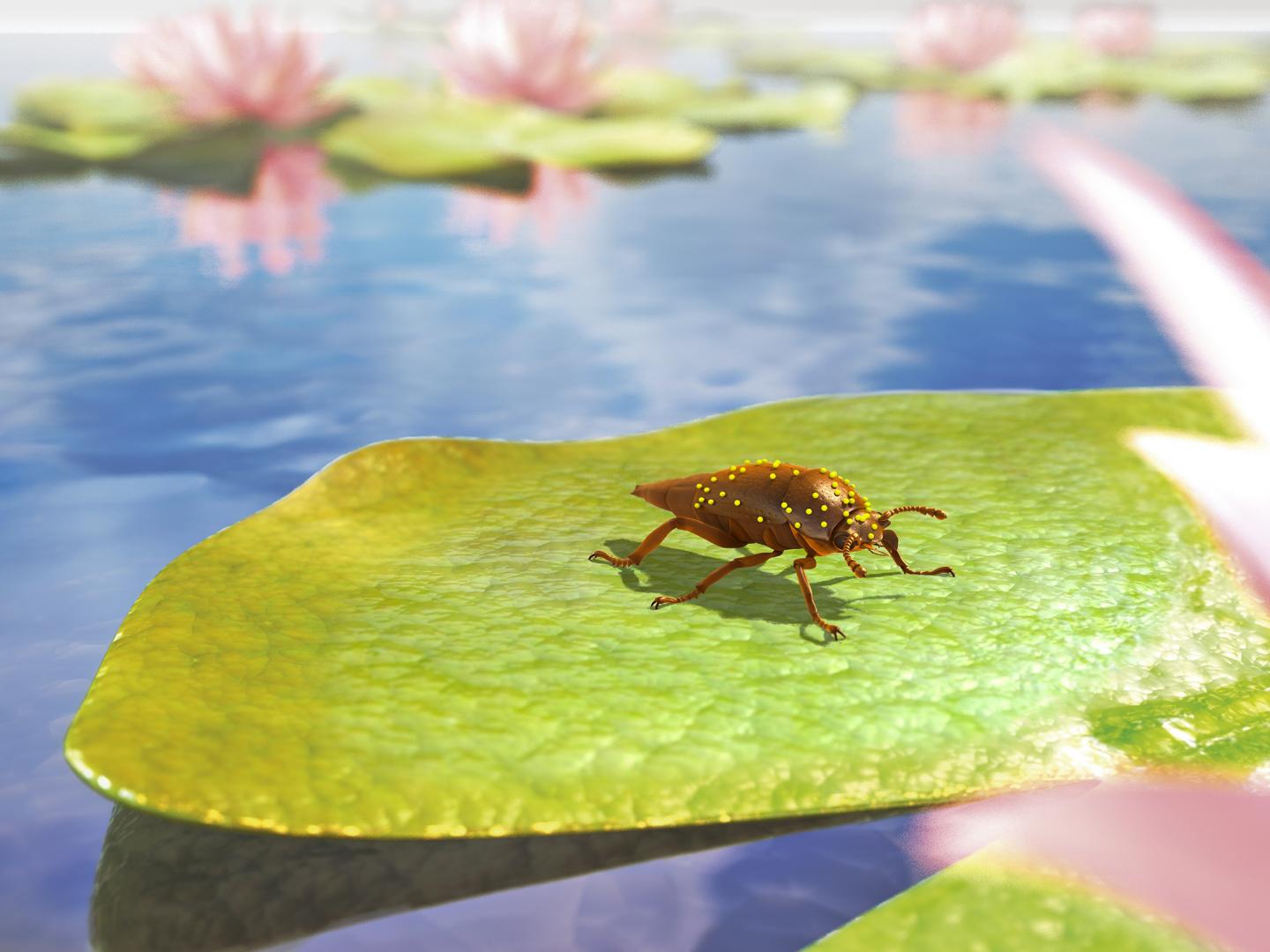
The Kateretidae are a small family of beetles with less than 100 described modern species that today live in South America and other temperate and subtropical regions. The species of this family feed on pollen and flower parts. Due to their dietary habits, they are nowadays regarded as pollinators of flowering plants (angiosperms). But in the middle Cretaceous period their rapid development had just begun. Previously, the Earth was colonized by gymnosperms, literally meaning “naked seeds”, which also includes our conifers. “The most important aspect of this study is that the pollen grains in three of the amber pieces do not belong to flowering plants,” says Peris. The pollen grains on the beetle of the fourth piece of amber, however, come from a water lily, a group of very primitive angiosperms that emerged at an early stage.
Living together for mutual benefit
There are other pollinating insects in amber, but almost all of them concern gymnosperms. When flowering plants (angiosperms) began their early development, they represented a new resource that was used by the Kateretidae. The beetles adapted quickly and formed a mutually beneficial symbiosis: The flowering plants served the beetles as a food source and these animals contributed to the propagation of the new angiosperms by pollination.
In earlier studies it was speculated that the beetles might belong to the insect groups that pollinated the earliest flowers. Some of these animals had developed the ability to pollinate gymnosperms well before the appearance of angiosperms. “Our study supports this hypothesis of significant host plant relocation, as there are no Kateretidae associated with gymnosperms today,” says Peris. Adapting to the new resource has proven to be an evolutionary advantage.
###
Publication: Peris, David; Labandeira, Conrad C.; Barrón, Eduardo; Delclòs, Xavier; Rust, Jes; and Wang, Bo: Generalist pollen-feeding beetles during the mid-Cretaceous, iScience, DOI: 10.2139/ssrn.3492117
Media contact:
Dr. David Peris
Institute for Geosciences
University of Bonn
Tel. +49-(0)228-734682
E-mail: [email protected]
Prof. Dr. Jes Rust
Institute for Geosciences
University of Bonn
Tel. +49-(0)228-734842
E-Mail: [email protected]
Media Contact
Dr. David Peris
[email protected]
49-022-873-4682
Related Journal Article
http://dx.