Researchers at the University of Göttingen compare the development of beetle brains with that of flies
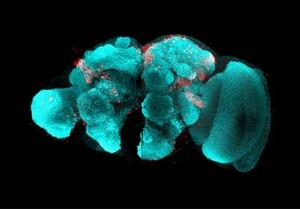
Credit: M Farnworth
In the human brain, hundreds of billions of nerve cells are interconnected in the most complicated way, and only when these interconnections are correctly made, can the brain function properly. This is no different for insects, even though their brains consist of ‘only’ one hundred thousand to one million nerve cells. Nevertheless, fascinating and unexpectedly complicated behaviour can be observed in insects, for example when rearing offspring in the bee hive or when mosquitoes search for blood. To a large extent, the brain develops in the embryo, but in many animals it is completed only after birth. Now, biologists from the University of Göttingen have found out that beetle larvae start using their brains, although still ‘under construction’. The results have been published in the journal PLOS Biology.
The biologists compared the development of the brains of flies and beetles, focusing on the “central complex” – a structure in the brain that insects need for their orientation in the environment. Using genetic engineering methods and genome editing, they first marked the same small group of nerve cells in both the fruit fly and the red flour beetle. This enabled them to follow the development of these cells from embryo to adult animal under the microscope and to compare the development between the animal species. Even before these investigations, it was known that part of the central complex is already formed in the beetle larvae, whereas in flies it only develops in the adult animal. It was thought that the completed development of this part was required to allow the beetle larva to walk; fly maggots do not need this part because they have no legs.
To their surprise, however, the scientists found that this part of the brain starts to work in the beetle larva, even though it has not yet reached a state similar to the adult animal. On the contrary – the structure corresponds to an embryonic stage of development known from other insects. The difference is that in the beetle larva the nerve cells of this brain ‘under construction’ are already forming connections, which probably helps the larva to orientate itself in its environment. “I had expected to find a miniature version of the adult central complex – but not that their ‘construction site’ would have started working,” says Max Farnworth, first author and PhD student in Evolutionary Development Genetics at the University of Göttingen, expressing his surprise.
The second big surprise was that the sequence of the brain’s developmental steps had changed in the beetle. Previously, it was thought that the developmental steps always proceeded in the same order – although the point in time when the step occurs may shift. This is known as ‘heterochrony’ in evolutionary biology. However, in the embryo of the beetle, some developmental steps changed their position to occur earlier in the series than in the fly. This was observed, for instance, with respect to the formation of crossings of nerve cells and the formation of synapses, while other steps took place later, just like in the fly.
“We have discovered the first example of a change in the developmental order in the brain, known as a ‘sequence heterochrony’,” explains senior author Professor Gregor Bucher, the Head of Evolutionary Developmental Genetics. “The development of insect brains is probably much more variable than we could have imagined. This could explain how they were able to adapt their brains in so many different ways to the demands of the environment.”
###
Original publication: Max Farnworth et al. Sequence heterochrony led to a gain of functionality in an immature stage of the central complex: A fly-beetle insight. PLOS Biology 2020.
Doi: https:/
Contact:
Professor Gregor Bucher
University of Göttingen
Faculty of Biology and Psychology, Evolutionary Developmental Genetics
Justus-von-Liebig-Weg 11, 37077 Göttingen, Germany
Tel: +49 (0)551 39-5426
Email: [email protected]
http://www.
Media Contact
Melissa Sollich
[email protected]
Original Source
https:/
Related Journal Article
http://dx.