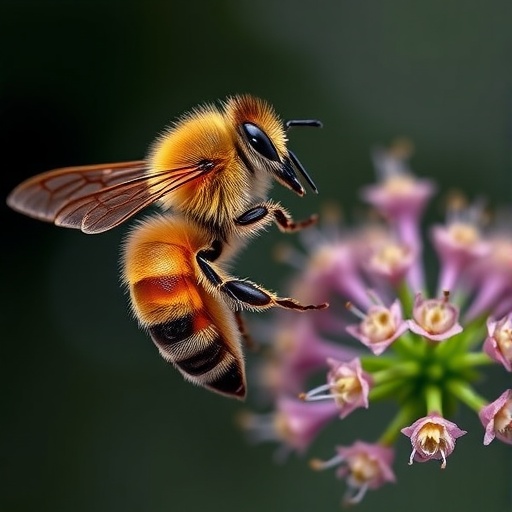
In a groundbreaking study published in Biology Letters, researchers from Queen Mary University of London have unveiled a remarkable cognitive ability in the bumblebee species Bombus terrestris. For the first time, it has been demonstrated that these insects can distinguish between visual stimuli based solely on the duration of light flashes. This discovery upends prior assumptions that time-based visual discrimination, akin to understanding Morse code’s dots and dashes, was an ability exclusive to humans and certain vertebrates such as macaques and pigeons.
The team, led by PhD candidate Alex Davidson and senior lecturer Dr. Elisabetta Versace, embarked on a quest to discern if bumblebees possess an innate ability to decode temporal aspects of visual signals. By designing a specialized maze, the scientists created an experimental environment enabling individual bees to be conditioned to associate a sugar reward with either a short or long-lasting flash of light. This setup mimicked Morse code’s fundamentals: the short flash symbolizing the letter ‘E’ (dot) and the long flash denoting the letter ‘T’ (dash).
Throughout the experiment, the positions of these flashing stimuli were systematically altered within the maze, ensuring bees could not rely on spatial memory or other environmental cues to make their decisions. Instead, they were compelled to base their foraging choices entirely on the temporal characteristics of the light flashes. Intriguingly, when presented with stimuli unaccompanied by any sugar reward, the majority of bees continued to select the flashing light duration previously associated with the sweet treat, affirming their ability to internally process duration cues independent of smell or other confounding factors.
This ability is of particular interest because in their natural habitat, bumblebees are not typically exposed to flashing visual signals. Their success suggests that the capacity to process the length of a stimulus’s presentation may have evolved for alternate functions, such as tracking movement or communicating in different sensory modalities, then co-opted in this artificial experimental setting. Alternatively, Davidson and Versace hypothesize that timing discrimination could arise from fundamental neural properties intrinsic to their miniature nervous systems.
One compelling puzzle posed by this study is the neural mechanism underlying such precise time differentiation. Known biological clocks that regulate circadian rhythms or seasonal cycles operate on markedly longer scales and cannot explain the discrimination between tens or hundreds of milliseconds characterizing a ‘dot’ versus a ‘dash’. Given this, it is possible that Bombus terrestris utilize one or more internal timing mechanisms that function on ultra-short timescales, a feature previously hypothesized but never empirically demonstrated at such a small scale.
This revelation is especially fascinating considering the sheer size of the bumblebee brain, which measures less than one cubic millimeter. Despite its miniature size, it possesses the capacity to encode durations with enough fidelity to guide foraging behavior based on fleeting temporal differences. The implications of these findings resonate far beyond entomology, challenging our conceptions of cognitive complexity and temporal perception’s evolutionary origins across taxa.
Dr. Elisabetta Versace emphasized the broader significance of this discovery in the context of time-based cognition across species. Many sophisticated behaviors, including communication strategies and navigational skills, depend heavily on an organism’s ability to process temporal information. By revealing that insects with minimal neural substrate can accomplish such feats, the study opens new avenues for comparative research that aim to unravel the evolutionary pressures and neural architectures underlying time perception.
Moreover, this work bridges biological intelligence and artificial neural networks. Versace posits that understanding how minimal neural structures efficiently process complex variables like time can inspire the design of more scalable and resource-efficient algorithms in machine learning and robotics. In this way, the bumblebee’s temporal discrimination ability becomes a blueprint for developing artificial cognitive systems that mirror biological efficiency.
Future research will undoubtedly delve deeper into the molecular and electrophysiological bases of this timing capability in insects. Identifying specific neural circuits and timing mechanisms could elucidate shared principles applicable across diverse species, refining models of how brains encode and utilize temporal information. The potential discovery of such universal timing processes could revolutionize our understanding of cognition and time perception at the most fundamental biological levels.
Alex Davidson reflected on the excitement surrounding the experiment’s success, noting the unexpected nature of the bees’ learning. He remarked that watching the bees adapt to and master a task involving abstract, non-natural stimuli—light flashes of varying durations—provided compelling evidence of cognitive flexibility not previously attributed to invertebrates. This adaptability points toward an underestimated richness in insect sensory processing and learning capabilities.
In summary, this pioneering investigation confirms that the bumblebee Bombus terrestris transcends simple sensory detection and achieves sophisticated temporal discrimination. Their ability to differentiate brief versus prolonged light flashes and base navigational decisions on this input uncovers a new dimension of insect cognition. This discovery not only reshapes our understanding of the neuroecology of pollinators but also sets a foundational precedent for exploring time processing in minimalistic neural architectures.
As scientific inquiry unravels the intricate neural codes permitting such feats, the humble bumblebee may well become an emblem of cognitive efficiency and complexity. Understanding how miniature brains grapple with time will enrich the dialogue between neurobiology, ethology, and artificial intelligence, revealing how nature’s smallest brains tackle some of the most challenging aspects of perception.
Subject of Research: Time perception and duration discrimination abilities in the bumblebee Bombus terrestris
Article Title: Duration discrimination in the bumblebee Bombus terrestris
News Publication Date: 12-Nov-2025
Web References: DOI: 10.1098/rsbl.2025.0440
Image Credits: Alex Davidson, Queen Mary University of London
Keywords: Bees, Pattern recognition, Cognition, Problem solving
Tags: animal cognition and visual perceptionBombus terrestris visual discriminationbumblebee cognitive abilitiesconditioning bees with light signalsexperimental maze for beesgroundbreaking discoveries in entomologyinnovative insect communication studyMorse code in insectsQueen Mary University of London researchshort and long flash light associationtemporal aspects of visual signalsunexpected intelligence in bumblebees