By copying the multilayer geometry of mammal bones, cathodes for sodium-ion batteries can be made more structurally stable, while maintaining high capacities and fast charge rates
Credit: Kang Ho Shin, Sul Ki Park, Puritut Nakhanivej, Yixian Wang, Pengcheng Liu, Seong-Min Bak, Min Sung Choi, David Mitlin and Ho Seok Park
WASHINGTON, December 8, 2020 — Sodium-ion batteries are poised to replace lithium-ion batteries for large-scale electrical energy storage. They offer several advantages over lithium-ion batteries, particularly due to the widespread abundance of sodium.
However, it is difficult to develop sodium cathodes, materials through which electrons can enter a battery. Many candidate materials are unstable or cannot withstand high voltages.
To find a solution, researchers from Sungkyunkwan University, the University of Texas at Austin, and Brookhaven National Laboratory turned to nature. They describe their mammal bone-inspired sodium cathode in the journal Applied Physics Reviews, from AIP Publishing.
“We believe that nature provides a very promising solution to resolve technical problems,” said Ho Seok Park, one of the authors. “Accordingly, we tried to find the ideal architecture that can resolve these kinetic and stability limitations.”
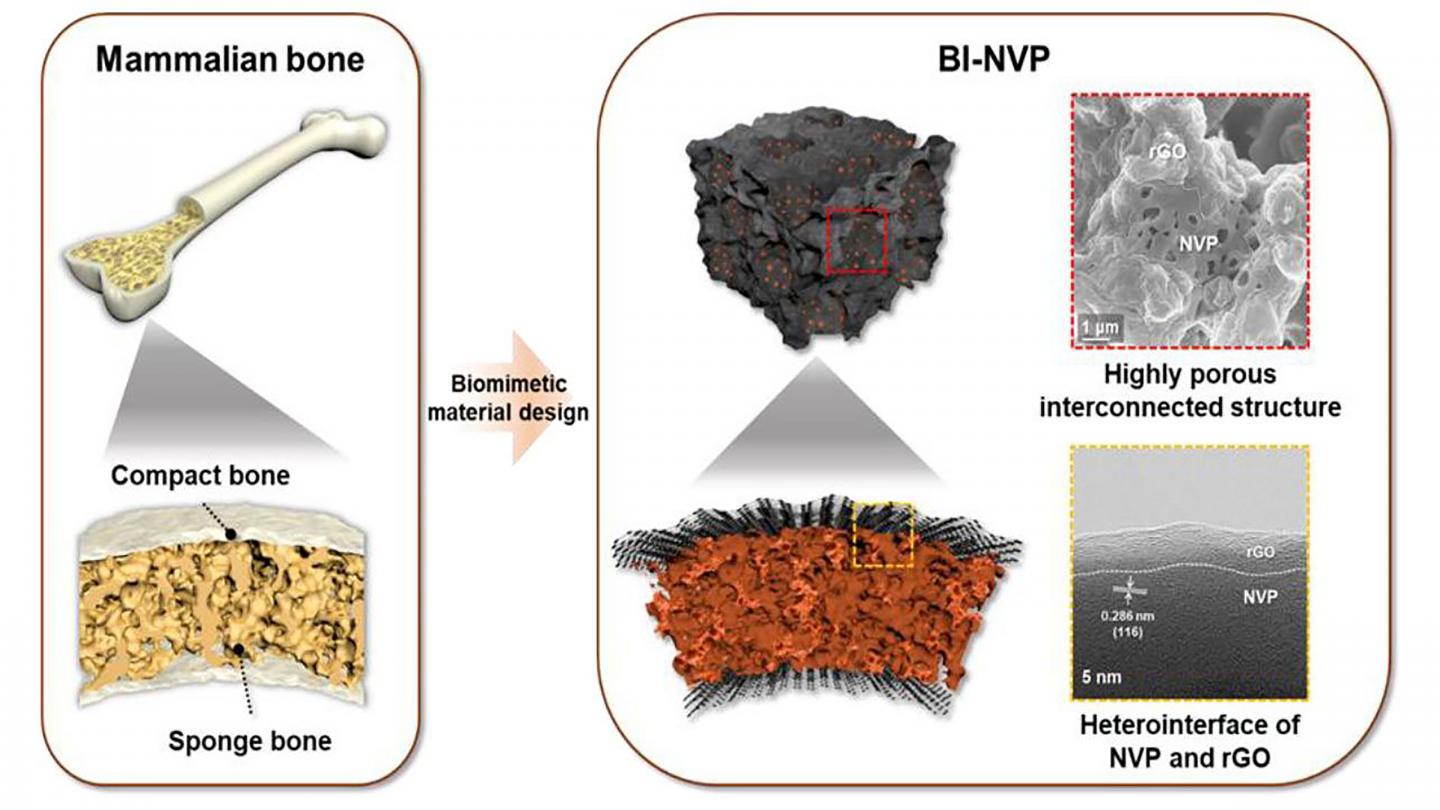
Mammal bone structures consist of an inner porous, spongy bone that allows the storage and transport of bone marrow, surrounded by a hard, compact bone, which offers mechanical and structural integrity under severe stress.
Following this design architecture, the group created a porous system of Na3V2(PO4)3 structures, also known as NVP, surrounded by a dense shell of reduced graphene oxide (rGO). NVP is a sodium cathode material that transports sodium ions rapidly but is structurally unstable.
The bonelike setup helps to improve the structural integrity of the system, reducing permanent damage caused by electrochemical and mechanical stress. Meanwhile, the combination of NVP and rGO creates a more favorable environment for sodium ions, enhancing the stability of the system. The battery can charge at ultrahigh rates and maintain over 90% of its capacity after 10,000 cycles of discharging and recharging, depending on the charge rate.
Despite these promising technical advances, the researchers note the work is currently just a proof of concept demonstrating the feasibility of a sodium cathode inspired by mammal bone. Additional work needs to be done to realize technological utilizations of the system.
“A large-scale synthesis of bone-inspired NVP with high quality, the optimization of bone-inspired NVP composition and structure, and the fabrication and test of electrodes with large area and high loading are thought to be required for more practical applications,” Park said.
###
The article, “Biomimetic composite architecture achieves ultrahigh rate capability and cycling life of sodium ion battery cathodes,” is authored by Kang Ho Shin, Sul Ki Park, Puritut Nakhanivej, Yixian Wang, Pengcheng Liu, Seong-Min Bak, Min Sung Choi, David Mitlin, and Ho Seok Park. The article will appear in Applied Physics Reviews on Dec. 8, 2020 (DOI: 10.1063/5.0020805). After that date, it can be accessed at https:/
ABOUT THE JOURNAL
Applied Physics Reviews features articles on significant and current topics in experimental or theoretical research in applied physics, or in applications of physics to other branches of science and engineering. The journal publishes both original research on pioneering studies of broad interest to the applied physics community, and reviews on established or emerging areas of applied physics. See https:/
Media Contact
Larry Frum
[email protected]
Related Journal Article
http://dx.