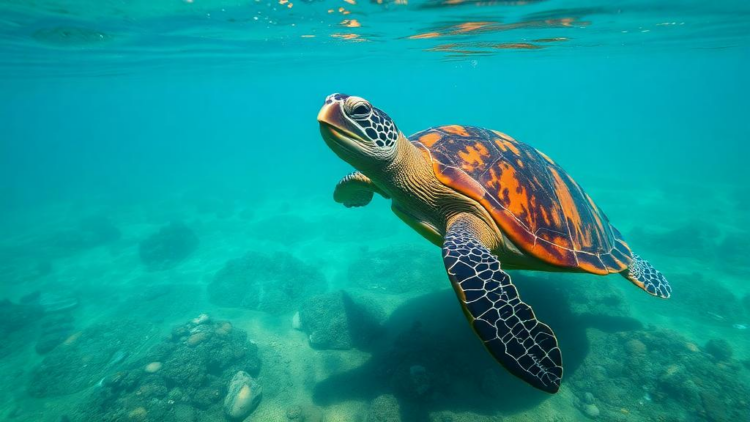
Three decades after France banned one of the most persistent insecticides ever deployed in the Caribbean, the chemical is still circulating through the food webs of Martinique — and it is ending up inside the blood of endangered green sea turtles. A new study published in Environmental Chemistry Letters reports that chlordecone, an organochlorine pesticide once used intensively on banana plantations in the French West Indies, was detectable in the blood plasma of more than half of the green turtles sampled in coastal waters of Martinique in 2022 and 2023. Even more striking, nearly one in five of the animals carried concentrations that exceed the toxicity threshold set for human blood plasma. The finding lands with particular force because the turtles were captured in bays that double as fishing and swimming zones for local communities, raising uncomfortable questions about how a chemical withdrawn from use in 1993 continues to contaminate marine life — and potentially the people who share those waters and seafood resources.
The research team, led by Sophie M. Dupont of La Rochelle Université and Damien Chevallier of the BOREA research unit, measured chlordecone concentrations in the plasma of 77 green turtles (Chelonia mydas). The animals were sampled across two bays on the island of Martinique, and the analyses were carried out using gas chromatography coupled to tandem mass spectrometry, one of the most sensitive and selective analytical techniques available for trace organic contaminants. This method allows chemists to separate chlordecone from the complex cocktail of lipids, proteins and other compounds present in blood plasma, and then to detect and quantify it at extremely low concentrations by fragmenting the molecules and measuring characteristic ion transitions. The approach minimizes false positives and provides the analytical confidence needed when results carry regulatory and public-health implications.
The results were unambiguous in one respect: contamination is widespread. Chlordecone was quantified in 58.4 percent of the turtle samples, meaning that a majority of the juvenile and subadult green turtles foraging in these Martinican bays carry measurable body burdens of a pesticide that has not been legally applied on the island for over thirty years. The researchers also tested whether contamination differed between the two sampling years or between the two bays, and found no statistically significant year effects or site effects. That uniformity is itself telling. It suggests that the contamination is not a localized legacy of a single spill or a hotspot of residual application, but rather a diffuse, island-wide environmental signature — exactly what would be expected from a chemical that has soaked into soils and sediments and is slowly leaching into rivers, groundwater and the sea.
Understanding why chlordecone lingers requires a look at its chemistry. The molecule is a highly chlorinated, cage-like polycyclic ketone, extremely stable and resistant to both chemical and biological degradation. When it was applied to banana fields to combat the banana weevil, it bound strongly to organic matter in the volcanic andosols typical of the Lesser Antilles. Rather than breaking down, it has been stored in deep soil horizons, where it continues to be transported by water percolation and erosion into streams and coastal waters decades after spraying stopped. Researchers have described this ongoing remobilization as a kind of pesticide resurrection, and in some cases accelerated: earlier work in the French West Indies has suggested that the herbicide glyphosate can mobilize chlordecone that would otherwise remain locked in soil, releasing it back into the environment in bioavailable forms.
The most consequential comparison in the new study is between turtle plasma concentrations and the human toxicity threshold. The authors report that 17.8 percent of the sampled turtles displayed chlordecone levels exceeding the threshold established as a point of concern for human blood plasma. Chlordecone is classified as a probable human carcinogen, and chronic exposure in humans has been associated with an increased risk of prostate cancer, as well as neurological, developmental and hormonal effects. Health authorities in the French West Indies have monitored chlordecone in residents and in food-producing animals for years, and the contamination of locally produced food — particularly root vegetables, freshwater crustaceans and fish — remains a major public health issue. The new data extend that concern to coastal wildlife that shares habitats with people.
Why green turtles are good sentinels for this kind of pollution comes down to their ecology. Green turtles are primarily herbivorous as juveniles and adults, grazing on seagrass beds in shallow coastal waters. This places them squarely within nearshore food webs where sediment-borne contaminants accumulate, and their long lifespans and high site fidelity mean they integrate exposure over time and across their foraging grounds. In Martinique, immature green turtles concentrate in coastal bays for years before moving on, making them effective indicators of local contamination. Previous research on these populations has documented other stressors, including the tumor disease fibropapillomatosis and shifts in diet caused by the spread of the invasive seagrass Halophila stipulacea, so adding a persistent organic pollutant to the list of exposures compounds existing worries about the health and demography of an endangered species.
The pathway from plantation soil to turtle blood runs through marine food webs. Stable-isotope studies in Guadeloupe and Martinique have shown that chlordecone moves through tropical coastal ecosystems along multiple routes, from contaminated sediments and detritus into invertebrates and seagrass-associated fauna, and from there into the animals that graze and forage on them. Because chlordecone is lipophilic — it accumulates in fatty tissues — it can biomagnify as it travels up trophic levels. For a herbivore like the green turtle, ingestion of contaminated seagrass and sediment particles during feeding appears sufficient to build up measurable plasma concentrations, and the absence of site effects in the new study hints that this exposure pathway is operating broadly across the island’s coastal zone rather than being confined to a polluted embayment.
For human health, the implications are sobering. The turtles were sampled in bays that are used for fishing and swimming, meaning the contaminated habitats overlap directly with areas of human activity and food collection. While turtle meat is not a staple of the local diet in Martinique and the species is protected, the same bays support fisheries for fish and crustaceans that are consumed regularly. If chlordecone levels in green turtles exceed human toxicity thresholds, the question of what those concentrations look like in edible species caught in the same waters becomes urgent. The French food safety agency ANSES has repeatedly revised its guidance on chlordecone risk in the region, and studies of the human population have shown widespread exposure. The new turtle data provide a wildlife-based benchmark that may help public health authorities refine their assessments of coastal contamination.
The study also underscores the extraordinary persistence of legacy organochlorine pollution and the limits of regulatory bans as a remediation tool. Chlordecone was banned nationally in 1993, yet in 2022 and 2023 it was still measurable in the plasma of more than half of the turtles tested, with no detectable decline signal between the two years. Given current estimates of the residence time of chlordecone in deep volcanic soils — potentially spanning centuries — exposure of coastal ecosystems in the French West Indies is likely to continue for generations. Modeling work on soil leaching suggests that simple hydraulic processes can account for the residues still observed today, meaning there is no quick fix: the contamination will only decline as slowly as the chemical can be flushed out of the landscape.
For conservationists, the findings add a chemical stressor to the already long list of threats facing green turtles in the Caribbean, from habitat loss and bycatch to disease and climate change. For the people of Martinique, the study is a reminder that the environmental legacy of intensive banana cultivation is not confined to farmland and freshwater; it has reached the island’s coastal waters, its marine wildlife and, indirectly, the human food chain. The authors’ comparison of turtle plasma against human toxicity thresholds is deliberately provocative: it frames the turtles not just as wildlife deserving protection, but as living monitors of contamination that humans may themselves be experiencing. Thirty years after the ban, the message written in the blood of Martinique’s green turtles is that chlordecone’s story is far from over, and that monitoring both wildlife and public health in these waters will need to continue for the foreseeable future.
Subject of Research: Persistent chlordecone insecticide contamination in green turtles in Martinique’s coastal waters three decades after the pesticide ban
Article Title: Chlordecone levels in green turtles from Martinique 30 years after the national ban of this insecticide
Article References: Dupont, S. M., Millet, M., Bustamante, P., Fort, J., Girondot, M., Le Loc’h, G., Moreau, J., Aubert, N., Bourgeois, O., Boutrin, L., Chevallier, P., Chevallier, T., Delvenne, C., Fournier, P., Fournier-Chambrillon, C., Frouin, C., Gaffard, A., Habold, C., Hielard, G., … Chevallier, D. (2026). Chlordecone levels in green turtles from Martinique 30 years after the national ban of this insecticide. Environmental Chemistry Letters. https://doi.org/10.1007/s10311-026-01923-1
Image Credits: AI Generated
DOI: 10.1007/s10311-026-01923-1
Keywords: chlordecone, green turtle, Martinique, French West Indies, pesticide contamination, ecotoxicology, organochlorine, marine pollution, sea turtle conservation, public health, mass spectrometry, persistent organic pollutants
Cite Scienmag News
APA MLA Chicago
Bethany Barker. (September 30, 2026). Banned pesticide still flows through Martinique’s sea turtles 30 years on, study finds. Scienmag. https://scienmag.com/banned-pesticide-still-flows-through-martiniques-sea-turtles-30-years-on-study-finds/
Bethany Barker. “Banned pesticide still flows through Martinique’s sea turtles 30 years on, study finds.” Scienmag, 30 September 2026, https://scienmag.com/banned-pesticide-still-flows-through-martiniques-sea-turtles-30-years-on-study-finds/. Accessed 30 September 2026.
Bethany Barker. “Banned pesticide still flows through Martinique’s sea turtles 30 years on, study finds.” Scienmag. September 30, 2026. https://scienmag.com/banned-pesticide-still-flows-through-martiniques-sea-turtles-30-years-on-study-finds/
Copy citation Download RIS
Tags: bioaccumulation of organochlorine chemicalschemical persistence in tropical waterschlordeconechlordecone contamination in sea turtlesecological consequences of pesticide use in agricultureecotoxicologyendangered green sea turtles and chemical exposureenvironmental impact of banned pesticidesFrench West Indiesgreen turtlelong-term pesticide residue in Caribbean ecosystemsmarine conservation and pollution monitoringmarine food web contaminationmarine pollutionmarine pollution and human health risksMartiniquemass spectrometryorganochlorinepersistent organic pollutantsPersistent organic pollutants in marine lifepesticide contaminationPublic healthsea turtle conservationseafood safety and chemical residues