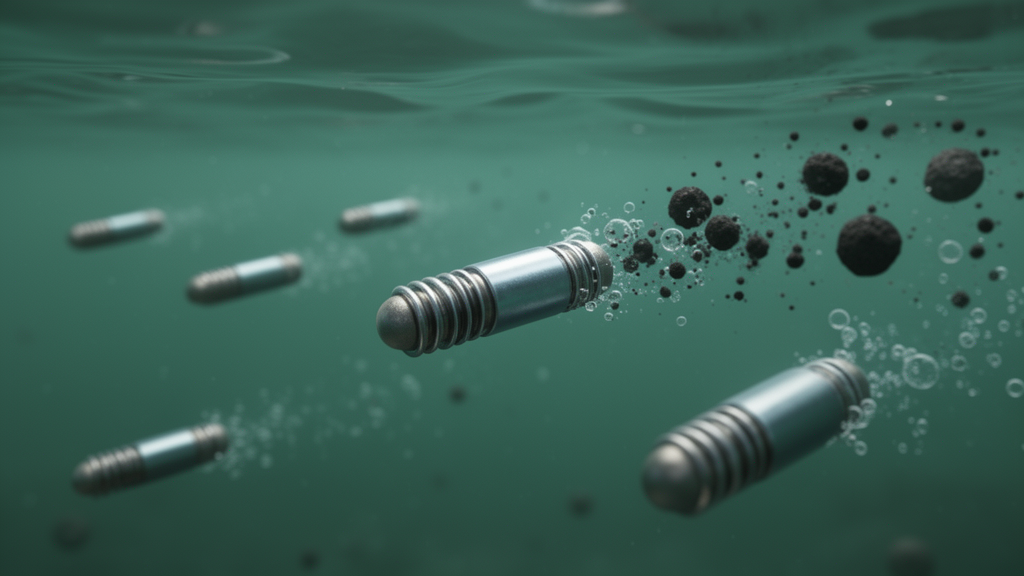
Photocatalytic micromotors, self-propelled micro- and nanoparticles that convert light-driven surface redox chemistry into motion, are the focus of a new review published in Discover Chemical Engineering on 17 September 2026. The review, authored by Nur Lina Syahirah Mustapa, Mohamed Syazwan Osman and colleagues, examines how band-engineered heterostructures could make these tiny active platforms more effective at cleaning polluted water, while also scrutinising whether their reported performance gains survive contact with real-world conditions.
Unlike passive photocatalysts, micromotors combine pollutant degradation with self-propulsion, which enhances mass transfer and increases contact between pollutants and catalysts. The review identifies several persistent obstacles that limit practical performance: rapid charge recombination, weak response to visible light, insufficient redox potential, propulsion that depends on chemical fuels, and instability in complex water matrices. According to the authors, band-engineered heterostructures offer a promising route around these problems by tailoring interfacial charge transfer, strengthening built-in electric fields, improving reactive oxygen species generation, and sustaining the chemical gradients needed to keep the motors moving.
The review systematically evaluates four classes of heterostructure photocatalytic micromotors, distinguished by their band alignment schemes: Type-II, p–n junction, Z-scheme and S-scheme architectures. A central theme is that band alignment governs not only photocatalytic activity but also propulsion behaviour, linking charge separation, redox strength, reactive oxygen species pathways and mass-transfer enhancement. The contaminants considered include emerging pollutants such as pharmaceuticals, dyes, antibiotics and microplastics, a category of concern for water treatment worldwide.
Notably, the authors state that they go beyond cataloguing material systems. Instead, they critically assess whether reported performance gains remain meaningful under realistic conditions, with particular scepticism directed at studies that rely on peroxide fuels, model pollutants or idealised water matrices. This distinction matters because many laboratory demonstrations of micromotor propulsion depend on hydrogen peroxide as fuel, a requirement that complicates deployment in natural waters where such chemicals are not available and could themselves pose environmental concerns.
The review closes by mapping key challenges and future directions for the field. These include achieving fuel-free solar propulsion, developing scalable fabrication methods, enabling catalyst recovery after treatment, ensuring environmental safety, and demonstrating long-term operation in natural waters. As an open-access review article, the paper is currently shared in an accepted-manuscript version that is subject to further edits before the final version of record replaces it. The authors emphasise that the field’s promise depends on closing the gap between idealised laboratory conditions and the complex chemistry of real contaminated water, a gap that band engineering alone may not close without advances in propulsion chemistry and system engineering.
Subject of Research: Band-engineered heterostructure photocatalytic micromotors for autonomous water remediation
Article Title: Band-engineered heterostructure photocatalytic micromotors for autonomous water remediation
Article References: Mustapa, N. L. S., Bakar, N. F. A., Nordin, A. H., Wang, L., Sirimahachai, U., Saufi, A. S., Ibrahim, T. N. B. T., & Osman, M. S. (2026). Band-engineered heterostructure photocatalytic micromotors for autonomous water remediation. Discover Chemical Engineering. https://doi.org/10.1007/s43938-026-00147-7
Image Credits: AI Generated
DOI: 10.1007/s43938-026-00147-7
Keywords: photocatalytic micromotors, band engineering, heterostructures, water remediation, emerging contaminants, microplastics, reactive oxygen species, charge separation, fuel-free propulsion, Type-II heterostructure, Z-scheme, S-scheme
News Source: Denise Maddox. (October 28, 2026). Band-Engineered Micromotors Take Aim at Water Pollution, Review Finds. Scienmag.