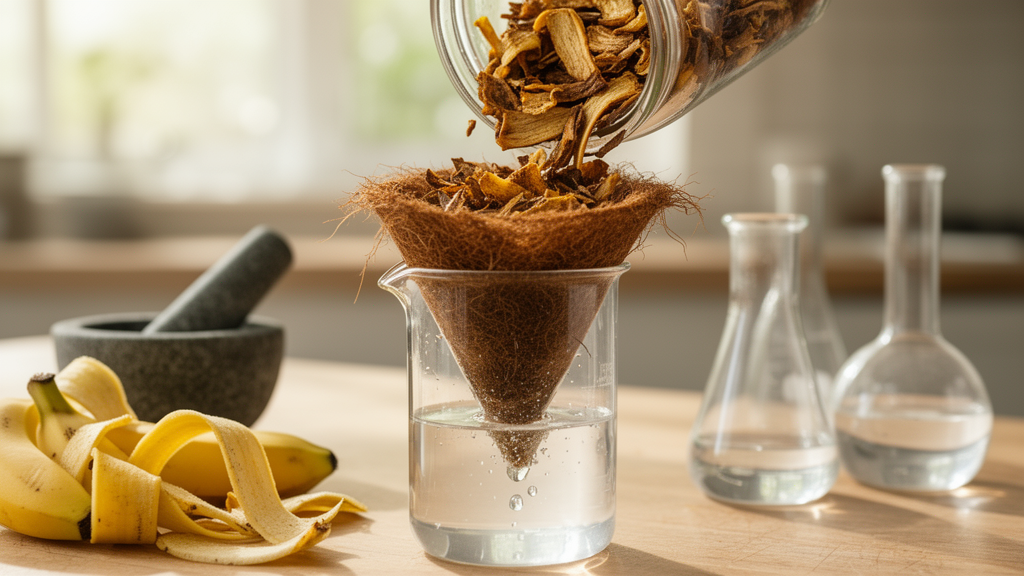
Every year, the global banana industry discards mountains of peels that account for as much as 40 percent of the fruit’s mass, most of which rots in landfills and releases greenhouse gases. Researchers in South Africa have now shown that this humble kitchen waste can do something remarkable: scrub toxic heavy metals out of contaminated water. In a study published in Frontiers in Environmental Engineering, a team from Mangosuthu University of Technology and the University of South Africa demonstrated that dried banana peel powder efficiently captures copper(II) and chromium(VI), two of the most problematic water pollutants in industrializing regions, while a sophisticated suite of mathematical models revealed exactly how the metal ions behave on the peel’s irregular, biopolymeric surface.
The stakes are high. Heavy metal contamination of rivers and groundwater is a persistent crisis driven by industrialisation, urban expansion, and inadequate treatment infrastructure, particularly in sub-Saharan Africa. Copper, though an essential micronutrient at trace levels, becomes toxic at elevated concentrations, causing gastrointestinal distress, liver damage, and oxidative stress. Hexavalent chromium is far worse: a well-established carcinogen linked to mutagenicity, respiratory complications, and organ failure even at low exposure. Conventional remediation technologies such as chemical precipitation, ion exchange, membrane filtration, and electrochemical methods can work, but they suffer from high operational costs, sludge generation, and energy intensity that make them poorly suited for low-resource settings. Biosorption, the use of cheap biological materials to sequester metal ions, offers an appealing alternative, and banana peels turn out to be unusually well equipped for the job.
The researchers collected peels from a local fruit and vegetable market, washed them, dried them in a convection air dryer at 105 degrees Celsius for 48 hours, and ground them into powder. The material was then dried at 120 degrees Celsius, a temperature chosen deliberately based on prior thermogravimetric analysis showing that significant decomposition of banana peel begins around 122 degrees Celsius. Drying just below that threshold removes surface moisture without degrading the oxygen-bearing functional groups, including carboxyl, hydroxyl, and carbonyl moieties, that are essential for metal binding. Fourier transform infrared spectroscopy confirmed a surface rich in hydroxyl, carboxyl, carbonyl, and amine groups, while scanning electron microscopy revealed the rough, irregular, heterogeneous texture characteristic of raw lignocellulosic biomass.
Batch experiments in a standard jar-test apparatus showed that solution pH is the single most influential operating parameter. At pH 2, the peel surface is so heavily protonated that copper uptake collapsed to just 3 percent, but removal soared to a maximum of 97 percent at pH 4, where deprotonated carboxylate and hydroxyl groups attract the positively charged cations. Chromium behaved differently: it exists in water as negatively charged oxyanions such as HCrO4− and CrO42−, so it relied on electrostatic attraction to the positively charged, mildly acidic surface, peaking at 65 percent removal at pH 4 before declining as the surface deprotonated toward neutral conditions. Statistical analysis confirmed that pH significantly influenced removal of both metals, with F-values far exceeding critical thresholds. Kinetic tests showed copper removal climbing rapidly to 87 percent within the first 40 minutes as abundant surface sites filled, then slowing to a plateau near 92 percent as intraparticle diffusion took over.
The heart of the study, however, lies in its modelling. Conventional adsorption kinetics, such as the pseudo-first-order and pseudo-second-order equations, assume a uniform surface with time-invariant rate constants, an assumption that rarely holds for natural biomaterials. To go beyond this limitation, the team applied fractal-like kinetic models, in which the rate coefficient decays as a power function of time, capturing surface irregularities, pore tortuosity, and anomalous diffusion. For chromium, the fractal-like pseudo-first-order model delivered the best fit of any model tested, with a coefficient of determination of 0.9960 and a fractal exponent of 0.8483, indicating pronounced surface heterogeneity and time-dependent sorption energies. For copper, by contrast, the fractal exponent was only 0.1401, and classical models remained adequate, suggesting copper interacts with a more uniform subset of binding sites through predictable chemisorption.
Equilibrium isotherm analysis reinforced this mechanistic split. The Langmuir-Freundlich hybrid model, which blends the ideal monolayer picture with a heterogeneous-site correction, achieved the best overall fit for both metals, with R-squared values of 0.9817 for chromium and 0.9212 for copper. Langmuir monolayer capacities came out at 11.39 milligrams per gram for chromium and 13.51 milligrams per gram for copper, while the Freundlich parameter below unity confirmed favourable adsorption on heterogeneous sites in both systems. The high apparent Langmuir-Freundlich capacity for chromium of nearly 38 milligrams per gram hints at multilayer, high-energy site uptake, consistent with the metal’s multiple speciation states and its tendency to undergo reduction to trivalent chromium before surface binding.
Spectroscopic evidence tied the mathematics back to real chemistry. After adsorption, FTIR peaks at wavenumbers corresponding to carboxylic and amine groups shifted or weakened for both metals, with copper also perturbing alkane and hydroxyl bands. Energy-dispersive X-ray analysis showed that potassium, silicon, and chlorine on the pristine surface dropped markedly after metal uptake, a signature of ion exchange in which native mineral ions are displaced by the incoming metals. X-ray diffraction revealed that crystalline sylvite inclusions diminished after adsorption while the cellulose peak near 22 degrees persisted, with new weak reflections appearing that suggested metal-induced rearrangements within the biopolymer network. The nitrogen adsorption analysis classified the raw powder as mesoporous, with an average pore diameter of about 2.9 nanometres, wide enough to admit hydrated metal ions to interior binding sites.
The comparison with the broader literature adds an intriguing design insight. Most prior studies on banana peel and other lignocellulosic adsorbents rely on chemically or thermally activated materials, whose smoother, more uniform energy landscapes let simple pseudo-second-order models suffice. The present study used raw, unmodified peel, preserving a rugged distribution of pore sizes and functional group environments, and this is precisely where the advanced fractal and non-integer power-law models proved their worth, particularly for chromium. The authors suggest a practical principle: surface modification not only boosts capacity but also simplifies kinetics, whereas raw biomass demands richer mathematical descriptions to be understood. For copper, classical chemisorption models remained adequate, echoing behaviour seen for other divalent transition metals on relatively homogeneous surfaces.
The work has clear limits that the authors acknowledge: it was conducted entirely in batch mode on synthetic solutions, without column experiments, regeneration cycles, or tests on real effluents, all of which will be needed before banana peel filters reach working treatment plants. Real wastewater brings competing ions, organic fouling, and variable pH that can erode performance, and regulatory compliance for hexavalent chromium may still require polishing with membranes or other technologies. Even so, the study lands a persuasive blow for circular-economy thinking. Banana peels are abundant, essentially free, and biodegradable, and their performance, removing more than 90 percent of copper and up to 65 percent of chromium under optimal conditions, positions them as credible candidates for low-cost pre-treatment and polishing stages in resource-constrained communities. By pairing rigorous model discrimination with a waste product most people throw away, the research offers a template for turning agricultural refuse into affordable environmental protection.
Subject of Research: Biosorption of copper(II) and chromium(VI) from water using banana peel waste, analyzed with classical and fractal-like kinetic and isotherm models
Article Title: Valorisation of banana peel waste for copper (II) and chromium (VI) biosorption from aqueous solution: classical and fractal-like kinetics and isotherms model analysis
Article References: Mzimela, S., Bakare, B. F., Musonge, P., & Khumalo, S. M. (2026). Valorisation of banana peel waste for copper (II) and chromium (VI) biosorption from aqueous solution: classical and fractal-like kinetics and isotherms model analysis. Frontiers in Environmental Engineering, 5, Article 1945870. https://doi.org/10.3389/fenve.2026.1945870
Image Credits: AI Generated
DOI: 10.3389/fenve.2026.1945870
Keywords: banana peel, biosorption, heavy metals, copper, chromium, water treatment, fractal kinetics, adsorption isotherms, circular economy, wastewater remediation, agricultural waste valorisation, Valorisation
News Source: Denise Maddox. (October 15, 2026). Banana Peels Turned Into Low-Cost Filters That Pull Toxic Metals From Water. Scienmag.