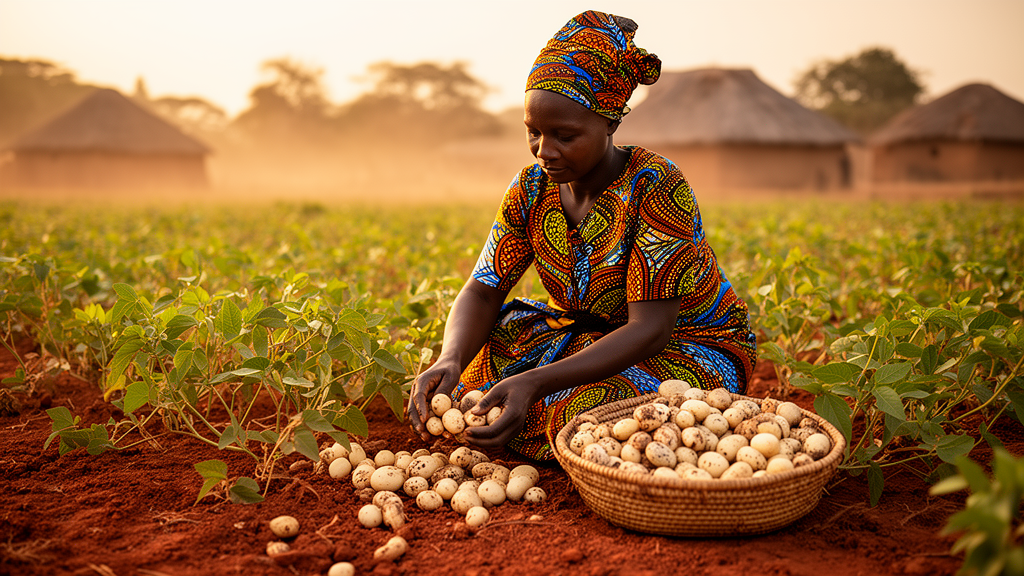
Deep in the sandy-loam fields of northern Malawi, a subterranean legume with extraordinary drought tolerance is quietly sustaining households that climate change has pushed to the brink. Bambara groundnut, a crop so hardy it thrives without a single application of fertilizer, has now been given its most detailed on-farm assessment yet. A research team led by Mphatso Divinity Kachingwe of Mzuzu University surveyed 195 smallholder farmers across the Bolero and Mpherembe Extension Planning Areas in Rumphi and Mzimba Districts, and the findings, published in Discover Agriculture, reveal both the remarkable resilience of this neglected crop and the stubborn barriers that keep it from feeding more people.
The numbers tell a striking story of self-reliance. Seventy-nine percent of farmers rely entirely on seeds saved from their own previous harvests, a figure that underscores how completely Bambara groundnut has been left out of formal seed distribution systems. No respondent applied manure or fertilizer to their Bambara fields, yet the crop still produces, drawing on its innate capacity to fix atmospheric nitrogen through a symbiosis with soil rhizobia. What makes this legume technically special is its superior drought tolerance, which stabilizes nodulation and nitrogenase activity even under water-limited conditions. That physiological trait makes Bambara groundnut a more reliable nitrogen fixer in stress-prone environments than major grain legumes such as soybean, common bean, and groundnut, a distinction with real implications for soil fertility management across sub-Saharan Africa.
The survey documented twelve distinct Bambara groundnut landraces still in circulation across the two districts, each named and recognized by farmers according to seed colour, size, shape, and taste. Varieties such as Ziswesi, Zifipa, and Zituwa, corresponding to red, black, and cream seed types, were distributed evenly across all studied sections, suggesting that on-farm conservation through informal seed systems is actively maintaining genetic diversity. Farmers distinguished landraces using a combination of observable seed characteristics and culinary attributes, knowledge that has enabled them to retain preferred types over successive growing seasons. This indigenous taxonomic system, the researchers argue, provides an essential foundation for demand-led breeding programs that must integrate farmer and consumer preferences if improved varieties are ever to be adopted.
When asked what they value most in a Bambara groundnut variety, farmers gave a clear technical hierarchy. Forty percent prioritized good taste and cookability, thirty-eight percent ranked yield potential highest, and cultural value came last at just two percent. These preferences align closely with findings from Ghana, where taste, ease of cooking, pest resistance, and high yield were the main characteristics farmers favoured in improved Bambara groundnut varieties. The consistency across countries suggests that breeding priorities for this crop are converging on a well-defined set of agronomic and culinary traits, giving breeders a technically actionable target list.
Monocropping dominated the production landscape at ninety-two percent, a finding the researchers attribute partly to the influence of a local organization called the Biodiversity Conservation Initiative, which has trained farmers to cultivate Bambara groundnut as a seed crop under participatory seed multiplication programs. Farmers reported that sole cropping minimizes competition for nutrients, light, and moisture, supporting better yields and easier management during weeding and harvesting. This contrasts with observations from South Africa’s Limpopo Province, where intercropping with maize was the most common planting method, believed to increase land-use efficiency without significantly compromising yields. The divergence highlights how local institutional support and agronomic tradition shape cropping system choices for underutilized legumes.
Perhaps the most culturally revealing finding concerns the taboos that once governed who could grow this crop. Eighty-five percent of respondents acknowledged that cultural beliefs associated with Bambara groundnut cultivation exist in their communities, yet ninety-eight percent of those respondents reported that they do not adhere to the associated restrictions. Historically, only individuals who had lost a child were permitted to cultivate Bambara groundnut, children and unmarried women were forbidden from handling its seeds, and menstruating women were barred from entering its fields. Today, farmers across both districts dismiss these taboos as relics. The researchers interpret this as an evolving cultural perspective that favours agricultural pragmatism over traditional constraint, pointing to a generational shift in attitudes toward the crop.
Women are the primary custodians of Bambara groundnut in northern Malawi, dominating virtually every production activity. Seventy-seven percent of respondents were female, and women led land preparation at forty-six percent, planting at sixty-four percent, and harvesting at fifty-two percent. This gendered division of labour reflects broader trends across sub-Saharan Africa, where women are the primary managers of native legume crops. The researchers note that men and women increasingly work together on some production tasks, suggesting the crop is gaining household recognition for its nutritional and economic value as well as its drought resistance.
Utilization patterns centre on household food security, with sixty-one percent of farmers growing the crop primarily for consumption. Preparation methods include boiling at fifty-six percent, roasting at twenty percent, and traditional dishes such as chilanda and nkhowe at fourteen and ten percent respectively. Eighty-four percent of households consume Bambara groundnut one to two times per week, a low-to-moderate frequency the researchers attribute to seasonal availability, limited production, and competition with exotic legumes such as beans and groundnuts. The crop is also valued for perceived medicinal benefits, particularly improving energy levels and postnatal recovery, though empirical evidence supporting these uses remains limited.
Seed conservation relies almost entirely on farmer-led traditional techniques. Ash application was the most common storage method at fifty percent, creating an alkaline physico-chemical barrier against post-harvest pests and fungi, while leaving Bambara groundnut unshelled reduces pest attack risk because insects struggle to break the hard pod. Insecticide use was lowest at ten percent. The choice of conservation technique varied significantly with location and market access, a statistical association that suggests storage decisions are embedded in local knowledge systems shaped by community context rather than uniform technical recommendations.
The barriers to scaling this climate-smart crop are stark. Lack of markets was the most commonly cited constraint at thirty-four percent, followed closely by lack of improved seeds at twenty-five percent. Ninety-one percent of Bambara groundnut trading occurs at farm-gates through informal channels, with only farmers in sections served by community seed banks, operated with support from the Biodiversity Conservation Initiative, accessing formal organized markets at nine percent. Surplus harvests are sold informally at low and unstable prices, discouraging large-scale production despite the crop’s adaptability and nutritional value. The researchers recommend participatory breeding for farmer-preferred traits, development of improved seed systems, market development, community seed banks, and post-harvest processing methods as priority interventions. Without these, Bambara groundnut risks remaining what it has long been: a nutritionally exceptional, drought-proof legume trapped at subsistence level by the absence of the formal systems that sustain its mainstream competitors.
Subject of Research: Agricultural Science
Article Title: Farmer production practices, utilization, seed conservation, and constraints of Bambara groundnut in Northern Malawi
Article References: Kachingwe, M. D., Mwale, S. E., Manda, L., Pungulani, L., & Malongo, A. (2026). Farmer production practices, utilization, seed conservation, and constraints of Bambara groundnut in Northern Malawi. Discover Agriculture, 4(1), Article 322. https://doi.org/10.1007/s44279-026-00805-y
Image Credits: AI Generated
DOI: 10.1007/s44279-026-00805-y
Keywords: Bambara groundnut, Vigna subterranea, Malawi, climate-smart agriculture, neglected and underutilized crops, seed conservation, food security, nitrogen fixation, smallholder farming, landrace diversity, Farmer, production
News Source: Alan Morgan. (October 17, 2026). Bambara Groundnut: Malawi’s Drought-Proof Legume Held Back by Taboos and Missing Markets. Scienmag.