Artificial intelligence (AI) is bringing notable changes to atmospheric science, particularly with the introduction of large AI weather models like Pangu Weather and GraphCast. However, alongside these advancements, questions have arisen about the alignment of these models with fundamental physics principles.
Credit: Ya Wang
Artificial intelligence (AI) is bringing notable changes to atmospheric science, particularly with the introduction of large AI weather models like Pangu Weather and GraphCast. However, alongside these advancements, questions have arisen about the alignment of these models with fundamental physics principles.
Previous studies have demonstrated that Pangu-Weather can accurately replicate certain climate patterns like tropical Gill responses and extra-tropical teleconnections through qualitative analysis. However, quantitative investigations have revealed significant differences in wind components, such as divergent winds and ageostrophic winds, within current AI weather models. Despite these findings, there are still concerns that the importance of physics in climate science is sometimes overlooked.
“The qualitative assessment finds AI models could understand and learn spatial patterns in weather and climate data. On the other hand, the quantitative approach highlights a limitation: current AI models struggle to learn certain wind patterns and instead rely solely on total wind speed,” Explains Professor Gang Huang from the Institute of Atmospheric Physics (IAP) at the Chinese Academy of Sciences. “This underscores the need for comprehensive dynamic diagnostics of AI models. Only through a holistic analysis can we augment our understanding and impose necessary physical constraints.”
Researchers, including collaborators from the IAP, Seoul National University, and Tongji University, advocate for a collaborative approach between AI and physics in climate modeling, moving beyond the notion of an ‘either-or’ scenario.
Professor Gang Huang emphasizes, “While AI excels in capturing spatial relationships within weather and climate data, it struggles with nuanced physical components like divergent winds and ageostrophic winds. This underscores the necessity for rigorous dynamic diagnostics to enforce physical constraints.”
Published in Advances in Atmospheric Sciences, their perspectives paper illustrates methods to impose both soft and hard physical constraints on AI models, ensuring consistency with known atmospheric dynamics.
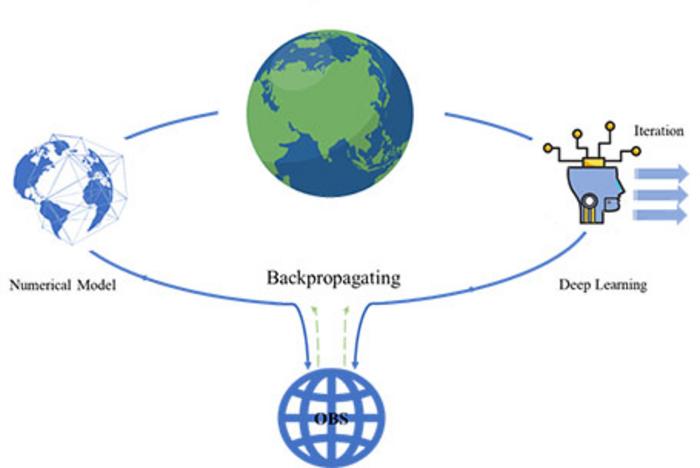
Moreover, the team advocates for a transition from offline to online parameterization schemes to achieve global optimality in model weights, thereby fostering fully coupled physics-AI balanced climate models. Dr. Ya Wang envisions, “This integration enables iterative optimization, transforming our models into truly learnable systems.”
Recognizing the importance of community collaboration, the researchers promote a culture of openness, comparability, and reproducibility (OCR). By embracing principles akin to those in the AI and computer science communities, they believe in cultivating a culture conducive to the development of a truly learnable climate model.
In summary, by synthesizing AI’s spatial prowess with physics’ foundational principles and fostering a collaborative community, researchers aim to realize a climate model that seamlessly blends AI and physics, representing a significant step forward in climate science.
Journal
Advances in Atmospheric Sciences
Article Title
Toward a Learnable Climate Model in the Artificial Intelligence Era
Article Publication Date
13-Apr-2024