• HOME
  • NEWS
  • EXPLORE
    • CAREER
      • Companies
      • Jobs
    • EVENTS
    • iGEM
      • News
      • Team
    • PHOTOS
    • VIDEO
    • WIKI
  • BLOG
  • COMMUNITY
    • FACEBOOK
    • INSTAGRAM
    • TWITTER
Tuesday, October 27, 2026
BIOENGINEER.ORG
No Result
View All Result
  • Login
  • HOME
  • NEWS
  • EXPLORE
    • CAREER
      • Companies
      • Jobs
        • Lecturer
        • PhD Studentship
        • Postdoc
        • Research Assistant
    • EVENTS
    • iGEM
      • News
      • Team
    • PHOTOS
    • VIDEO
    • WIKI
  • BLOG
  • COMMUNITY
    • FACEBOOK
    • INSTAGRAM
    • TWITTER
No Result
View All Result
Bioengineer.org
No Result
View All Result
Home NEWS Science News Biology

Bacterial symbiont Chromobacterium anophelis disrupts mosquito swarming and mating in semi-field tests

by
October 27, 2026
in Biology
Reading Time: 2 mins read
0
Bacterial symbiont Chromobacterium anophelis disrupts mosquito swarming and mating in semi-field tests

Bacterial symbiont Chromobacterium anophelis disrupts mosquito swarming and mating in semi-field tests

Share on FacebookShare on TwitterShare on LinkedinShare on RedditShare on Telegram

A semi-field study of the malaria mosquito Anopheles coluzzii reports that exposure to the bacterium Chromobacterium anophelis and its cell-free supernatant sharply reduced both survival and reproductive behavior, with the strongest effects seen at the highest doses tested.

C. anophelis is an entomopathogenic bacterium originally isolated from malaria mosquitoes. Under laboratory conditions it has previously shown both larvicidal and adulticidal effects, but its influence on mosquito reproductive behavior and survival under semi-field conditions had remained insufficiently explored, according to the researchers behind the new work.

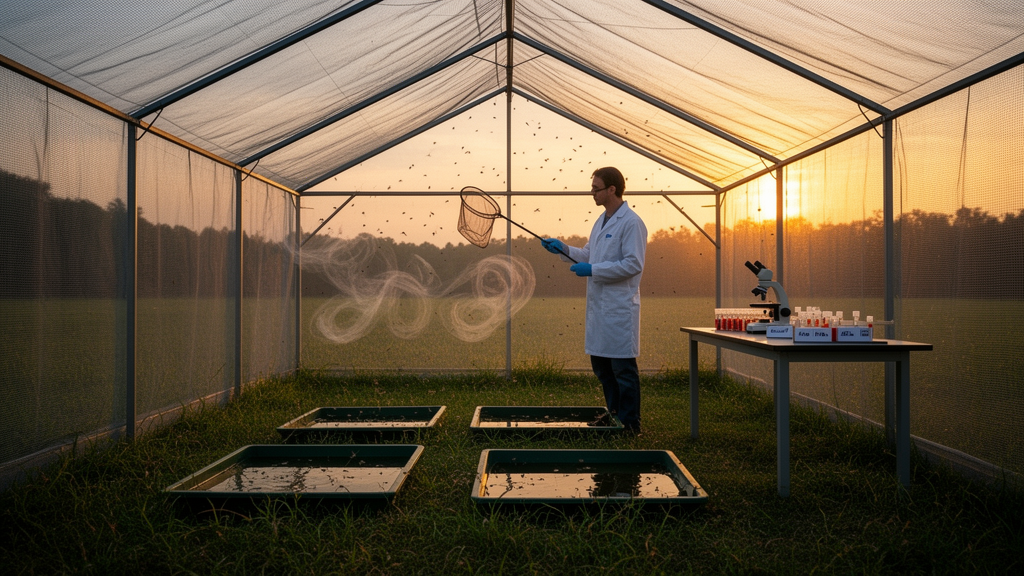
In the study, mosquitoes were exposed to varying concentrations of bacterial suspensions (Ca) or of the bacterium’s cell-free supernatant (Sup) through sugar feeding. Survival probability was monitored daily for 14 days, and behavioral and reproductive parameters were recorded during dusk swarming events.

Exposure to both the bacterial suspensions and the supernatant significantly reduced mosquito survival. In the highest-dose treatment groups, complete mortality was observed within 10 days.

Swarm size was markedly reduced in the Ca_10p6 and Sup_30% treatments, which the authors describe as indicating strong behavioral impairment. Mating attempts and insemination rates were also substantially lower in these high-exposure groups.

In some cases, males were observed to participate in swarms and attempt mating but failed to inseminate females. The researchers suggest this points to physiological disruption beyond simple behavioral suppression.

By contrast, control mosquitoes and low-dose treatments (Sup_10% and Ca_10p5) maintained relatively high survival and reproductive performance, indicating that the effects were dose-dependent.

The analyses included Kaplan–Meier survival estimates, analysis of variance, and behavioral comparisons across seven treatment groups.

The authors conclude that C. anophelis and its metabolites impair both survival and reproductive success in An. coluzzii through a combination of lethal and sublethal effects. They suggest that microbial agents of this kind could help disrupt mosquito reproductive behavior and reduce vector population replacement.

The team notes that its data identify C. anophelis and its cell-free supernatant as candidates for further evaluation as complementary tools for mosquito vector control. The findings come from a semi-field experimental design, and the authors frame the work as an early step requiring further evaluation rather than a demonstrated field intervention.

Subject of Research: Effects of Chromobacterium anophelis bacteria on the survival, swarming and mating of Anopheles coluzzii mosquitoes under semi-field conditions.

Article Title: Influence of Chromobacteriumanophelis bacteria on Anopheles coluzzii mosquito swarming behavior and its reproductive potential

Article References: Gnambani, J. E., Millogo, D., Lamy, D. L., Ilboudo, S., Diabaté, A., & Bilgo, E. (2026). Influence of Chromobacteriumanophelis bacteria on Anopheles coluzzii mosquito swarming behavior and its reproductive potential. Parasites & Vectors. https://doi.org/10.1186/s13071-026-07613-9

Image Credits: AI Generated

DOI: 10.1186/s13071-026-07613-9

Keywords: Chromobacterium anophelis, Anopheles coluzzii, mosquito vector control, malaria, swarming behavior, insemination, bacterial symbionts, cell-free supernatant, semi-field experiment, survival, reproductive success, entomopathogenic bacteria

News Source: Drew Townsend. (October 27, 2026). Bacterial symbiont Chromobacterium anophelis disrupts mosquito swarming and mating in semi-field tests. Scienmag.

Tags: Anopheles coluzziibacterial symbiontscell-free supernatantChromobacterium anophelisentomopathogenic bacteriainseminationmalariamosquito vector controlreproductive successsemi-field experimentsurvivalswarming behavior
Share12Tweet7Share2ShareShareShare1

Related Posts

Marine Vibrio strain strips weight from LDPE plastic in lab test

Marine Vibrio strain strips weight from LDPE plastic in lab test

October 27, 2026
Sulfur takes center stage in a thioxoacetamide crystal and docking study

Sulfur takes center stage in a thioxoacetamide crystal and docking study

October 27, 2026

Spider Mite Genus Demoted as New Species Joins Saudi Arabia’s Grass Fauna

October 27, 2026

Tiny web-dwelling bug discovered in China is a brand-new species

October 27, 2026

POPULAR NEWS

  • George Mason Engineer to Probe Defects in SiC and III-N Materials for High-Voltage Devices

    George Mason Engineer to Probe Defects in SiC and III-N Materials for High-Voltage Devices

    29 shares
    Share 12 Tweet 7
  • FAPESP Week Netherlands: São Paulo and Dutch researchers meet in Leiden to build joint science partnerships

    29 shares
    Share 12 Tweet 7
  • Fruit Fly Studies in Space Reveal Which Gravity Findings Hold Up

    29 shares
    Share 12 Tweet 7
  • Bacterial symbiont Chromobacterium anophelis disrupts mosquito swarming and mating in semi-field tests

    29 shares
    Share 12 Tweet 7

About

We bring you the latest biotechnology news from best research centers and universities around the world. Check our website.

Follow us

Recent News

George Mason Engineer to Probe Defects in SiC and III-N Materials for High-Voltage Devices

FAPESP Week Netherlands: São Paulo and Dutch researchers meet in Leiden to build joint science partnerships

Fruit Fly Studies in Space Reveal Which Gravity Findings Hold Up

Subscribe to Blog via Email

Enter your email address to subscribe to this blog and receive notifications of new posts by email.

Join 85 other subscribers
  • Contact Us

Bioengineer.org © Copyright 2023 All Rights Reserved.

Welcome Back!

Login to your account below

Forgotten Password?

Retrieve your password

Please enter your username or email address to reset your password.

Log In
No Result
View All Result
  • Homepages
    • Home Page 1
    • Home Page 2
  • News
  • National
  • Business
  • Health
  • Lifestyle
  • Science

Bioengineer.org © Copyright 2023 All Rights Reserved.