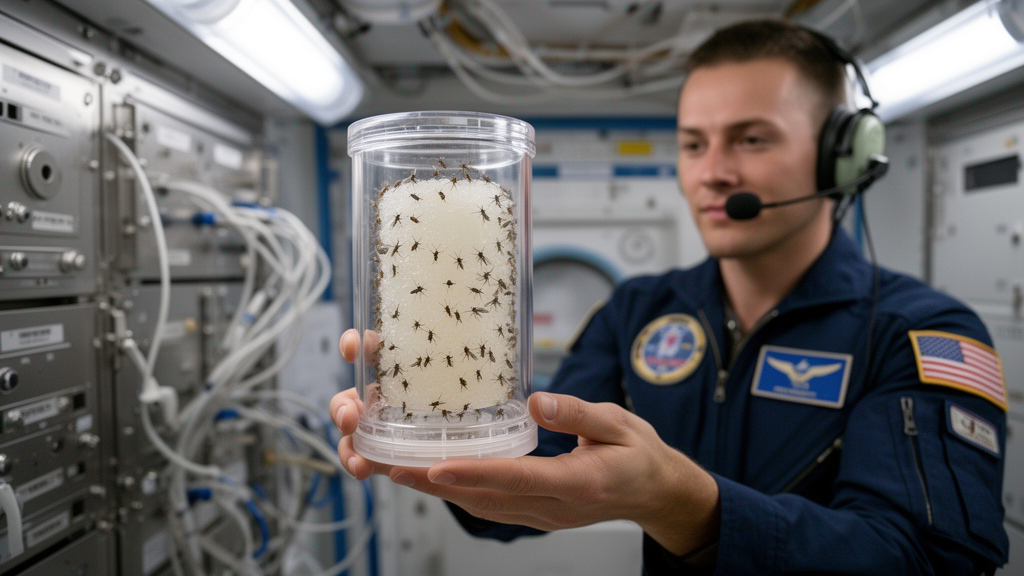
Fruit flies have been riding rockets since 1947, when a batch of Drosophila melanogaster launched aboard a suborbital V-2 rocket in one of the first biological experiments in space. Nearly eight decades later, the fly remains one of the most widely used animals in gravitational biology, prized for its ten-day generation time at 25 degrees Celsius, its vast genetic toolkit, and its ability to develop from embryo to adult and even reproduce in orbit. But a new critical appraisal published in Frontiers in Space Technologies argues that many of the field’s headline findings deserve a more careful reading, particularly when it comes to deciding which biological responses are truly caused by altered gravity and which are artifacts of the machines used to mimic it.
The review, written by a team at the Universidad del Valle in Colombia, tackles two questions that have long hovered over the literature. First, does sensitivity to gravity genuinely differ across the fly’s life stages, as is often claimed? Second, when a response appears on a ground-based simulation platform, how confident can researchers be that it reflects reduced gravity rather than some quirk of the equipment? The authors searched PubMed, Web of Science, Scopus and Google Scholar from 1940 to 2026, combining the term Drosophila with microgravity, spaceflight, hypergravity, random positioning machine, clinostat, diamagnetic levitation and acoustic levitation, and screened the reference lists of earlier reviews.
On the first question, the evidence is more cautious than the popular narrative. A frequently invoked idea holds that development, especially early development, is more sensitive to altered gravity than adult life. The primary studies instead point to oogenesis, embryogenesis and metamorphosis as candidate gravity-sensitive windows, but the studies behind each stage differ in fly strain, hardware, exposure duration, gravity level, control type and endpoint. Some stages have simply been studied more often than others. The authors conclude that the data do not yet support any ranking of stages by sensitivity, and that such a ranking would require comparing several stages within a single experimental design, with independent replication.
The developmental record itself is instructive. In a 1985 Biorack experiment on the Space Shuttle, female flies exposed to spaceflight microgravity produced more eggs, fewer larvae hatched, and some adults showed head and thoracic abnormalities, changes reportedly absent from an in-flight 1 g centrifuge group. On the later IML-2 mission, with an improved design, stimulation of oogenesis and a slight developmental delay were confirmed, but every embryo, larva, pupa and adult recovered was normal in morphology and function. Crucially, the in-flight 1 g centrifuge and a 1.4 g ground centrifuge produced similar effects, indicating that centrifugation itself can contribute to the differences observed. The early embryonic abnormalities were therefore not reproduced under better flight conditions.
Ground-based work on the ovary tells a subtler story. After a full cycle of oogenesis on a random positioning machine, ovaries showed increased cellular respiration, elevated actin and alpha-actinin with higher mRNA levels of the corresponding genes, and increased acetylation of histone H3 at lysines 9 and 27. In contrast, a 3D clinostat did not affect germline stem cell self-renewal, the differentiation of their descendants or egg chamber formation, although histone H4 content decreased. The review concludes that ovarian cells respond to altered gravity at the metabolic, cytoskeletal and chromatin levels, while the key processes of early oogenesis appear robust; whether the cellular changes affect fertility has not been established.
Metamorphosis emerges as a responsive window, but with a warning attached. Pupae developed on the International Space Station showed many differentially expressed genes, yet a random positioning machine reproduced most of that response only when spaceflight-like environmental constraints were added on the ground, and suboptimal environments amplified the transcriptional response to simulated altered gravity. Larvae raised in orbit showed altered expression of genes involved in plasmatocyte maturation, phagocytosis, pattern recognition and humoral immunity, and a multigenerational experiment spanning a 44.5-day biosatellite flight and a 12-day ISS flight found no reported morphological differences but shifts in metabolic, cuticle, morphogenesis and cytoskeletal gene expression. The size of the pupal response, the authors stress, depends strongly on environmental conditions that differ between flight and ground experiments.
Adult responses are well documented in spaceflight, spanning immunity, cardiac function, the nervous system and behavior. Flies born and raised on the ISS showed cardiac constriction with myofibrillar remodeling, reduced cardiac output and increased proteasomal gene expression. Locomotor activity increased markedly in orbit, and males showed accelerated aging after recovery. Heat-shock genes were activated in flies that developed in orbit, and after return the Toll pathway failed to respond to fungal infection while the Imd bacterial response remained normal. Yet the most informative results come from in-flight 1 g centrifuges: one study found postflight climbing defects and showed that changes in metabolic, oxidative-stress and synaptic-transmission pathways occurred both in microgravity and at 1 g in orbit, whereas neuronal loss, altered glial counts, oxidative damage and apoptosis immediately after flight appeared only in the microgravity group. In other words, only part of the adult neural response can be attributed to reduced gravity itself.
The second half of the review dissects the ground-based platforms, and here the technical detail matters. Clinostats and random positioning machines continuously reorient the sample so the gravity vector averages to near zero over time, but rotation also introduces centrifugal and tangential accelerations that grow with distance from the axis, limiting usable sample volume. In liquid-filled containers, rotation generates non-steady fluid motion with the highest shear stresses at the vessel walls, and completely filling a vessel removes the gas-liquid interface, so oxygen supply depends on diffusion distance and vessel geometry; filled flasks can become hypoxic and accumulate carbon dioxide. Diamagnetic levitation, which uses a strong magnetic field gradient to balance the weight of water-rich tissue, allows effective 0, 1 and 2 g positions within the same magnet. Flies walked faster at effective 0 g and more slowly at effective 2 g than at effective 1 g, with no other clear field effect up to 16.5 tesla, but the strong field itself contributed to transcriptional changes in flies levitated for up to 22 days, complicating attribution of molecular responses. Hypergravity centrifuges cannot simulate microgravity at all, but they map dose-response relationships along the gravity continuum, with Coriolis forces, acceleration gradients and start-stop transients as their main confounders.
The review also examines acoustic levitation, a contact-free technique that suspends small objects at the pressure nodes of an ultrasonic standing wave. It has levitated zebrafish embryos, seeds and even living hoverflies with minimal behavioral disruption, but Drosophila have so far been levitated only as dead specimens. The authors are explicit that the technique does not reproduce free fall: the acoustic radiation force acts on the object’s surface and balances its weight much as a physical support does, so internal gravitational loading, including hydrostatic gradients and sedimentation within cells, persists. They propose five validation steps before the method could be used as an altered-gravity platform: physical characterization of each setup, biological tolerance testing, sham controls separating ultrasound exposure from loss of support, benchmarking against gravity-responsive endpoints established on other platforms and in spaceflight datasets, and independent replication in more than one laboratory. Embryos and pupae, being immobile and small enough for current levitators, are the natural first targets.
Three conclusions emerge from the appraisal. The candidate gravity-sensitive windows of oogenesis, embryogenesis and metamorphosis remain just that, candidates, pending within-experiment comparisons and independent replication, and normal morphology and preserved fertility have coexisted with extensive transcriptional change. A substantial part of the Drosophila spaceflight response cannot yet be attributed to reduced gravity, because hardware conditions shape the pupal transcriptome, part of the adult neural response is shared by microgravity and 1 g groups in orbit, and centrifugation itself can mimic some flight effects. Finally, responses are most credible when they are absent from appropriate 1 g controls and converge across platforms with different confounders, as the increase in adult locomotor activity does, seen in orbit and at effective 0 g in diamagnetic levitation alike. Transcriptomic responses, by contrast, have converged only partially and depend heavily on environmental conditions. The fly remains an invaluable discovery engine for candidate cellular mechanisms and countermeasure targets, but its limits are equally clear: it has no lungs, adaptive immunity or bone, an open circulatory system, and no way to model the fluid shift that dominates early human adaptation to weightlessness, so its findings must ultimately be tested in mammals.
Subject of Research: Stage-specific and platform-specific attribution of altered-gravity responses in Drosophila melanogaster
Article Title: Stage-specific sensitivity and the attribution of altered-gravity responses in Drosophila melanogaster: a critical appraisal of spaceflight and ground-based platforms
Article References: Florez-Cuadros, M., Zapata-Galvez, D., Ealo, J., Calderón-Losada, O., & Cárdenas-Henao, H. (2026). Stage-specific sensitivity and the attribution of altered-gravity responses in Drosophila melanogaster: a critical appraisal of spaceflight and ground-based platforms. Frontiers in Space Technologies, 7, Article 1971567. https://doi.org/10.3389/frspt.2026.1971567
Image Credits: AI Generated
DOI: 10.3389/frspt.2026.1971567
Keywords: Drosophila melanogaster, microgravity, spaceflight, simulated microgravity, diamagnetic levitation, acoustic levitation, hypergravity, random positioning machine, oogenesis, metamorphosis, International Space Station, gravitational biology
News Source: Denise Maddox. (October 27, 2026). Fruit Fly Studies in Space Reveal Which Gravity Findings Hold Up. Scienmag.