• HOME
  • NEWS
  • EXPLORE
    • CAREER
      • Companies
      • Jobs
    • EVENTS
    • iGEM
      • News
      • Team
    • PHOTOS
    • VIDEO
    • WIKI
  • BLOG
  • COMMUNITY
    • FACEBOOK
    • INSTAGRAM
    • TWITTER
Sunday, June 28, 2026
BIOENGINEER.ORG
No Result
View All Result
  • Login
  • HOME
  • NEWS
  • EXPLORE
    • CAREER
      • Companies
      • Jobs
        • Lecturer
        • PhD Studentship
        • Postdoc
        • Research Assistant
    • EVENTS
    • iGEM
      • News
      • Team
    • PHOTOS
    • VIDEO
    • WIKI
  • BLOG
  • COMMUNITY
    • FACEBOOK
    • INSTAGRAM
    • TWITTER
  • HOME
  • NEWS
  • EXPLORE
    • CAREER
      • Companies
      • Jobs
        • Lecturer
        • PhD Studentship
        • Postdoc
        • Research Assistant
    • EVENTS
    • iGEM
      • News
      • Team
    • PHOTOS
    • VIDEO
    • WIKI
  • BLOG
  • COMMUNITY
    • FACEBOOK
    • INSTAGRAM
    • TWITTER
No Result
View All Result
Bioengineer.org
No Result
View All Result
Home NEWS Science News Health

Bacteria can ‘outsmart’ programmed cell death

Bioengineer by Bioengineer
December 24, 2019
in Health
Reading Time: 2 mins read
0
IMAGE
Share on FacebookShare on TwitterShare on LinkedinShare on RedditShare on Telegram

IMAGE

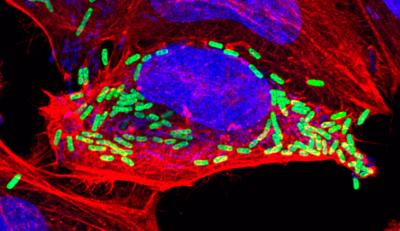
Credit: Hamid Kashkar, University of Cologne


Certain bacteria can override a defence mechanism of the immune system, so called programmed cell death, through inhibition of death effector molecules by their outer membranes components. Shigella bacteria, which cause diarrhoea, use lipopolysaccharides (LPS) on their surface to block the effector caspases. Lipopolysaccharides are a component of the bacterial outer membrane. This strategy enables the bacteria to multiply within the cell. This is the result of a study conducted by the molecular immunologist Professor Hamid Kashkar and his team in the institute for Medical Microbiology and Immunology at the CECAD Cluster of Excellence in Aging Research at the University of Cologne. The article ‘Cytosolic Gram-negative bacteria prevent apoptosis by inhibition of effector caspases through LPS’ by Günther et al. appeared in the current issue of Nature Microbiology.

Various bacterial pathogens can escape our immune system by staying and multiplying within our body cells (intracellularly). The intracellular propagation of pathogens later leads to cell breakdown and the release of microorganisms that infect neighbouring cells, spread and cause tissue damage and infectious disease.
However, the body has a response to this bacterial strategy: programmed cell death, or apoptosis, reacts to cellular stress situations during infections and causes quick suicide of the infected cells.

Due to this rapid self-destruction programme of our body cells, pathogens cannot multiply – the immune system successfully eliminates them.
Scientists have observed in the past that pathogens can effectively block apoptosis, allowing them to reproduce and spread intracellularly. However, the molecular mechanism responsible for how these bacteria ‘outsmarted’ the immune system was largely unknown.

Kashkar lab has now showed that the pathogen that causes shigellosis (Shigella), a typical cause of acute inflammatory diarrhoea, blocks apoptosis by efficiently blocking certain enzymes, so-called caspases, which act as engines that initiate apoptosis.

The biologists showed that lipopolysaccharides bind and block the caspase. Bacteria without complete LPS, on the other hand, spark apoptosis, which blocks them from reproducing intracellularly. They are successfully eliminated by the immune system and thus no longer able to cause infectious diseases. Kashkar lab’s work has thus deciphered an important bacterial strategy to prevent the rapid death of the host cell and establish a niche to spread.

###

Media Contact
Hamid Kashkar
[email protected]
49-221-478-84091

Original Source

https://www.nature.com/articles/s41564-019-0620-5

Related Journal Article

http://dx.doi.org/10.1038/s41564-019-0620-5

Tags: BacteriologyCell BiologyInfectious/Emerging DiseasesMedicine/Health
Share13Tweet8Share2ShareShareShare2

Related Posts

Tracking Lanthanide-Labeled Microplastics in Plants

June 25, 2026

Neural Design Enables Zero-Shot Drug-Binding Proteins

June 25, 2026

Genomic Insights into Human Skin Fungi Diversity

June 25, 2026

Chiral Laser Gyroscopes Surpass Lock-In Limit

June 25, 2026
Please login to join discussion

POPULAR NEWS

  • Saying Goodbye to PGY-6: Pediatric Fellowship Realities

    103 shares
    Share 41 Tweet 26
  • Multi-Hospital Study Reveals Long Covid Burden Is Twice as High as Current Estimates

    92 shares
    Share 36 Tweet 23
  • Detection of EDCs in Breast Milk and Infant Urine Up to Six Months Highlights Early Exposure Risks

    77 shares
    Share 31 Tweet 19
  • New Drug Candidate Developed at McMaster Shows Potential for Treating Brain Cancer

    58 shares
    Share 23 Tweet 15

About

We bring you the latest biotechnology news from best research centers and universities around the world. Check our website.

Follow us

Recent News

Tracking Lanthanide-Labeled Microplastics in Plants

POSTECH Researchers Slash Cost of Reconstituted Cell-Free Systems by 95%

AI and Physics Collaborate to Design Advanced Hydrogen Storage Materials

Subscribe to Blog via Email

Success! An email was just sent to confirm your subscription. Please find the email now and click 'Confirm' to start subscribing.

Join 82 other subscribers
  • Contact Us

Bioengineer.org © Copyright 2023 All Rights Reserved.

Welcome Back!

Login to your account below

Forgotten Password?

Retrieve your password

Please enter your username or email address to reset your password.

Log In
No Result
View All Result
  • Homepages
    • Home Page 1
    • Home Page 2
  • News
  • National
  • Business
  • Health
  • Lifestyle
  • Science

Bioengineer.org © Copyright 2023 All Rights Reserved.