Coating developed by collaborative team of University of Missouri engineers and food scientists
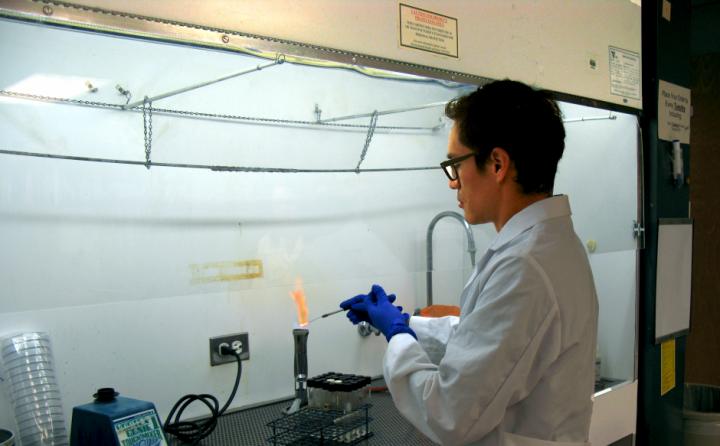
Credit: University of Missouri
In the future, a durable coating could help keep food-contact surfaces clean in the food processing industry, including in meat processing plants. A new study from a team of University of Missouri engineers and food scientists demonstrates that the coating — made from titanium dioxide — is capable of eliminating foodborne germs, such as salmonella and E. coli, and provides a preventative layer of protection against future cross-contamination on stainless steel food-contact surfaces.
The study was conducted by Eduardo Torres Dominguez, who is pursuing a doctorate in chemical engineering in the MU College of Engineering, and includes a team of researchers from the College of Engineering and the MU College of Agriculture, Food and Natural Resources. Dominguez is also a Fulbright scholar.
“I knew that other researchers had developed antimicrobial coatings this way, but they hadn’t focused on the coatings’ mechanical resistance or durability,” Dominguez said. “In the presence of ultraviolet light, oxygen and water, the titanium dioxide will activate to kill bacteria from the food contact surfaces on which it is applied. Although the coating is applied as a liquid at the beginning of the process, once it is ready to use it becomes a hard material, like a thin layer of ceramic.”
Heather K. Hunt, an associate professor in the College of Engineering and one of Dominguez’s advisors, guided Dominguez through the process of finding, selecting, synthesizing and characterizing the titanium dioxide material — a known disinfecting agent that is also food safe.
“We picked this material knowing it would have good antimicrobial behavior, and we strengthened its mechanical stability to withstand normal wear and tear in a typical food processing environment,” said Hunt, whose appointment is in the Department of Biomedical, Biological and Chemical Engineering. “In addition to normal cleaning procedures, our coating can add an additional layer of prevention to help stop the spread of foodborne contamination.”
Once Dominguez developed the coating, Azlin Mustapha, a professor in the College of Agriculture, Food and Natural Resources’ Food Science program and Dominguez’s other advisor, helped him optimize its antimicrobial, or disinfecting, properties. Matt Maschmann, an assistant professor in the Department of Mechanical and Aerospace Engineering in the College of Engineering, helped Dominguez optimize the material’s durability through hardness testing.
Mustapha is encouraged by the group’s progress as this could be a way to deter the spread of foodborne germs in a food processing environment.
“This will not only be helpful in the raw food processing lines of a processing plant but also ready-to-eat food lines, like deli counters, as well,” Mustapha said. “All surfaces in a food processing plant that come into contact with food are prone to be contaminated by foodborne germs spread by the handling of a contaminated food product.”
The researchers said this is the first step needed toward future testing of the coating’s properties in a real-world environment. Although the team has not tested it for use against the novel coronavirus, Hunt and Mustapha believe their coating has the potential to aid in helping stop the spread of the COVID-19 pandemic in a food processing environment because of its durability and disinfecting qualities. So far, it has shown to be effective against a strain of E. coli that can be deadly in people, and more work is being done to test the coating against other disease-causing bacteria.
The study, “Design and characterization of mechanically stable, nanoporous TiO2 thin film antimicrobial coatings for food contact surfaces,” was published in Materials Chemistry and Physics. Co-authors include Phong Nguyen at MU and Annika Hylen at St. Louis University. Funding was provided by the graduate fellowship program of the Fulbright Program and the Comision Mexico-Estados Unidos para el Intercambio Educativo y Cultural (COMEXUS). The content is solely the responsibility of the authors and does not necessarily represent the official views of the funding agencies.
###
Media Contact
Eric Stann
[email protected]
Original Source
https:/
Related Journal Article
http://dx.