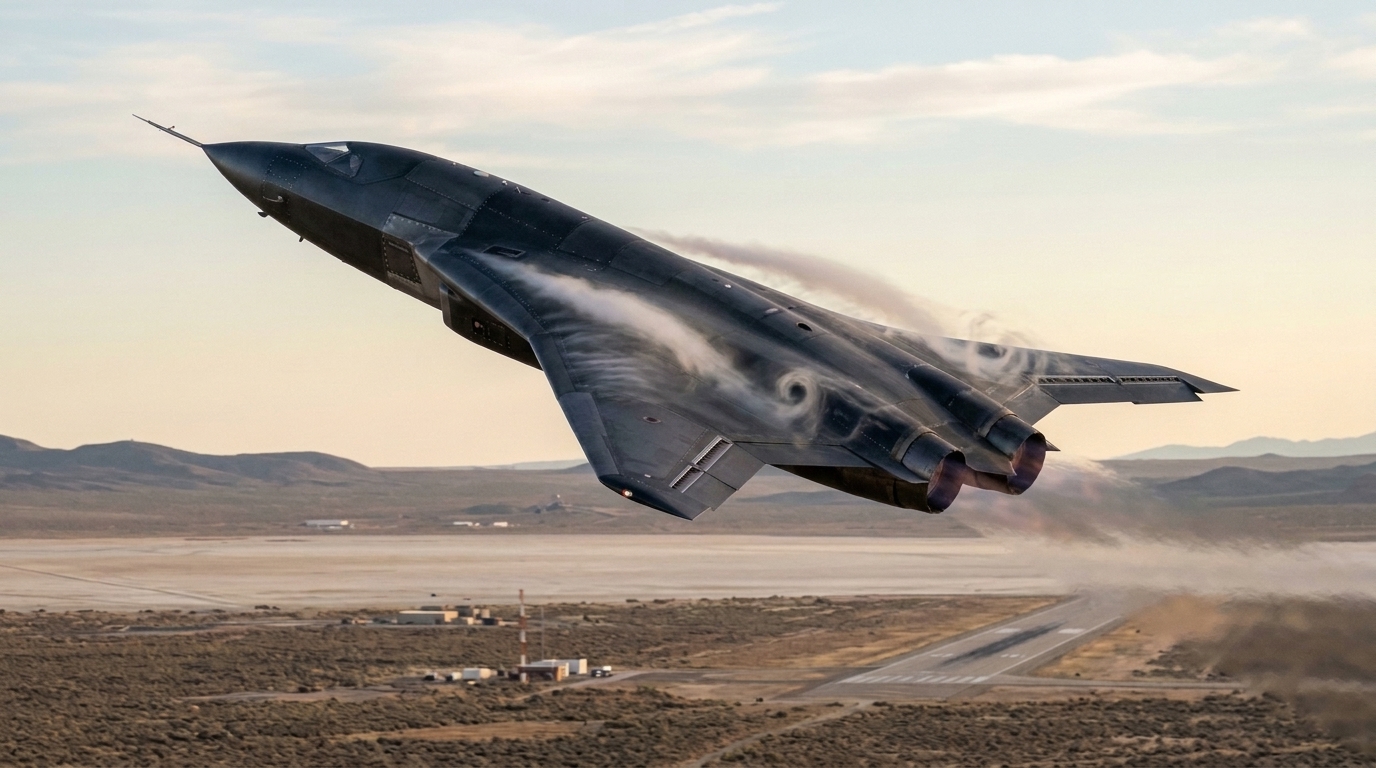
A comprehensive research review published in Advances in Aerodynamics documents the rapid evolution of active flow control aircraft, tracking engineering milestones that eliminate conventional mechanical rudders and dramatically expand short takeoff and landing capabilities. As defined by the National Aeronautics and Space Administration, active flow control introduces energy directly into the boundary layer on demand to manipulate local aerodynamic phenomena, allowing modest localized fluid inputs to generate dominant primary effects across an entire airframe. By replacing the century-old command sequence of pilot input, mechanical surface deflection, flow field alteration, and vehicle attitude adjustment with a direct command-to-flow-field architecture, fluidic actuation fundamentally alters surface pressure distributions. Across contemporary aerospace development, these fluid manipulation strategies are concentrated in two critical operational areas: rudderless flight control, which removes external control surfaces to overcome steep aerodynamic and signature penalties, and short takeoff and landing systems that rely on pneumatic lift enhancement to operate from constrained airstrips.
Conventional mechanical control surfaces impose significant performance compromises on advanced flying wing aircraft, which serve as the primary operational platforms for rudderless flight control development. Traditional hinged rudders add substantial structural weight, require voluminous internal mechanical assemblies, present maintenance complexities, and introduce nonlinear control responses including actuator saturation and mechanical dead zones. In low-observable flying wing configurations, heading control presents an irreconcilable conflict between vehicle stability and stealth characteristics: maintaining radar cross-section requirements demands minimal surface deflection, whereas aerodynamic stability augmentation necessitates continuous, high-frequency oscillations that deflect past the dead zone and degrade low-observability profiles. Furthermore, mechanical rudders suffer from degraded control authority at high cruising sweeps compared to traditional horizontal tail planes and risk complete flow detachment, aerodynamic reversal, or catastrophic control loss when operating at high angles of attack. Replacing moving aerodynamic surfaces with fluidic actuators removes these moving boundaries, enabling airframe stabilization through circulation control, fluidic thrust-vectoring control, flow separation control, and separation induction control.
Early systematic investigations into active flow control aircraft were spearheaded through collaborative European and North Atlantic Treaty Organization initiatives. In 2004, BAE Systems and ten academic institutions launched the Flapless Air Vehicle Integrated Industry Research program alongside the AEROMEMS II consortium to explore micro-electro-mechanical systems and fluidic effectors. Early flight experiments conducted by the University of Manchester verified specific fluidic axes, beginning in 2005 with the electric compressor-driven Tutor40 unmanned aerial vehicle using outer-wing circulation control for roll manipulation, followed in 2006 by the Vector II platform demonstrating pitch control via co-flow fluidic thrust vectoring. These trials progressed to the subscale Santos and JAVA demonstrators, which integrated combined circulation and thrust vectoring layouts. In September 2010, the ninety-kilogram DEMON unmanned aerial vehicle completed its maiden flight at forty-five meters per second, utilizing an auxiliary power unit to feed trailing-edge circulation control and co-flow thrust vectoring nozzles, successfully verifying mechanical-free roll control under real atmospheric flight conditions.
Subsequent multinational research consolidated these aerodynamic concepts into mature unmanned platform evaluations under the NATO Science and Technology Organization Applied Vehicle Technology program. Across successive phases including AVT-168, AVT-215, AVT-239, and AVT-295, researchers investigated virtual aerodynamic shaping, boundary layer blowing, and flow-effector integration across the Innovative Control Effectors and stability and control configuration airframes. Detailed engineering evaluations completed in 2019 revealed that replacing mechanical rudders with active flow control actuators achieved a ten percent reduction in internal volume and a twenty-five percent reduction in component weight. In parallel flight trials conducted in August 2018, a subscale ICE vehicle verified rudderless pitch and roll control using engine bleed air fed through trailing-edge circulation control slots, though flight logging recorded high pitch-axis sensitivity alongside lateral-directional cross-coupling. Flight dynamics evaluations finalized in the optimal ICE-04 configuration established that pairing trailing-edge circulation control with yaw-oriented fluidic thrust vectoring provided the most effective flight control combination for low-observable operational profiles.
Parallel flight trials conducted with the subscale MAGMA demonstrator, developed by BAE Systems and the University of Manchester, further advanced full-envelope fluidic maneuvering. Originating from the 1303 blended platform with thickened wings and rounded leading edges, MAGMA successfully conducted baseline flights with conventional mechanical surfaces in 2017 before achieving pure active flow control roll and pitch manipulation in April 2019 without any moving control surfaces. Wing roll control was governed by compact trailing-edge circulation slots, while pitch authority was generated by blowing engine compressor bleed air through an internal spanwise nozzle array positioned downstream of a backward-facing step, an aerodynamic feature specifically designed to eliminate hysteresis and bi-stable flow switching. Subsequent flight dynamics simulations carried out in 2021 demonstrated that integrating circulation control with yaw fluidic thrust vectoring achieved complete three-axis vehicle stabilization while drawing an average of sixty-two percent of the available engine compressor mass flow.
In the United States, the Defense Advanced Research Projects Agency initiated the Control of Revolutionary Aircraft with Novel Effectors program in 2020 to integrate active flow control into aircraft conceptual design rather than retrofitting actuators onto existing airframes. Partnering with Aurora Flight Sciences, Lockheed Martin, Georgia Tech, and BAE Systems, the multi-phase program advanced through conceptual and preliminary design stages, committing tens of millions of dollars toward component testing and wind tunnel validation. BAE Systems introduced tailless canard configurations utilizing forebody vortex manipulation alongside supercritical circulation control, while Georgia Tech explored sweeping-jet circulation and distributed bleed driven by internal pressure differentials. In May 2023, the demonstrator was designated the X-65, and Aurora Flight Sciences was commissioned in January 2024 to construct the full-scale flight article. Designed as a joined-wing platform weighing 3,274 kilograms with a 9.144-meter wingspan, the X-65 incorporates 318 kilograms of active flow control equipment, fourteen fluidic actuator arrays, and fourteen backup mechanical surfaces, targeted to validate cruise rudderless flight up to Mach 0.7 alongside low-speed active flow control operations.
Substantial contributions to rudderless flow control have concurrently emerged from Chinese academic and defense research institutions across a range of actuation methodologies. Research led by Nanjing University of Aeronautics and Astronautics utilized electric centrifugal blowers to validate circulation control roll authority on conventional airframes in 2014, progressing to a fully tailless canard unmanned airframe in 2015 and a three-axis rudderless flying wing in 2019. Novel thrust-vectoring designs using passive secondary flow induction achieved dramatic agility enhancements, reducing tactical turning radii by eighty percent while increasing pitch acceleration by 143.6 percent in flight tests by Cao and colleagues in 2015. Dual-nozzle configurations developed by Lin and associates demonstrated multi-axis authority through by-pass fluidic nozzles, while researchers at the China Aerodynamics Research and Development Center applied dielectric barrier discharge plasma actuators to suppress stall separation in 2016 and conducted closed-loop engine bleed air circulation flights on a tailless flying wing in 2023, achieving actuator response intervals under 0.02 seconds with control moments matching multi-degree mechanical deflections.
Significant aerodynamic gains have been realized through the application of zero-mass-flux dual synthetic jet actuators pioneered by the National University of Defense Technology. Operating entirely without external air bottles, compressor bleed lines, or heavy mechanical valves, distributed dual synthetic jet arrays manipulate local flow structures with minimal electrical power. Between 2021 and 2023, researchers integrated these solid-state actuators across successive unmanned flying platforms, including the AFC-1 and the multi-axis AFC-2, culminating in the AFC-3 and the turbojet-powered AFC-4 flying wing. The AFC-4 achieved complete three-axis rudderless flight control at a cruise velocity of seventy meters per second and Mach 0.2, representing the fastest published active flow control flight velocity to date. Compared to bleed-air systems such as MAGMA, the dual synthetic jet architecture demonstrated a sixty-five percent reduction in system weight ratio, with actuation hardware accounting for only 5.85 percent of the total aircraft mass while expanding operational control to simultaneous pitch, roll, and yaw authority.
Beyond flight attitude control, active flow manipulation has demonstrated transformative performance in short takeoff and landing operations through high-lift generation. Unmodified plain airfoils exhibit theoretical lift coefficient limits well below 1.5, while mechanical multi-element flaps struggle to exceed maximum lift coefficients around 2.0. By contrast, pneumatic circulation control wings exploit trailing-edge boundary layer blowing over rounded Coanda surfaces to delay separation and entrain vast external flow streams, breaking past mechanical boundaries to generate lift coefficients exceeding 7.0. Early foundational tests conducted at the David Taylor Naval Ship Research and Development Center confirmed that circulation control could more than double maximum three-dimensional wing lift. In 1979, full-scale flight testing of a modified Grumman A-6 demonstrator confirmed these physical principles, recording a doubling of lift coefficients at high angles of attack, an 85 percent increase in maximum lift, a 65 percent reduction in landing roll, and a 60 percent reduction in takeoff distance.
Pneumatic lift enhancement was further validated on large-scale military and transport prototypes exploring upper surface blowing and blown flap architectures. During the 1980s, NASA evaluated the Quiet Short-haul Research Aircraft equipped with upper surface blown flaps and circulation control, recording full-scale exhaust flow deflections up to ninety-seven degrees. In transport design evaluations directed by Englar, dual-radius and double-slot circulation airfoils applied to the Boeing 737 airframe demonstrated that replacing fifteen complex mechanical flap mechanisms per wing with single-element circulation blowing enabled a 43 percent increase in allowable gross operating weight off existing runway lengths. Similar aerodynamic concepts were demonstrated on the Boeing 367-80 prototype, which achieved a maximum lift coefficient of 3.2 using ejector-fed boundary layer control, the Hunting jet flap aircraft reaching lift coefficients of 9.0, and the modified de Havilland C-8A augmented jet flap demonstrator, which logged a 43 percent decrease in takeoff speed.
Despite verified experimental successes across subscale and experimental airframes, transitioning active flow control aircraft into operational production involves substantial physical and systems-level hurdles. A fundamental aerodynamic challenge stems from control efficiency scaling: while conventional mechanical surfaces become increasingly effective as dynamic pressure rises, active flow control effectiveness deteriorates at elevated flight velocities. In high-speed circulation control regimes, maintaining requisite blowing momentum coefficients demands supersonic jet velocities, triggering aggressive shock-wave and boundary-layer interactions across Coanda curves that culminate in sudden momentum-coefficient stall. Furthermore, high-altitude operations present severe rarefaction penalties; at ten kilometers, atmospheric air density falls to 33 percent of sea-level values, cutting natural aerodynamic damping to one-third while simultaneously reducing fluidic jet effectiveness, raising unanswered operational questions regarding high-altitude flight stability.
Resolving these operational limitations requires coordinated actuation architectures, robust mathematical modeling, and adaptive flight control algorithms. Future implementation strategies will increasingly integrate high-output bleed air systems for high-demand maneuvers with distributed arrays of dual synthetic jets positioned across thin airfoils, wingtips, and shock-prone regions. However, flight dynamics modeling for active flow control platforms remains intensely challenging due to severe aerodynamic nonlinearities, high-dimensional coupling across pressure ratios, temperatures, and local Mach numbers, and an absence of exhaustive wind tunnel datasets across full operating envelopes. Flight management computers must also incorporate redundant dynamic allocation strategies capable of instantly identifying localized actuator failures and reconfiguring non-faulty fluidic arrays to prevent asymmetric departure or sudden lift collapse, establishing a pathway toward resilient next-generation flight vehicles.
Subject of Research: Active flow control technologies for rudderless flight and short takeoff and landing aircraft
Article Title: Progress of active flow control aircraft adopting rudderless flight control and STOL
Article References: Zhao, Z., Luo, Z., Deng, X., Zhang, J., Zhou, Y., Peng, W., & Feng, Y. (2026). Progress of active flow control aircraft adopting rudderless flight control and STOL. Advances in Aerodynamics, 8(1), Article 11. https://doi.org/10.1186/s42774-025-00225-4
Image Credits: AI Generated
DOI: 10.1186/s42774-025-00225-4
Keywords: aerodynamics, active flow control, rudderless aircraft, circulation control, short takeoff and landing, fluidic thrust vectoring, dual synthetic jets, flight dynamics, Progress, active, flow, control
News Source: Denise Maddox. (November 6, 2026). Aviation Engineers Advance Active Flow Control for Rudderless and Short Takeoff Aircraft. Scienmag.