• HOME
  • NEWS
  • EXPLORE
    • CAREER
      • Companies
      • Jobs
    • EVENTS
    • iGEM
      • News
      • Team
    • PHOTOS
    • VIDEO
    • WIKI
  • BLOG
  • COMMUNITY
    • FACEBOOK
    • INSTAGRAM
    • TWITTER
Wednesday, July 8, 2026
BIOENGINEER.ORG
No Result
View All Result
  • Login
  • HOME
  • NEWS
  • EXPLORE
    • CAREER
      • Companies
      • Jobs
        • Lecturer
        • PhD Studentship
        • Postdoc
        • Research Assistant
    • EVENTS
    • iGEM
      • News
      • Team
    • PHOTOS
    • VIDEO
    • WIKI
  • BLOG
  • COMMUNITY
    • FACEBOOK
    • INSTAGRAM
    • TWITTER
  • HOME
  • NEWS
  • EXPLORE
    • CAREER
      • Companies
      • Jobs
        • Lecturer
        • PhD Studentship
        • Postdoc
        • Research Assistant
    • EVENTS
    • iGEM
      • News
      • Team
    • PHOTOS
    • VIDEO
    • WIKI
  • BLOG
  • COMMUNITY
    • FACEBOOK
    • INSTAGRAM
    • TWITTER
No Result
View All Result
Bioengineer.org
No Result
View All Result
Home NEWS Science News Biology

Avatar worms help to identify factors that modify genetic diseases

Bioengineer by Bioengineer
January 21, 2020
in Biology
Reading Time: 2 mins read
0
IMAGE
Share on FacebookShare on TwitterShare on LinkedinShare on RedditShare on Telegram

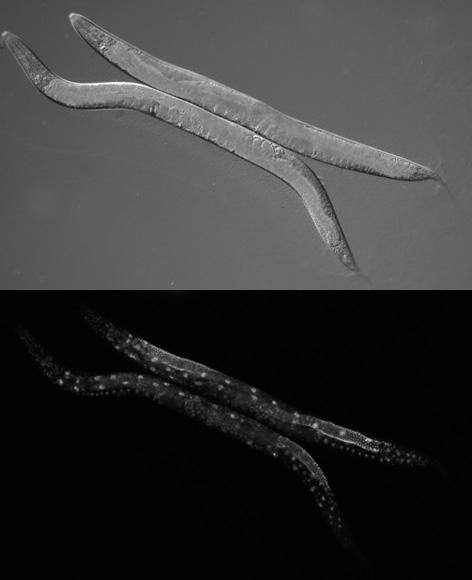
IDIBELL researchers have used gene-editing technology in C. elegans to reproduce human mutations that cause retinitis pigmentaria. With this method, they have studied factors that affect disease development and possible drug treatments
IMAGE

Credit: J. Cerón


Often, patients from the same family and carriers of the same genetic mutation, develop a disease differently. This disparity may be due to the existence of mutations in other secondary genes, which influence the onset and progression of the disease caused by the main mutation. As an example, members of a family who are carriers of the same mutation may show symptoms of the disease at age 20, and others at age 50. Knowing what factors influence the onset and development of the disease would help a better prognosis and the application of preventive treatments. Retinitis pigmentaria is a group of a genetic and degenerative diseases characterized by the loss of light-receptor cells in the retina, this causes a non-responder retina and a progressive vision loss.

Two researchers from Dr. Cerón’s group, Dmytro Kukhtar and Karinna Rubio-Peña, from Bellvitge Biomedical Research Institute (IDIBELL), have worked on this topic in the last few years. To do it, and by CRISPR gene-editing technology, they introduced in C. elegans worms, mutations that cause retinitis pigmentaria in humans. Next, these mutations were classified into two groups: those that caused an obvious problem to worms (eg sterility or smaller size) and those that did not.

Worms that were not affected by human mutations were used to search for other genes whose inactivation caused alterations in the mutant worms, but not in the control worms. Thus, up to three genes were identified as candidates to be disease modifiers, and in cooperation with the main mutation could be affecting disease progression.

On the other hand, those avatar worms to which the human mutation caused them a defect were used to look for drugs that would alleviate the negative effect of the mutation. The result was surprising because researchers identified drugs that were harmful to worms harboring patient mutations, but these drugs did not affect control worms equally. In this way, this study changes the paradigm of drug screens since although it is important to find drugs that cure, it is also relevant for health to identify those drugs that could be harmful to patients with certain genetic mutations.

###

This research work has been funded mainly by the Carlos III Health Institute (ISCIII) and the ONCE Foundation.

Reference:

Mimicking of splicing-related retinitis pigmentosa mutations in C. elegans allow drug screens and identification of disease modifiers. Kukhtar D, Rubio-Peña K, Serrat X, Cerón J. Human Molecular Genetics. 2020 Jan 10. pii: ddz315.

Media Contact
Carla Serra
[email protected]

Original Source

http://www.idibell.cat/en/whats-on/noticies/avatar-worms-help-identify-factors-modify-genetic-diseases

Related Journal Article

http://dx.doi.org/10.1093/hmg/ddz315

Tags: BiologyBiotechnologyGenetics
Share12Tweet8Share2ShareShareShare2

Related Posts

Here are a few rewritten headlines for a science magazine post, each with a slightly different tone: Intriguing & poetic: How do organs sculpt themselves? Sea stars hold the secret Direct & research-focused: Sea stars reveal the hidden rules of organ formation Metaphorical & inviting: Tiny architects beneath the waves: What sea stars teach us about building organs Short & punchy: Star-shaped clues to how our organs take shape Question-led: Could a sea star show us how organs form? Elegant & feature-style: The body’s blueprint, glimpsed in a sea star’s arm

July 6, 2026
Bacteria evolve faster with unconventional gene copies — Biology

Bacteria evolve faster with unconventional gene copies

July 6, 2026

Neighbours rewire soil feedback via root microbiome shifts

July 6, 2026

Evolution-Inspired Biosensors Revolutionize Lipid Tracking in Real Time

July 2, 2026
Please login to join discussion

POPULAR NEWS

  • Detection of EDCs in Breast Milk and Infant Urine Up to Six Months Highlights Early Exposure Risks

    77 shares
    Share 31 Tweet 19
  • New Drug Candidate Developed at McMaster Shows Potential for Treating Brain Cancer

    58 shares
    Share 23 Tweet 15
  • KTU Researchers Explore Ultrasound’s Role in Enhancing Blood Flow Beyond Diagnostics

    53 shares
    Share 21 Tweet 13
  • 高齢者の骨粗鬆症治療の持続性比較

    51 shares
    Share 20 Tweet 13

About

We bring you the latest biotechnology news from best research centers and universities around the world. Check our website.

Follow us

Recent News

Return exactly one rewritten English science news headline for the original title below. Maximum 12 words. Output plain text only. Do not use HTML, Markdown, quotes, labels, explanations, bullets, numbering, or multiple options. Original title: MIT engineers whip up a more breathable hydrogel

Flame retardant BDE-209 targets molecularly linked to ulcerative colitis

Ultra-high frequency particle impacts mimic rockbursts to shatter hard rock

Subscribe to Blog via Email

Enter your email address to subscribe to this blog and receive notifications of new posts by email.

Join 83 other subscribers
  • Contact Us

Bioengineer.org © Copyright 2023 All Rights Reserved.

Welcome Back!

Login to your account below

Forgotten Password?

Retrieve your password

Please enter your username or email address to reset your password.

Log In
No Result
View All Result
  • Homepages
    • Home Page 1
    • Home Page 2
  • News
  • National
  • Business
  • Health
  • Lifestyle
  • Science

Bioengineer.org © Copyright 2023 All Rights Reserved.