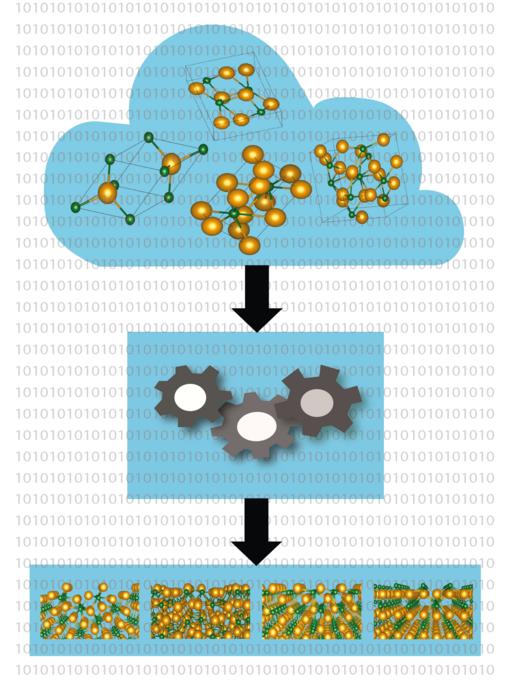
Computer-based methods are becoming an increasingly powerful tooI in the search for new materials for key technologies such as photovoltaics, batteries and data transmission. Prof. Dr. Caterina Cocchi and Holger-Dietrich Saßnick from the University of Oldenburg in Germany have now developed a high-throughput automatised method to calculate the surface properties of crystalline materials starting directly at the level of established laws of physics (first principles). In an article published in the journal npj computational materials, they report that this can speed up the search for relevant materials for applications in key areas such as the energy sector. They also plan to combine the method with artificial intelligence and machine learning techniques to further accelerate the process.
Credit: University of Oldenburg / EST group
Computer-based methods are becoming an increasingly powerful tooI in the search for new materials for key technologies such as photovoltaics, batteries and data transmission. Prof. Dr. Caterina Cocchi and Holger-Dietrich Saßnick from the University of Oldenburg in Germany have now developed a high-throughput automatised method to calculate the surface properties of crystalline materials starting directly at the level of established laws of physics (first principles). In an article published in the journal npj computational materials, they report that this can speed up the search for relevant materials for applications in key areas such as the energy sector. They also plan to combine the method with artificial intelligence and machine learning techniques to further accelerate the process.
So far similar methods have focused on bulk materials rather than surfaces, the two physicists explain. “All the relevant processes for energy conversion, production, and storage occur on surfaces,” says Cocchi, who heads the Theoretical Solid State Physics research group at the University of Oldenburg. However, calculating the material properties of surfaces is far more challenging than for complete crystals because the surface facets often have a complex structure due to factors such as defects in the crystal structure or the uneven growth of a crystal, she explains.
This complexity poses problems for researchers in the field of materials science: “It is often not possible to clearly determine the properties of samples in experiments,” says Cocchi. This motivated Cocchi and her colleague Saßnick to develop an automated procedure for high-quality screening of the characteristics of new compounds.
Reliable results
The result of their work was incorporated into the aim2dat computer programme, which only requires the chemical composition of a compound as input. The information about the crystal’s structure is extracted from existing databases. The software then calculates the conditions under which the surface of the material is chemically stable. In a second step it determines key properties, in particular the energy required to excite electrons into conduction states or detach themselves from a surface. This parameter plays an important role in materials that convert solar energy into electricity, for example. “We don’t make any assumptions in our calculations; we use only the fundamental equations of quantum mechanics, which is why our results are very reliable,” Cocchi explains.
The two scientists demonstrated the applicability of the method using the semiconductor cesium telluride. The crystals of this material, which is used as an electron source in particle accelerators, can occur in four different forms. “The composition and quality of the material samples are difficult to control in experiments,” notes Saßnick. Nevertheless, the Oldenburg researchers were able to perform a detailed analysis of the physical properties for the different configurations of the caesium telluride crystals.
Cocchi and Saßnick have embedded the software in a publicly accessible programme library so that other researchers can also use and improve the procedure. “Our method has great potential as a tool for discovering new materials – and in particular physically and structurally complex solids – for all kinds of applications in the energy sector,” says Cocchi.
Journal
npj Computational Materials
DOI
10.1038/s41524-024-01224-7
Method of Research
Computational simulation/modeling
Subject of Research
Not applicable
Article Title
Automated analysis of surface facets: the example of cesium telluride
Article Publication Date
20-Feb-2024
COI Statement
The authors declare no competing interests.