• HOME
  • NEWS
  • EXPLORE
    • CAREER
      • Companies
      • Jobs
    • EVENTS
    • iGEM
      • News
      • Team
    • PHOTOS
    • VIDEO
    • WIKI
  • BLOG
  • COMMUNITY
    • FACEBOOK
    • INSTAGRAM
    • TWITTER
Monday, July 13, 2026
BIOENGINEER.ORG
No Result
View All Result
  • Login
  • HOME
  • NEWS
  • EXPLORE
    • CAREER
      • Companies
      • Jobs
        • Lecturer
        • PhD Studentship
        • Postdoc
        • Research Assistant
    • EVENTS
    • iGEM
      • News
      • Team
    • PHOTOS
    • VIDEO
    • WIKI
  • BLOG
  • COMMUNITY
    • FACEBOOK
    • INSTAGRAM
    • TWITTER
  • HOME
  • NEWS
  • EXPLORE
    • CAREER
      • Companies
      • Jobs
        • Lecturer
        • PhD Studentship
        • Postdoc
        • Research Assistant
    • EVENTS
    • iGEM
      • News
      • Team
    • PHOTOS
    • VIDEO
    • WIKI
  • BLOG
  • COMMUNITY
    • FACEBOOK
    • INSTAGRAM
    • TWITTER
No Result
View All Result
Bioengineer.org
No Result
View All Result
Home NEWS Science News Biology

Atmospheric aerosol formation from biogenic vapors is strongly affected by air pollutants

Bioengineer by Bioengineer
December 16, 2018
in Biology
Reading Time: 2 mins read
0
IMAGE
Share on FacebookShare on TwitterShare on LinkedinShare on RedditShare on Telegram

IMAGE

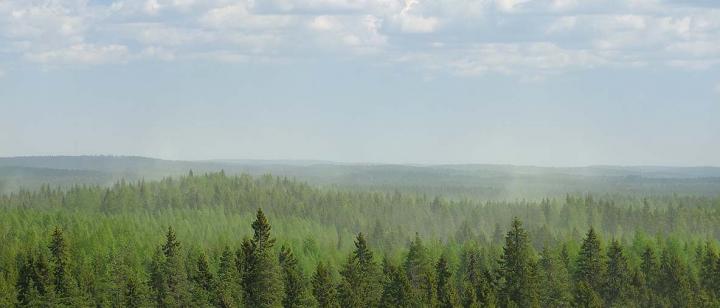
Credit: Matti Loponen and Juho Aalto

The formation of new aerosol particles is a complicated process. Researchers have only recently started to understand this process on a molecular level after instruments able to detect nanometer-scale particles became available.

The human population has altered the composition of atmospheric gas in several ways. Sulfur dioxide from industrial emissions, nitrogen oxides from traffic, and ammonia from agriculture can all affect particle formation after chemical reactions in the atmosphere. These gases can also interact with organic vapors, which originate mainly from forests and vegetation. The atmosphere contains thousands of different organic compounds, but only a small fraction of them can form and grow particles.

Earlier it was thought that new particle formation always requires sulfuric acid, which forms from the oxidation of sulfur dioxide. Later, it was found that certain organic vapors can also form particles. In this study, the researchers found that in continental moderately polluted atmospheres, e.g. in the Finnish boreal forest, particles are formed most efficiently when sulfuric acid, ammonia and organic vapors are all present simultaneously. Nitrogen oxides, on the other hand, decreased the amount of newly formed particles.

The results help to understand how new particle formation and the associated climate impact will change if air pollution levels decrease in the future due to stricter emission control. Aerosol particles can affect the climate by scattering solar radiation and by acting as seed particles for cloud droplets. The aerosol-cloud-climate interactions are still associated with large uncertainties in current climate models.

The laboratory experiments leading to these results were conducted at the European Center for Nuclear Research, CERN, in Geneva, which has one of the best laboratory facilities for detailed particle formation studies. The study was led by Associate Professor Katrianne Lehtipalo from the University of Helsinki.

“We wanted to create the boreal forest atmosphere in our chamber,” she says. Long-term field measurements at the Hyytiala SMEAR II station in southern Finland helped the researchers to identify the right conditions for particle formation.

“Particle formation is a delicate process, and it took us a while to find the correct gas mixture, but in the end we were able to replicate atmospheric observations almost perfectly,” Lehtipalo says.

The study was conducted in collaboration between 25 different institutes in 9 different countries.

###

More information: Associate Professor Katrianne Lehtipalo, Institute for Atmospheric and Earth System Research, University of Helsinki, [email protected], +358-40-6630939

Article: Lehtipalo, K. et al. Multicomponent new particle formation from sulfuric acid, ammonia, and biogenic vapors. Science Advances 12.12.2018.

Media Contact
Katrianne Lehtipalo
[email protected]
358-406-630-939

Related Journal Article

http://dx.doi.org/10.1126/sciadv.aau5363

Tags: Atmospheric ChemistryAtmospheric ScienceClimate ChangePollution/Remediation
Share12Tweet8Share2ShareShareShare2

Related Posts

American Ornithological Society Grants Seven 2026 Kessel Research Fellowships

American Ornithological Society Grants Seven 2026 Kessel Research Fellowships

July 13, 2026
Heat Exposure in Early Life Linked to Changes in Children’s Brain Development

Heat Exposure in Early Life Linked to Changes in Children’s Brain Development

July 13, 2026

Modeling Fish Breeding Programs Incorporating Social Behavior in Large Groups

July 13, 2026

New Guidelines Released for Prolactinoma Treatment by Chinese Neurosurgical Journal

July 13, 2026
Please login to join discussion

POPULAR NEWS

  • Detection of EDCs in Breast Milk and Infant Urine Up to Six Months Highlights Early Exposure Risks

    77 shares
    Share 31 Tweet 19
  • New Drug Candidate Developed at McMaster Shows Potential for Treating Brain Cancer

    58 shares
    Share 23 Tweet 15
  • KTU Researchers Explore Ultrasound’s Role in Enhancing Blood Flow Beyond Diagnostics

    53 shares
    Share 21 Tweet 13
  • Experimental Therapy Simultaneously Destroys Prostate Tumor Cells and Reactivates Antitumor Immunity

    46 shares
    Share 18 Tweet 12

About

We bring you the latest biotechnology news from best research centers and universities around the world. Check our website.

Follow us

Recent News

American Ornithological Society Grants Seven 2026 Kessel Research Fellowships

Nrf2 Metabolic Shift Boosts Regulatory T Cells in Liver Cancer

Screen Use to Calm Children: Benefits and Risks Explored

Subscribe to Blog via Email

Enter your email address to subscribe to this blog and receive notifications of new posts by email.

Join 85 other subscribers
  • Contact Us

Bioengineer.org © Copyright 2023 All Rights Reserved.

Welcome Back!

Login to your account below

Forgotten Password?

Retrieve your password

Please enter your username or email address to reset your password.

Log In
No Result
View All Result
  • Homepages
    • Home Page 1
    • Home Page 2
  • News
  • National
  • Business
  • Health
  • Lifestyle
  • Science

Bioengineer.org © Copyright 2023 All Rights Reserved.