• HOME
  • NEWS
  • EXPLORE
    • CAREER
      • Companies
      • Jobs
    • EVENTS
    • iGEM
      • News
      • Team
    • PHOTOS
    • VIDEO
    • WIKI
  • BLOG
  • COMMUNITY
    • FACEBOOK
    • INSTAGRAM
    • TWITTER
Thursday, June 4, 2026
BIOENGINEER.ORG
No Result
View All Result
  • Login
  • HOME
  • NEWS
  • EXPLORE
    • CAREER
      • Companies
      • Jobs
        • Lecturer
        • PhD Studentship
        • Postdoc
        • Research Assistant
    • EVENTS
    • iGEM
      • News
      • Team
    • PHOTOS
    • VIDEO
    • WIKI
  • BLOG
  • COMMUNITY
    • FACEBOOK
    • INSTAGRAM
    • TWITTER
  • HOME
  • NEWS
  • EXPLORE
    • CAREER
      • Companies
      • Jobs
        • Lecturer
        • PhD Studentship
        • Postdoc
        • Research Assistant
    • EVENTS
    • iGEM
      • News
      • Team
    • PHOTOS
    • VIDEO
    • WIKI
  • BLOG
  • COMMUNITY
    • FACEBOOK
    • INSTAGRAM
    • TWITTER
No Result
View All Result
Bioengineer.org
No Result
View All Result
Home NEWS Science News Chemistry

Astronomers map vast void in our cosmic neighborhood

Bioengineer by Bioengineer
July 22, 2019
in Chemistry
Reading Time: 3 mins read
0
IMAGE
Share on FacebookShare on TwitterShare on LinkedinShare on RedditShare on Telegram

IMAGE

Credit: UH

An astronomer from the University of Hawaii Institute for Astronomy and an international team published a new study that reveals more of the vast cosmic structure surrounding our Milky Way galaxy.

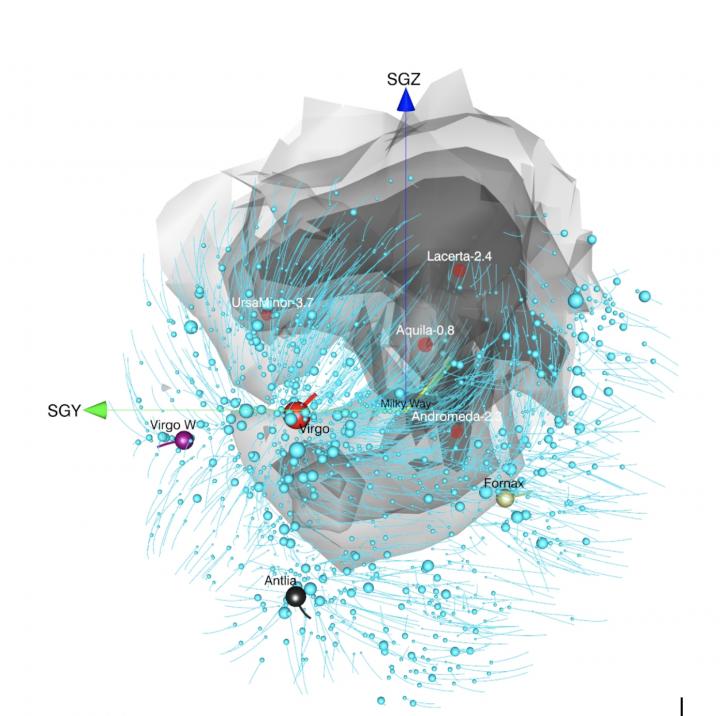
The universe is a tapestry of galaxy congregations and vast voids. In a new study being reported in The Astrophysical Journal, Brent Tully’s team applies the same tools from an earlier study to map the size and shape of an extensive empty region they called the Local Void that borders the Milky Way galaxy. Using the observations of galaxy motions, they infer the distribution of mass responsible for that motion, and construct three-dimensional maps of our local Universe.

Galaxies not only move with the overall expansion of the universe, they also respond to the gravitational tug of their neighbors and regions with a lot of mass. As a consequence, relative to the overall expansion they are moving towards the densest areas and away from regions with little mass – the voids.

Although we live in a cosmic metropolis, back in 1987 Tully and Richard Fisher noted that our Milky Way galaxy is also at the edge of an extensive empty region that they called the Local Void. The existence of the Local Void has been widely accepted, but it remained poorly studied because it lies behind the center of our galaxy and is therefore heavily obscured from our view.

Now, Tully and his team have measured the motions of 18,000 galaxies in the Cosmicflows-3 compendium of galaxy distances, constructing a cosmographic map that highlights the boundary between the collection of matter and the absence of matter that defines the edge of the Local Void. They used the same technique in 2014 to identify the full extent of our home supercluster of over one hundred thousand galaxies, giving it the name Laniakea, meaning “immense heaven” in Hawaiian.

For 30 years, astronomers have been trying to identify why the motions of the Milky Way, our nearest large galaxy neighbor Andromeda, and their smaller neighbors deviate from the overall expansion of the Universe by over 600 km/s (1.3 million mph). The new study shows that roughly half of this motion is generated “locally” from the combination of a pull from the massive nearby Virgo Cluster and our participation in the expansion of the Local Void as it becomes ever emptier.

###

An 11-minute video demonstrating the shape and extend of these cosmic structures is available online at https://vimeo.com/326346346

Interactive visualizations that allow the user to rotate, pan, and zoom maps of the mass distribution can be found at

https://sketchfab.com/models/f0a44df256aa4faf93391887d66010e2

https://sketchfab.com/models/78885b3d303d4b6e99cfe099b43929fb

The paper was published on July 22, 2019 in The Astrophysical Journal, and is available at https://doi.org/10.3847/1538-4357/ab2597.

Media Contact
Roy Gal
[email protected]

Related Journal Article

http://dx.doi.org/10.3847/1538-4357/ab2597

Tags: AstronomyAstrophysicsPlanets/MoonsSpace/Planetary Science
Share12Tweet8Share2ShareShareShare2

Related Posts

Long-Term Biochar Application Boosts Microbial Carbon Storage in Cropland Soils—But Soil Depth Is Key — Chemistry

Long-Term Biochar Application Boosts Microbial Carbon Storage in Cropland Soils—But Soil Depth Is Key

June 3, 2026
Why Doesn’t Coffee Taste Like Caffeine? Exploring the Science Behind Its Flavor — Chemistry

Why Doesn’t Coffee Taste Like Caffeine? Exploring the Science Behind Its Flavor

June 3, 2026

University of Maryland Heads Multi-University Effort to Develop Advanced Intelligent Systems

June 3, 2026

Study Finds Increased Antidepressant Concentrations in Select Waterways

June 3, 2026
Please login to join discussion

POPULAR NEWS

  • ESMO 2025: mRNA COVID Vaccines Enhance Efficacy of Cancer Immunotherapy

    321 shares
    Share 128 Tweet 80
  • Multi-Hospital Study Reveals Long Covid Burden Is Twice as High as Current Estimates

    87 shares
    Share 34 Tweet 22
  • Saying Goodbye to PGY-6: Pediatric Fellowship Realities

    70 shares
    Share 28 Tweet 18
  • Common Food Preservatives Associated with Elevated Blood Pressure and Increased Heart Disease Risk

    57 shares
    Share 23 Tweet 14

About

We bring you the latest biotechnology news from best research centers and universities around the world. Check our website.

Follow us

Recent News

Natural Depsipeptide Antibiotic Targets Bacterial Ribosome

Deep Learning Reveals Genetics of White Matter Structure

Lung Ultrasound Advances in Childhood Necrotizing Pneumonia

Subscribe to Blog via Email

Enter your email address to subscribe to this blog and receive notifications of new posts by email.

Join 83 other subscribers
  • Contact Us

Bioengineer.org © Copyright 2023 All Rights Reserved.

Welcome Back!

Login to your account below

Forgotten Password?

Retrieve your password

Please enter your username or email address to reset your password.

Log In
No Result
View All Result
  • Homepages
    • Home Page 1
    • Home Page 2
  • News
  • National
  • Business
  • Health
  • Lifestyle
  • Science

Bioengineer.org © Copyright 2023 All Rights Reserved.