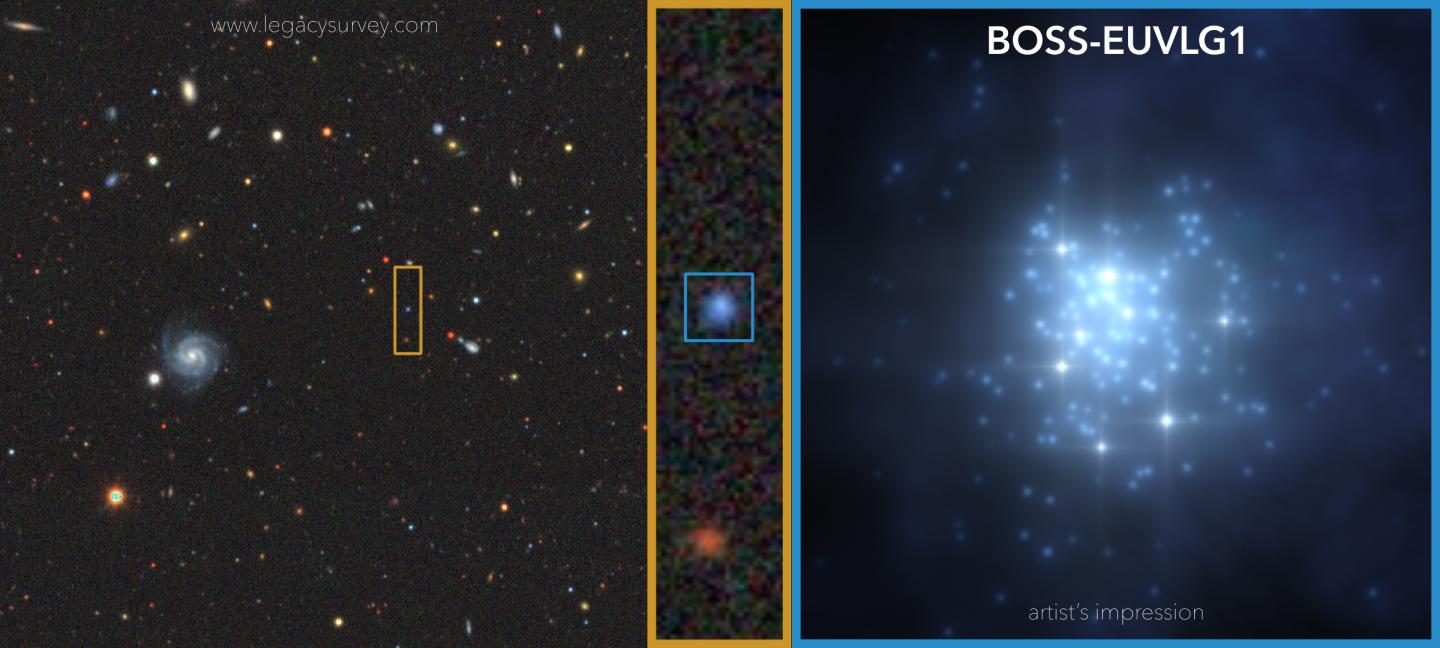
Credit: DESI Legacy Imaging Surveys and Gabriel Pérez Díaz, SMM (IAC).
It was found using observations made with the Gran Telescopio Canarias (GTC), at the Roque de los Muchachos Observatory, (Garafía, La Palma, Canary Islands), and with the ATACAMA Large Millimetre/submillimetre Array (ALMA), in Chile. The discovery was recently published in the journal Monthly Notices of the Royal Astronomical Society Letters.
The galaxy, called BOSS-EUVLG1, has a red-shift of 2.47. This is a measure of the reddening of the light coming from the galaxy, and can be used to find its distance, the further away the galaxy, the greater the value. For BOSS-EUVLG1, the value of 2.47 means that we are observing the galaxy when the universe was some 2 thousand million years old, around 20% of its present age.
The large values of redshift and luminosity of BOSS-EUVLG1 caused it to be classified previoulsy in the BOSS (Baryon Oscillation Spectroscopic Survey) project as a quasar. However, from the observations made with the OSIRIS and EMIR instruments on the GTC, and with the millimetre wave telescope ALMA, the researchers have shown that it is not a quasar but in fact a galaxy with extreme, exceptional properties.
The study revealed that the high luminosity of BOSS-EUVLG1 in the ultraviolet and in Lyman-alpha emission is due to the large number of young, massive stars in the galaxy. This high luminosity, well above the range for other galaxies, gave rise to its initial identification as a quasar. However, in quasars the high luminosity is due to the activity around the supermassive black holes in their nuclei, and not to star formation.
“BOSS-EUVLG1 seems to be dominated by a burst of formation of young, very massive stars, with hardly any dust, and with a very low metallicity, explains Rui Marques Chaves, a researcher at the CAB, formerly a doctoral student at the Instituto de Astrofísica de Canarias and the University of La Laguna (ULL), and first author of the article.
The rate of star formation in this galaxy is very high, around a thousand solar masses per year, around a thousand times higher than that in the Milky Way, although the galaxy is 30 times smaller. “This rate of star formation is comparable only to the most luminous infrared galaxies known, but the absence of dust in BOSS-EUVLG1 allows its ultraviolet and visible emission to reach us with hardly any attenuation”, explains Ismael Pérez Fournon, an IAC researcher and a co-author of the article.
So, the results of the study suggest that BOSS-EUVLG1 is an example of the initial phases of the formation of massive galaxies. In spite of its high luminosity and star formation rate, its low metallicity shows that the galaxy has hardly had time to enrich its interstellar medium with dust and newly formed metals. Nevertheless, “the galaxy will evolve towards a dustier phase, similar to the infrared galaxies, -notes Camilo E. Jiménez Ángel, a doctoral student at the IAC, and a co-author of the article-. Also, its high luminosityh in the UV will last only a few hundred million years, a very short period in the evolution of a galaxy”.
“This would explain why other galaxies similar to BOSS-EUVLG1 have not been discovered”, finishes Claudio Dalla Vecchia, a researcher at the IAC, and a co-author of the article.
BOSS-EUVLG1 was discovered via the analysis of half a million spectra of galaxies and quasars in the BOSS project of the Sloan Digital Sky Survey (SDSS) and observations with large telescopes such as the GTC and ALMA.
###
Article: R. Marques-Chaves, J. Alvarez-Márquez, L. Colina, I. Pérez-Fournon, D. Schaerer, C. Dalla Vecchia, T. Hashimoto, C. Jiménez-Ángel and Y. Shu. “The discovery of the most UV-Ly-alfa luminous star-forming galaxy: a young, dust- and metal-poor starburst with QSO-like luminosities”. Arxiv: https:/
Media Contact
Prensa IAC
[email protected]
Original Source
https:/