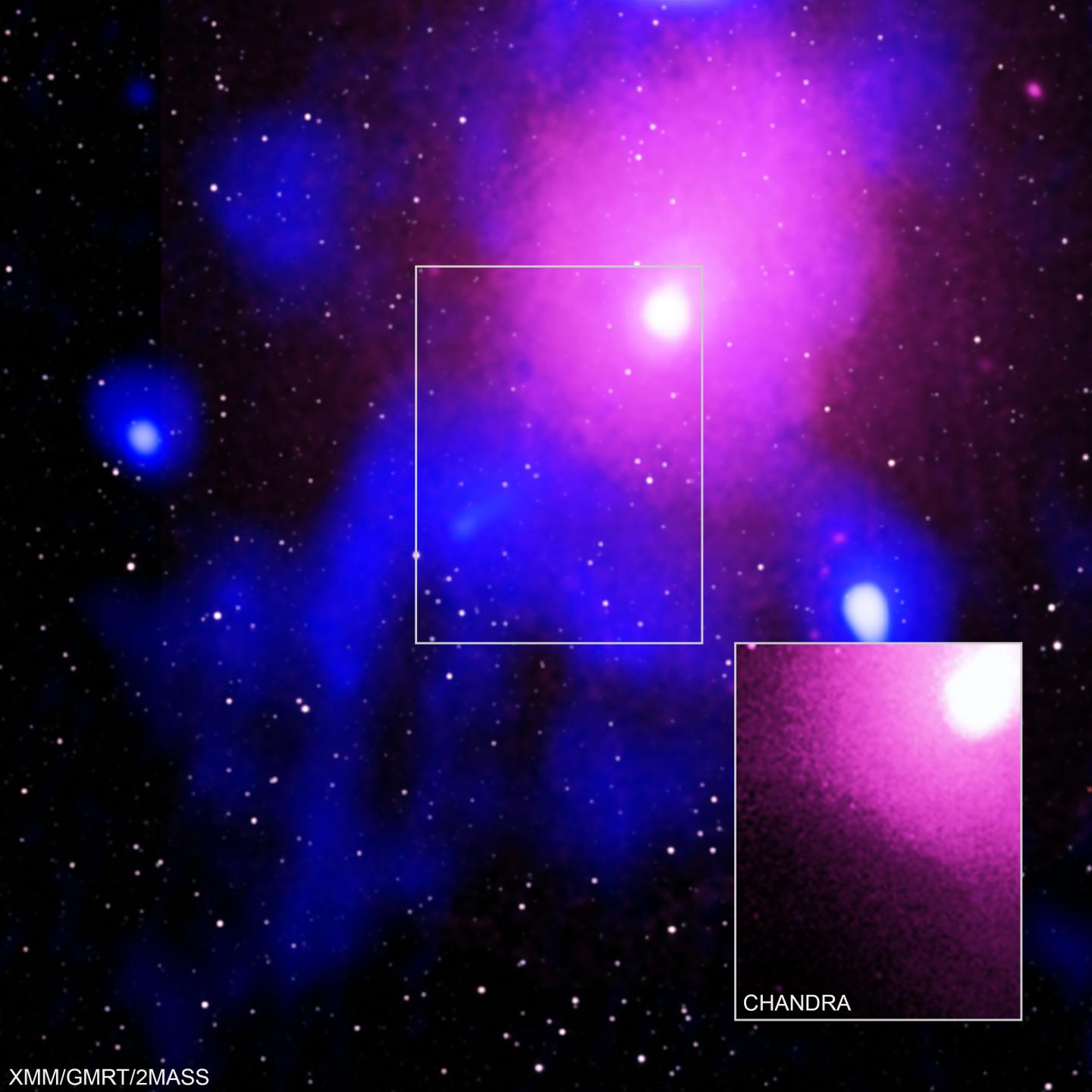
Credit: X-ray: NASA/CXC/Naval Research Lab/Giacintucci, S.; XMM:ESA/XMM; Radio: NCRA/TIFR/GMRTN; Infrared: 2MASS/UMass/IPAC-Caltech/NASA/NSF
Scientists studying a distant galaxy cluster have discovered the biggest explosion seen in the Universe since the Big Bang.
The blast came from a supermassive black hole at the centre of a galaxy hundreds of millions of light-years away.
It released five times more energy than the previous record holder.
Professor Melanie Johnston-Hollitt, from the Curtin University node of the International Centre for Radio Astronomy Research, said the event was extraordinarily energetic.
“We’ve seen outbursts in the centres of galaxies before but this one is really, really massive,” she said.
“And we don’t know why it’s so big.
“But it happened very slowly–like an explosion in slow motion that took place over hundreds of millions of years.”
The explosion occurred in the Ophiuchus galaxy cluster, about 390 million light-years from Earth.
It was so powerful it punched a cavity in the cluster plasma–the super-hot gas surrounding the black hole.
Lead author of the study Dr Simona Giacintucci, from the Naval Research Laboratory in the United States, said the blast was similar to the 1980 eruption of Mount St. Helens, which ripped the top off the mountain.
“The difference is that you could fit 15 Milky Way galaxies in a row into the crater this eruption punched into the cluster’s hot gas,” she said.
Professor Johnston-Hollitt said the cavity in the cluster plasma had been seen previously with X-ray telescopes.
But scientists initially dismissed the idea that it could have been caused by an energetic outburst, because it would have been too big.
“People were sceptical because the size of outburst,” she said. “But it really is that. The Universe is a weird place.”
The researchers only realised what they had discovered when they looked at the Ophiuchus galaxy cluster with radio telescopes.
“The radio data fit inside the X-rays like a hand in a glove,” said co-author Dr Maxim Markevitch, from NASA’s Goddard Space Flight Center.
“This is the clincher that tells us an eruption of unprecedented size occurred here.”
The discovery was made using four telescopes; NASA’s Chandra X-ray Observatory, ESA’s XMM-Newton, the Murchison Widefield Array (MWA) in Western Australia and the Giant Metrewave Radio Telescope (GMRT) in India.
Professor Johnston-Hollitt, who is the director of the MWA and an expert in galaxy clusters, likened the finding to discovering the first dinosaur bones.
“It’s a bit like archaeology,” she said.
“We’ve been given the tools to dig deeper with low frequency radio telescopes so we should be able to find more outbursts like this now.”
The finding underscores the importance of studying the Universe at different wavelengths, Professor Johnston-Hollitt said.
“Going back and doing a multi-wavelength study has really made the difference here,” she said.
Professor Johnston-Hollitt said the finding is likely to be the first of many.
“We made this discovery with Phase 1 of the MWA, when the telescope had 2048 antennas pointed towards the sky,” she said.
“We’re soon going to be gathering observations with 4096 antennas, which should be ten times more sensitive.”
“I think that’s pretty exciting.”
###
MORE INFORMATION
ICRAR
The International Centre for Radio Astronomy Research (ICRAR) is a joint venture between Curtin University and The University of Western Australia with support and funding from the State Government of Western Australia.
THE MURCHISON WIDEFIELD ARRAY
The Murchison Widefield Array (MWA) is a low-frequency radio telescope and is the first of four Square Kilometre Array (SKA) precursors to be completed. A consortium of partner institutions from seven countries (Australia, USA, India, New Zealand, Canada, Japan, and China) financed the development, construction, commissioning, and operations of the facility. The MWA consortium is led by Curtin University.
Publication:
‘Discovery of a giant radio fossil in the Ophiuchus Galaxy Cluster’, published in The Astrophysical Journal on February 27th, 2020.
Multimedia:
Available from http://www.
Contacts:
Prof. Melanie Johnston-Hollitt (ICRAR / Curtin University)
Ph: +61 400 951 815 E: [email protected]
Pete Wheeler (Media Contact, ICRAR)
Ph: +61 423 982 018 E: [email protected]
Lauren Sydoruk (Media Contact, Curtin University)
Ph: +61 9266 4241 E: [email protected]
Media Contact
Pete Wheeler
[email protected]
042-398-2018