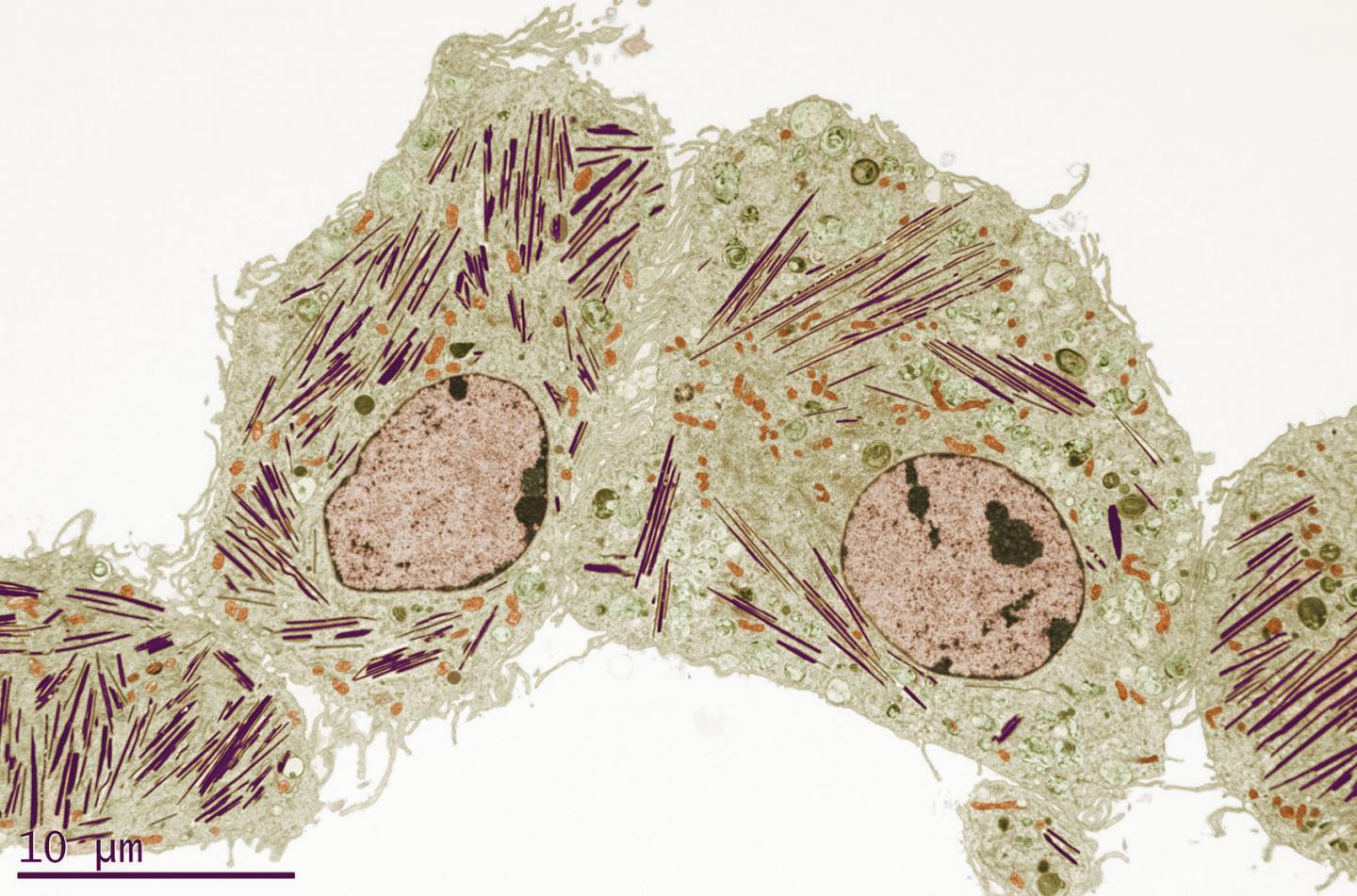
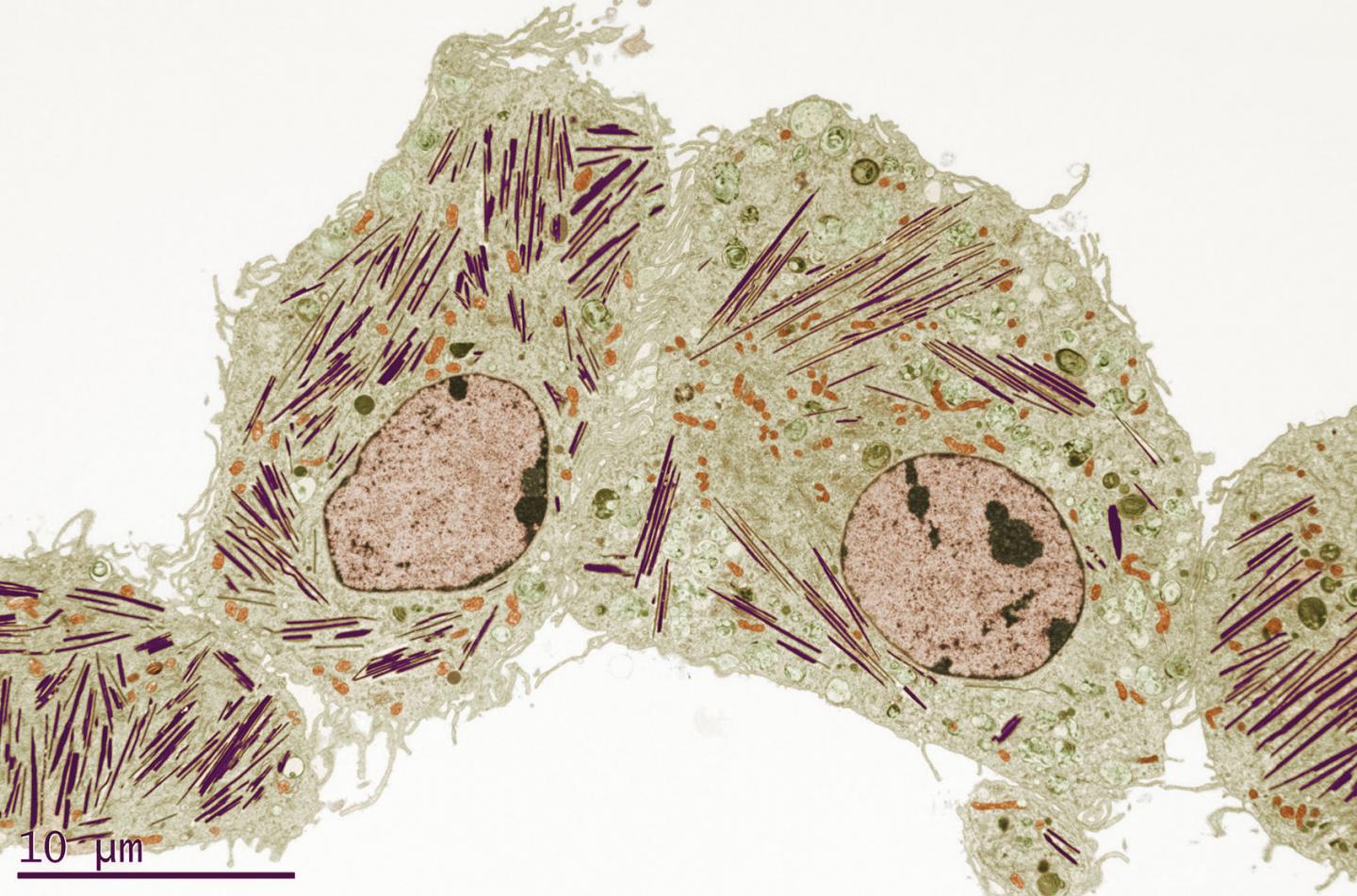
Credit: Courtesy of EBioMedicine
Experiments designed to reveal how a protein protects the lungs from asthma-related damage suggest a new way to treat a rare disease marked by the inability of cells to break down fats, according to a report in EBioMedicine published online Oct. 25.
The study results address Gaucher's disease, which is caused by a genetic glitch in cell structures called lysosomes that process fats and remove cellular waste. Found mostly in Jews of Eastern and Central European origin, the condition may come with joint pain, blood disorders, enlarged spleens and livers, memory loss, and lung damage.
At a cellular level, Gaucher's disease is associated with abnormally low production of the protein progranulin, as well as with the misplaced buildup of the enzyme beta-glucocerebrosidase, or GBA, outside lysosomes, instead of inside where it is needed.
Led by researchers from NYU Langone Medical Center, the new study found that a manufactured version of progranulin reversed most effects of Gaucher's disease in mouse and human cell studies, including GBA accumulation.
"Our results suggest a new way to treat Gaucher's disease that corrects abnormal enzyme delivery by progranulin to lysosomes, as opposed to current treatment strategies that temporarily replenish lysosomal GBA stores, which are then steadily consumed," says senior study investigator Chuanju Liu, PhD, a professor in the Departments of Orthopaedic Surgery and Cell Biology at NYU Langone. The research team and NYU Langone hold a patent on related, potential therapies.
Among the study's other key findings was that progranulin must bind to other molecules to transport the enzyme to lysosomes, specifically the protective "heat shock" protein 70. If unshielded, cellular GBA molecules fold up and stick together outside lysosomes.
Researchers also found that adding synthetic progranulin, or Pcgin, to blood cells obtained from patients with Gaucher's, led to a 40 percent reduction in GBA clumping within a week. Pcgin was used because it is chemically more stable than progranulin and poses no risk of uncontrolled tumor-like cell growth in test animals, say the authors.
"Our new experiments are the first to explain why reduced progranulin is a key characteristic of Gaucher's, and why the mice engineered to lack the protein serve as such a good model to test new therapies," says lead study investigator Jian Jinlong, MD, PhD, an associate research scientist at NYU Langone.
Along with their role in brain disorders, progranulin shortages had been tied by previous research to cell swelling in asthmatic lungs. In the current set of experiments in progranulin-deficient mice, adding Pcgin reduced lung-tissue swelling by as much as 60 percent, an effect seen with current GBA-replacement treatments.
According to Liu, further research is needed to determine the precise mechanism by which progranulin reduces cell swelling, a process that would likely yield even more drug targets for Gaucher's disease.
Experts estimate that as many as one in 50,000 Americans has some form of Gaucher's, while one in 500 Jews of Ashkenazi descent has the disease.
###
Funding support for the study was provided by National Institute of Health grants R01 AR062207, and R01 AR 061484, and a grant from Atreaon Inc. of Newton, Mass., with which NYU Langone has a drug-licensing agreement.
Besides Liu and Jian, other NYU Langone researchers involved in these experiments are Qing-Yun Tian, MD; Aubryanna Hettinghouse, BS; Shuai Zhao, MS; Helen Liu; Jianlu Wei, MD, PhD; and Gabriele Grunig. Additional research support was provided by Ying Sun, MD, PhD, at Cincinnati Children's Hospital Medical Center in Ohio; Herman Overkleeft, PhD, at Leiden University in Germany; and Gerald Chan, PhD, at Harvard University in Boston.
Media Inquiries:
David March
212-404-3528
[email protected]
Media Contact
David March
[email protected]
212-404-3528
@NYULMC
http://nyulangone.org/