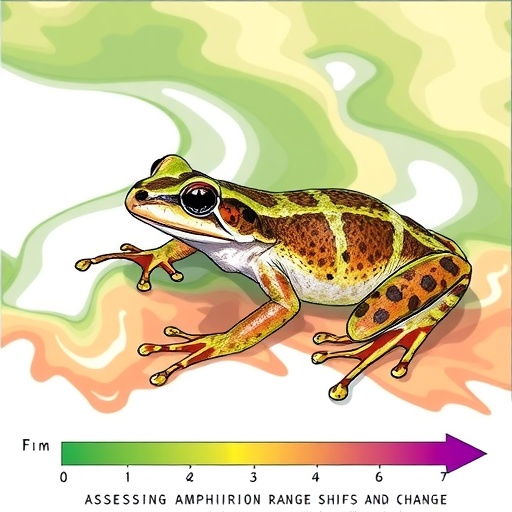
In the realm of biodiversity, few studies hold as much significance as those examining the impacts of climate change on species distribution. The essential research conducted by a dedicated team led by Sun et al. shines a light on the amphibian populations residing in Mount Emei, China. As environmental conditions shift, understanding the dynamics of these shifts becomes paramount for conservation efforts, ecosystem management, and the maintenance of biodiversity.
Amphibians are particularly vulnerable to climate change due to their permeable skin and dual life stages. The gradual increase in temperature and alterations in precipitation not only affect their habitat but fundamentally challenge their survival. This research meticulously integrates climate change models with fine-scale habitat suitability assessments. By applying robust methodologies, the authors provide insights into how various species of amphibians may respond to imminent environmental changes.
The study is particularly timely, as the global discourse surrounding climate change intensifies. Amphibian populations worldwide have been declining at alarming rates, rendering them key indicators for ecosystem health. Mount Emei serves as a critical case study, given its unique microclimatic conditions and rich biodiversity. The researchers used predictive models to ascertain potential shifts in amphibian habitats, taking into account variables such as temperature, humidity, and vegetation cover.
In their analyses, the authors employed advanced bioclimatic envelope models. These models utilize historical climate data alongside projected future scenarios, allowing for a comprehensive understanding of habitat shifts. The implications are profound: as temperatures rise, certain species may find their current habitats increasingly unsuitable, prompting migrations to cooler, more hospitable regions. The fine-scale approach taken by the researchers allows for localized forecasts, essential for effective conservation strategies.
The nuanced findings reveal that species-specific responses to climate fluctuations can vary greatly. Some amphibians may exhibit resilience, adapting their behaviors and ranges, while others could face severe declines. The research outcomes underscore the urgency for targeted conservation initiatives, highlighting the necessity for adaptive management practices that consider both current and future climate scenarios.
Moreover, this study sheds light on the potential for synergistic effects between climate change and habitat fragmentation. As human activity encroaches upon natural landscapes, amphibians are faced with not only shifting climates but also disrupted pathways to suitable habitats. The interplay between these factors poses significant challenges in preserving vulnerable populations.
One of the most significant takeaways from this research is the emphasis on collaborative efforts between scientists, policymakers, and local communities. Conservation planning must be informed by scientific data, with strategies developed in concert with those who inhabit these regions. Recognizing the interconnectedness of human activities and biodiversity is vital for devising sustainable solutions.
The ecological integrity of Mount Emei extends beyond amphibians, as the health of these species often reflects broader environmental conditions. By protecting amphibian habitats, stakeholders may inadvertently safeguard entire ecosystems, fostering resilience in the face of climate change. The multifaceted approach employed by Sun et al. exemplifies how integrative research can spur innovative conservation practices.
As global temperatures continue to rise, the urgency for immediate action becomes ever more critical. This research serves as a clarion call for increased awareness and proactive measures to mitigate the impacts of climate change on all forms of wildlife. The amphibians of Mount Emei are a testament to the delicate balance of nature, where even slight alterations can lead to cascading effects.
In conclusion, the study by Sun, Zhao, and Hu provides invaluable insights into the challenges faced by amphibians amidst climate change. It emphasizes the need for continued research and adaptive management strategies while reinforcing the importance of interdisciplinary collaboration. The findings not only contribute to our understanding of amphibian ecology but also serve as a beacon of hope for future conservation efforts. Protecting these remarkable creatures is as much about preserving our planet’s biodiversity as it is about ensuring that future generations can experience the wonders of nature firsthand.
The narrative entwined in the study reflects broader ecological themes, embodying the essentiality of understanding species responses to environmental shifts. As we advance into an uncertain future, the lessons drawn from Mount Emei will resonate across various landscapes, guiding efforts to nurture the connections between climate, habitats, and the survival of our planet’s amphibian populations.
While amphibians stand at the forefront of climate change studies, their fate is inextricably linked to human choices and behaviors. This research not only highlights the fragility of their existence but also serves as a reminder of the collective responsibility we bear to protect the natural world.
As the scientific community continues to unravel the complex relationships between species, ecosystems, and climate variables, studies like this illuminate pathways toward sustainable futures. The insights provided serve as a foundation upon which to build comprehensive action plans that champion biodiversity in the face of climate adversity.
By embedding findings such as these into broader conservation discussions, society can foster a culture of stewardship, ensuring that the plight of amphibians remains in the collective consciousness. The survival of these extraordinary creatures depends on our commitment to understand, protect, and adapt to the ever-changing landscape of climate challenges.
We owe it to ourselves and to future generations to heed the warnings posed by studies like Sun et al.’s. Mobilizing resources and support can empower on-the-ground efforts that not only assist amphibians but also bolster the resilience of ecosystems worldwide. After all, the echoes of triggered extinction events will resound long after the last of these remarkable species has vanished from our planet.
Subject of Research: Impact of climate change on amphibian range shifts in Mount Emei, China
Article Title: Integrating climate change and fine-scale habitat suitability to assess amphibian range shift in Mount Emei, China
Article References:
Sun, Z., Zhao, T., Hu, S. et al. Integrating climate change and fine-scale habitat suitability to assess amphibian range shift in Mount Emei, China. Front Zool 22, 16 (2025). https://doi.org/10.1186/s12983-025-00570-6
Image Credits: AI Generated
DOI: https://doi.org/10.1186/s12983-025-00570-6
Keywords: amphibians, climate change, habitat suitability, conservation, Mount Emei
Tags: amphibian population dynamicsamphibian vulnerability to environmental changesclimate change impacts on biodiversityclimate change modeling in biodiversity studiesconservation strategies for amphibiansecosystem health indicatorshabitat suitability assessments for amphibiansmicroclimatic conditions and biodiversityMount Emei amphibian speciespredictive modeling in conservation researchspecies distribution shifts due to climate changetemperature and precipitation effects on amphibians