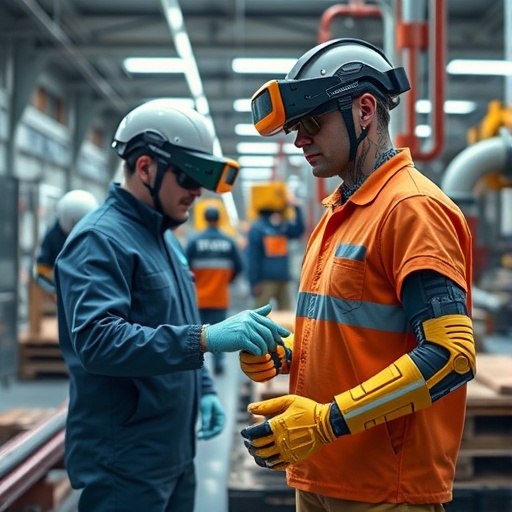
Manufacturing assembly is entering an era in which the most valuable co-worker on the factory floor may not be human. A new system called AssemblyMate is being presented as an interactive artificial intelligence and extended-reality assistant designed to understand not only what workers are doing, but also where objects are located, how they are moving and what has happened moments earlier. Described by Wang, Dengxiong, Pan and colleagues in npj Advanced Manufacturing, the platform brings together multimodal sensing, spatial reasoning and temporal interpretation to support complex assembly tasks.
The concept addresses a persistent challenge in modern production. Assembly instructions are often delivered through static manuals, screens or fixed software interfaces, even though real-world work unfolds in three dimensions and changes from one moment to the next. A component may be rotated, temporarily hidden, moved to a different workstation or placed beside a visually similar part. A useful digital assistant must therefore interpret the physical context rather than simply retrieve a predefined instruction. AssemblyMate is designed around that principle, acting as an AI-XR “co-worker” capable of interacting with workers and the surrounding workspace.
The “XR” in AssemblyMate refers to extended reality, a family of technologies that includes augmented, virtual and mixed reality. In an assembly environment, XR can place digital guidance directly into the worker’s field of view, aligning virtual information with physical tools, parts and fixtures. Instead of asking an operator to look away from the workbench at a distant monitor, an XR interface can indicate the next component, highlight a fastening location or display a warning near the relevant object. The effectiveness of such a system depends on accurate spatial registration: digital instructions must remain synchronized with the changing geometry of the real scene.
AssemblyMate’s central technical distinction is its use of multimodal spatial-temporal reasoning. “Multimodal” means that the system can combine different forms of information, potentially including visual observations, language, hand movements, object positions and task states. Spatial reasoning allows the AI to determine relationships such as whether one part is inside another, whether a tool is near a fastener or whether a component has been placed in the wrong orientation. Temporal reasoning adds the dimension of sequence, enabling the system to interpret what happened before and infer what is likely happening now.
That combination is crucial because assembly is not a collection of isolated snapshots. A worker’s current action only makes sense in relation to earlier steps. Picking up a tool may indicate preparation for fastening; removing a cover may expose a previously invisible connection; moving a component away from the workstation may signal that a subassembly has been completed. An AI that recognizes objects but ignores these transitions could provide irrelevant or mistimed advice. By modeling both space and time, AssemblyMate aims to follow the evolving state of an assembly process instead of treating every frame as an unrelated event.
The system is also described as context-aware, a term that goes beyond simple object detection. Recognizing a screwdriver is one task; understanding that the screwdriver is being used on a particular fastener in the current assembly sequence is another. Context awareness can connect the identity of an object with its role, location, orientation and relationship to nearby components. It can also help distinguish between an intentional pause and an error, or between a temporary movement and a completed operation. Such interpretation is essential for assistance that feels responsive rather than intrusive.
An interactive AI co-worker must also communicate in a form that supports human decision-making. In manufacturing, guidance cannot merely be technically correct; it must arrive at the right moment and be understandable under physical and cognitive pressure. An XR system can deliver visual overlays, while a language-based interface may allow workers to ask questions or request clarification. The underlying AI can then connect the worker’s request with the current spatial and temporal state of the task. This creates the possibility of two-way collaboration in which the human remains in control while the system supplies situational information and procedural support.
The significance of AssemblyMate extends beyond convenience. Manufacturing environments face increasing pressure to produce customized goods, adapt rapidly to new product designs and train workers for tasks that may change frequently. Conventional automation performs well when conditions are tightly controlled, but flexible assembly often requires human dexterity and judgment. An intelligent XR assistant could help bridge that gap by making digital production knowledge available directly within the physical workflow. It could also support less experienced operators without requiring every variation of a task to be encoded into rigid automation rules.
The research arrives as artificial intelligence is moving from screens into embodied environments. Large language models have demonstrated impressive abilities in text, while computer vision systems can identify objects and actions. The harder problem is combining those capabilities with the geometry, timing and uncertainty of the physical world. AssemblyMate represents an effort to solve that problem in a setting where mistakes can affect product quality, worker efficiency and safety. Its broader message is that the next generation of industrial AI will need to understand events as they unfold, not merely label what appears in an image.
By positioning the system as an interactive context-aware co-worker, the researchers point toward a more collaborative model of factory automation. The goal is not simply to replace a manual instruction sheet with a digital one, but to create an intelligent layer that observes, reasons and responds within the workspace. If systems such as AssemblyMate can reliably connect multimodal perception with spatial-temporal understanding, they could transform how workers learn, perform and troubleshoot assembly operations. The factory of the future may therefore be defined not only by robotic machines, but also by invisible streams of AI reasoning that make every tool, component and movement part of a shared digital understanding.
Subject of Research: Interactive AI-XR assistance for manufacturing assembly using multimodal spatial-temporal reasoning
Article Title: AssemblyMate: an interactive context-aware AI-XR co-worker with multimodal spatial-temporal reasoning for manufacturing assembly
Article References: Wang, X., Dengxiong, X., Pan, JK. et al. AssemblyMate: an interactive context-aware AI-XR co-worker with multimodal spatial-temporal reasoning for manufacturing assembly. npj Adv. Manuf. (2026). https://doi.org/10.1038/s44334-026-00108-6
Image Credits: AI Generated
DOI: 10.1038/s44334-026-00108-6
Keywords: Artificial intelligence, extended reality, manufacturing assembly, multimodal reasoning, spatial-temporal reasoning, context-aware AI, human-AI collaboration, industrial automation
Tags: AI-powered manufacturing assembly assistantAI-XR co-worker for complex manufacturing taskscontext-aware spatial-temporal reasoning in assemblydynamic interpretation of physical workspaceextended reality in industrial applicationsintegration of multimodal sensors in manufacturingintelligent manufacturing instruction deliveryinteractive AI assistants in factory settingsmultimodal sensing for factory automationreal-time assembly guidance with augmented realityspatial understanding in industrial environmentstemporal reasoning in assembly processes