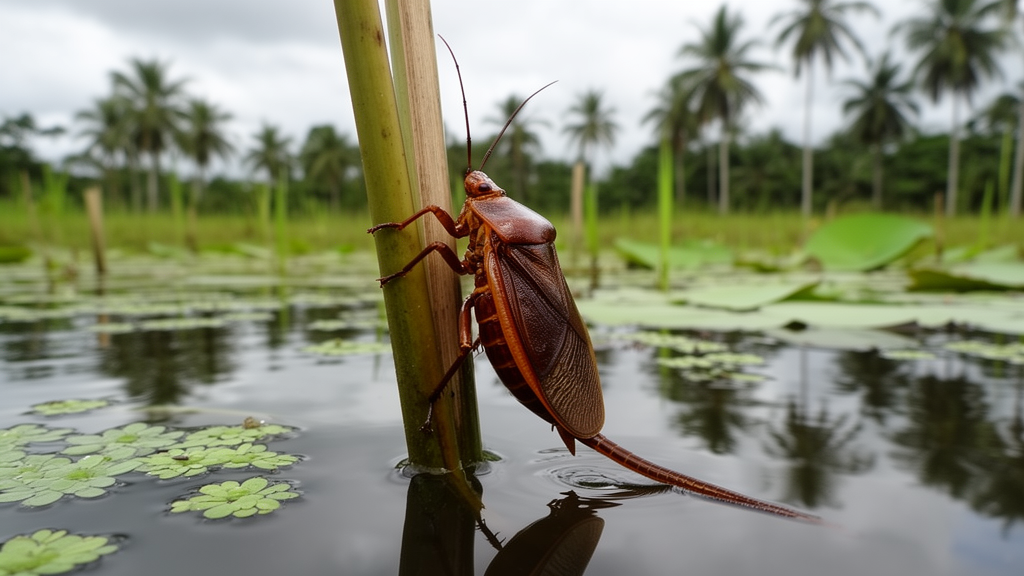
Researchers have documented the first occurrence of the Asian water bug Synaptonecta issa in South America, marking a significant expansion of the species’ range beyond its native Asian territories. The discovery, published in the Biodiversity Data Journal, identifies a population established in the Pacific Region of Colombia, specifically within the Municipality of Buenaventura in the Valle del Cauca Department. This finding adds a new chapter to the global story of biological invasions, as the species was previously known only from parts of Asia, the Caribbean, New Zealand, and the United States. The presence of this non-native insect in a permanent freshwater lagoon raises important questions about the pathways of introduction and the potential ecological impacts on local aquatic communities.
The study, led by a team including J.D. Sanchez-Muelas and colleagues, involved the collection of specimens from a wetland near the road to the Dagua River. The site, located at an elevation of 27 meters, was characterized by dense vegetation of the aquatic plant Cabomba cf. haynessi and high organic matter content. Using D-shaped aquatic nets, the researchers actively sampled the water column and vegetation, preserving the captured insects in 96% ethanol for detailed laboratory analysis. The specimens were subsequently identified using a combination of morphological keys and microscopic examination of genitalia, a standard practice in hemipteran taxonomy that allows for precise species-level identification even when external features are subtle.
Synaptonecta issa belongs to the family Micronectidae, a group of water bugs that are unique among aquatic heteropterans for not being strictly predatory. While many water bugs rely on hunting other aquatic organisms, members of the superfamily Corixoidea can also feed on small organic particles, a dietary flexibility that may contribute to their success in diverse environments. The family Micronectidae is divided into two subfamilies: the worldwide distributed Micronectinae and the Neotropical endemic Synaptogobiinae. Prior to this record, only three genera were recognized in the Neotropics: Monogobia, Synaptogobia, and Tenagobia. The arrival of Synaptonecta, a genus native to Asia, represents the first incursion of a non-native micronectid into this region, altering the taxonomic composition of local water bug assemblages.
The identification of S. issa was confirmed by examining specific morphological traits, including the shape of the male parameres, which are asymmetrical and depressed dorsoventrally. The right paramere is notably elongated and digitiform, approximately 1.5 times longer than the left, with distinct stridulatory lines on the basal third. These diagnostic features distinguish S. issa from other species in the genus and from native Neotropical taxa. The researchers also collected specimens of the native species Tenagobia signata at the same site, providing the first record of this species in Colombia. The co-occurrence of the invasive and native species in the same habitat highlights the immediate interaction between the introduced bug and the local ecosystem, although the specific nature of these interactions remains to be fully understood.
The pathway of introduction for S. issa into Colombia is not yet definitively established, but several plausible routes have been proposed. Previous studies have suggested that water bugs like S. issa may hitchhike on aquatic plants, which are commonly exported for ornamental purposes. The species is native to Southeast Asia, a region that is a major source of commercial aquatic plants. In the United States, the introduction of S. issa to Florida was linked to the trade of such plants. In Colombia, the proximity of the collection site to the port of Buenaventura, the country’s main maritime gateway, and to primary highways used for transporting imports, suggests that international trade may have played a role. The port has been identified in previous studies as a potential entry point for alien species, particularly in marine and coastal areas, although S. issa is a freshwater species.
The establishment of a population in the lagoon is supported by the collection of brachypterous, or flightless, specimens during two separate sampling events, one in 2023 and another in 2024. The presence of flightless individuals indicates that the bugs are not merely transient visitors but are likely reproducing and maintaining a local population. This is consistent with patterns observed in other regions, such as Florida, where S. issa initially appeared in a limited area before spreading to a wider range. The ability of the species to adapt to local conditions and utilize available resources, such as the Cabomba vegetation, suggests a degree of ecological plasticity that could facilitate further spread throughout the Chocó biogeographic region and potentially the broader Neotropics.
The ecological impact of S. issa on the Colombian aquatic ecosystem is currently unknown and requires further investigation. As a non-predatory water bug, it may compete with native species for food resources, particularly small organic particles and microalgae. The interaction with the native Tenagobia signata, which shares the same habitat, could involve competition for oviposition sites on aquatic plants or for space within the vegetation. Understanding these dynamics is crucial for assessing the risk of the invasive species disrupting local food webs or altering the structure of aquatic plant communities. Future studies should focus on monitoring the population dynamics of S. issa and its effects on native biodiversity in the region.
The discovery of S. issa in Colombia underscores the importance of monitoring for invasive species in freshwater habitats, particularly in areas with high levels of international trade and transport activity. The case of S. issa joins a growing list of water bugs that have successfully invaded new regions, including Trichocorixa verticalis in Europe and Africa, and Micronecta ludibunda in North America. These invasions highlight the vulnerability of aquatic ecosystems to biological introductions, which can occur through various vectors, including the trade of ornamental plants and the movement of water and equipment. The findings from this study provide a baseline for future research and emphasize the need for continued surveillance and rapid response to new introductions.
As the global movement of goods and organisms continues to increase, the risk of biological invasions in freshwater systems remains a significant concern for conservation biologists and ecosystem managers. The record of Synaptonecta issa in South America serves as a reminder that even small, often overlooked insects can have far-reaching ecological consequences. Further research, including molecular phylogeographic analyses, is needed to trace the exact route of introduction and to understand the genetic diversity of the established population. By studying this new introduction, scientists can gain insights into the mechanisms of invasion and develop strategies to mitigate the impacts of future biological invasions in the Neotropics and beyond.
Subject of Research: First record of the invasive Asian water bug Synaptonecta issa in South America
Article Title: A new introduced species in South America: the Asian water bug Synaptonecta issa (Distant, 1910) ( Heteroptera , Micronectidae )
Article References: Sanchez-Muelas, J., González Obando, R., Salazar-Rivera, K., Barbosa, J., & Moreira, F. (2026). A new introduced species in South America: the Asian water bug Synaptonecta issa (Distant, 1910) (Heteroptera, Micronectidae). Biodiversity Data Journal, 14, Article e186680. https://doi.org/10.3897/bdj.14.e186680
Image Credits: AI Generated
Keywords: invasive species, water bugs, Micronectidae, South America, Colombia, biological invasion, aquatic ecosystems, Heteroptera, Buenaventura, freshwater biodiversity, introduced, species
News Source: Gavin Prescott. (October 18, 2026). Asian Water Bug Establishes Population in Colombian Wetlands. Scienmag.