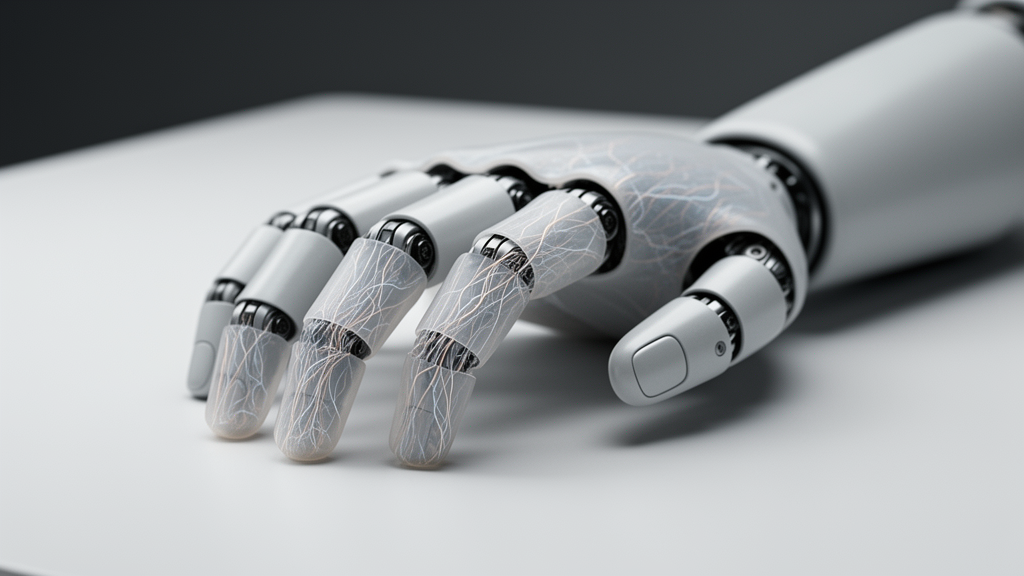
Human skin is arguably the most sophisticated touch sensor ever built. Spread across the body are more than 200,000 mechanoreceptors that continuously gather and encode pressure, vibration and deformation, allowing us to feel the texture of a page, detect a crawling insect and recoil from a hot surface almost instantaneously. Replicating that level of perception in machines has long been a central ambition of robotics, yet most existing electronic skins remain rudimentary: they contain relatively few sensing elements, sparse coverage and a readout scheme that buckles as the number of sensors grows.
A team led by Chuan Fei Guo of Southern University of Science and Technology in Shenzhen, together with collaborators at the Beijing Institute of Technology, the Mohamed bin Zayed University of Artificial Intelligence and elsewhere, now reports a major step forward. Writing in Nature Machine Intelligence, the researchers describe a large-scale iontronic skin, or NI-skin, that packs more than 10,000 sensing units at a density of 1,110 units per square centimetre, and organises them according to the layered processing architecture of the human somatosensory system. The design allows tactile information to flow in parallel rather than through a congested serial channel, an approach the authors say is key to scaling skin-like sensing to humanoid proportions.
The core problem with conventional sensor arrays is one of plumbing. In a typical serial readout architecture, each sensing element is polled in turn, so as element density rises, the total time to sweep the array grows, readout latency accumulates, signals from neighbouring elements bleed into one another as crosstalk, and the bandwidth needed to carry the data balloons. A humanoid robot covered from fingertip to torso with thousands of tactile sensors would, under such a scheme, drown in its own sensory data before it could react to a slipping object or an incoming impact.
The NI-skin sidesteps this bottleneck by borrowing a principle from both biology and communications engineering: frequency-based position encoding. Each iontronic sensor is assigned a characteristic frequency, so the identity of a sensing element is carried in the spectral signature of its signal rather than in its position within a scanning sequence. All sensors can therefore transmit simultaneously through a shared channel, in much the same way that frequency-division multiplexing allows many conversations to travel down a single telephone line. The result is parallel signal transmission with strongly suppressed crosstalk and a full-frame sensing rate of 100 frames per second, fast enough to capture the fleeting dynamics of contact during manipulation.
Iontronics itself is central to the performance. Instead of relying on conventional electronic conductors, iontronic sensors use the motion of ions within soft polymer materials to transduce pressure into electrical signals, a mechanism closely analogous to the mechanotransduction that occurs in biological sensory neurons. This gives the skin the soft, compliant character needed for safe contact with humans and delicate objects, while providing the high sensitivity required to resolve fine surface detail. Earlier work by the same group on creep-free polyelectrolyte elastomers and embedment-based sensor architectures laid the groundwork for drift-free, crosstalk-free sensing at scale.
Raw parallel transmission alone, however, would still flood a robot’s onboard computer with data. The second pillar of the architecture is what the researchers call hierarchical processing, a three-stage pipeline that mirrors the way the nervous system organises touch: signal encoding, convergence and cognitive modelling. At the lowest level, the iontronic sensors encode contact events into frequency-coded signals. At the next level, a convergent readout layer compresses the massive parallel stream, decreasing bandwidth consumption by hundreds of times before the data ever reach the robot’s central processor. Only the distilled, high-information content proceeds to the cognitive stage, where machine learning models interpret the tactile scene and drive decisions.
This division of labour is strikingly similar to the peripheral nervous system, where vast populations of sensory neurons converge onto far smaller numbers of afferent fibres, and the spinal cord performs reflexive processing before the brain becomes involved. By offloading encoding and compression to the skin itself, the NI-skin frees computational resources for higher-level tasks such as grasping strategy and environment modelling, much as human cognition is freed from having to consciously process every one of the hundreds of thousands of mechanoreceptor signals arriving each instant.
The practical capabilities the team demonstrates are considerable. A robotic body and grippers fitted with the skin could resolve surface features as fine as 300 micrometres through fine tactile interaction, mapping the relief of textures and contours at a resolution approaching that of human fingertip perception. Supplementary demonstrations show the skin capturing the tactile signatures of coins and fabrics, perceiving contact contours on a robotic palm, and enabling stable grasping of objects that would defeat most robotic hands: a 0.5-millimetre pencil lead and a delicate 0.2-millimetre soft solder wire, both of which demand exquisite feedback on the forces being applied.
Perhaps most compelling is the skin’s ability to sense harm. Drawing on the biology of nociception, the neural circuitry that detects damaging stimuli and triggers protective reflexes, the NI-skin registers noxious contact and initiates self-protective responses without waiting for the robot’s slow deliberative loop. In demonstrations, robots equipped with the skin withdrew from sharp stimuli, safely grasped a spiny chestnut and performed large-area tactile perception with self-protection across an embodied robot platform. This kind of reflex-like reaction is essential if humanoid machines are to operate safely around people and around themselves, protecting their own expensive surfaces and actuators from damage.
The authors and their collaborators have released the tactile interaction datasets, sensor visualisation code, model training scripts and interactive control software publicly through a GitHub repository, an openness that could accelerate adoption across the robotics community. They argue that the combination of high sensor density, large scale, high spatiotemporal resolution and bandwidth-efficient processing provides a tactile foundation approaching human-level perception. If humanoid robots are ever to fold laundry, handle tools or work alongside people without constant supervision, they will need skins that can feel with the fidelity and speed of the NI-skin, and think about what they feel in layers, just as we do.
Subject of Research: A high-density, large-scale iontronic skin with neural-hierarchical signal processing for humanoid robot tactile perception and self-protection
Article Title: Large-scale iontronic skins with neural-hierarchical processing architecture
Article References: Li, Z., Da, B., Shi, J., Wang, T., Si, W., Li, B., He, H., Liao, Z., Wu, T., Han, X., Bai, L., Kong, H., Song, C., & Guo, C. F. (2026). Large-scale iontronic skins with neural-hierarchical processing architecture. Nature Machine Intelligence. https://doi.org/10.1038/s42256-026-01325-6
Image Credits: AI Generated
DOI: 10.1038/s42256-026-01325-6
Keywords: iontronic skin, electronic skin, tactile sensing, humanoid robots, neuromorphic processing, frequency encoding, mechanoreceptors, nociception, robotics, sensors, data compression, haptic perception
News Source: Cassandra Pierce. (October 16, 2026). Artificial skin with brain-like wiring gives humanoid robots a human sense of touch. Scienmag.