• HOME
  • NEWS
  • EXPLORE
    • CAREER
      • Companies
      • Jobs
    • EVENTS
    • iGEM
      • News
      • Team
    • PHOTOS
    • VIDEO
    • WIKI
  • BLOG
  • COMMUNITY
    • FACEBOOK
    • INSTAGRAM
    • TWITTER
Sunday, August 16, 2026
BIOENGINEER.ORG
No Result
View All Result
  • Login
  • HOME
  • NEWS
  • EXPLORE
    • CAREER
      • Companies
      • Jobs
        • Lecturer
        • PhD Studentship
        • Postdoc
        • Research Assistant
    • EVENTS
    • iGEM
      • News
      • Team
    • PHOTOS
    • VIDEO
    • WIKI
  • BLOG
  • COMMUNITY
    • FACEBOOK
    • INSTAGRAM
    • TWITTER
  • HOME
  • NEWS
  • EXPLORE
    • CAREER
      • Companies
      • Jobs
        • Lecturer
        • PhD Studentship
        • Postdoc
        • Research Assistant
    • EVENTS
    • iGEM
      • News
      • Team
    • PHOTOS
    • VIDEO
    • WIKI
  • BLOG
  • COMMUNITY
    • FACEBOOK
    • INSTAGRAM
    • TWITTER
No Result
View All Result
Bioengineer.org
No Result
View All Result
Home NEWS Science News

Artificial Intelligence to identify individual birds of a same species

Bioengineer by Bioengineer
July 27, 2020
in Science News
Reading Time: 2 mins read
0
IMAGE
Share on FacebookShare on TwitterShare on LinkedinShare on RedditShare on Telegram

IMAGE

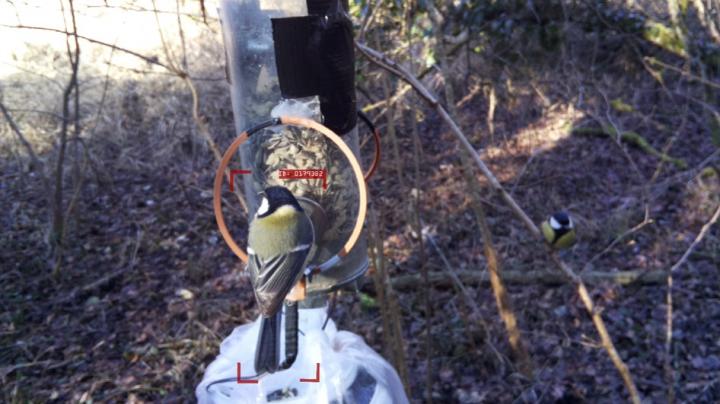
Credit: André Ferreira

Humans have a hard time identifying individual birds just by looking at the patterns on their plumage. An international study involving scientists form the CNRS, Université de Montpellier* and the University of Porto in Portugal, among others, has shown how computers can learn to differentiate individual birds of a same species. The results are published on 27 July 2020 in Methods in Ecology and Evolution.

Differentiating between individuals of a same species is essential in the study of wild animals, their processes of adaptation and behaviour. Scientists from the CEFE research centre in Ecology and Evolutionary Ecology (CNRS/ Université de Montpellier/ Université Paul-Valéry-Montpellier/ IRD/ EPHE) and the Research Centre in Biodiversity and Genetic Resources (CIBIO) at Porto University** have for the very first time identified individual birds with the help of artificial intelligence technology.

They have developed a technique that enables them to gather a large number of photographs, taken from various angles, of individual birds wearing electronic tags. These images were fed into computers which used deep learning technology to recognise the birds by analysing the photographs. The computers were able to distinguish individual birds according to the patterns on their plumage, something humans can’t do. The technology was able to identify specimens from populations of three different species: sociable weavers, great tits and zebra finches.

This new technique could not only result in a less invasive method of identification but also lead to new insights in ecology, for example, by opening ways of using AI to study animal behaviour in the wild.

###

Notes

* From the Centre d’écologie fonctionnelle et évolutive (CNRS/Université de Montpellier/ Université Paul-Valéry-Montpellier/IRD/EPHE)

** Completed in collaboration with three other laboratories: the Paris-Saclay Institute of Neuroscience (CNRS/Université Paris-Saclay), and the Max Planck and the FitzPatrick Institutes in South Africa.

Media Contact
Clara Barrau
[email protected]

Original Source

http://www.cnrs.fr/en/artificial-intelligence-identify-individual-birds-same-species

Related Journal Article

http://dx.doi.org/10.1111/2041-210X.13436

Tags: BiologyEcology/EnvironmentRobotry/Artificial Intelligence
Share12Tweet8Share2ShareShareShare2

Related Posts

KAIST develops semiconductor neuron that harnesses noise to selectively process signals

KAIST develops semiconductor neuron that harnesses noise to selectively process signals

August 16, 2026
Imagining natural and extra robotic thumbs together strengthens kinesthetic sensorimotor networks

Imagining natural and extra robotic thumbs together strengthens kinesthetic sensorimotor networks

August 16, 2026

PARP1 Drives Neuropathic Pain Through GPX4-Dependent Ferroptosis in Injured Mice’s Sensory Neurons

August 15, 2026

Strubbelig–NHL3 Receptor Complex Helps Arabidopsis Respond to Cellulose Deficiency

August 15, 2026
Please login to join discussion

POPULAR NEWS

  • KAIST develops semiconductor neuron that harnesses noise to selectively process signals

    29 shares
    Share 12 Tweet 7
  • Imagining natural and extra robotic thumbs together strengthens kinesthetic sensorimotor networks

    29 shares
    Share 12 Tweet 7
  • PARP1 Drives Neuropathic Pain Through GPX4-Dependent Ferroptosis in Injured Mice’s Sensory Neurons

    29 shares
    Share 12 Tweet 7
  • Strubbelig–NHL3 Receptor Complex Helps Arabidopsis Respond to Cellulose Deficiency

    29 shares
    Share 12 Tweet 7

About

We bring you the latest biotechnology news from best research centers and universities around the world. Check our website.

Follow us

Recent News

KAIST develops semiconductor neuron that harnesses noise to selectively process signals

Imagining natural and extra robotic thumbs together strengthens kinesthetic sensorimotor networks

PARP1 Drives Neuropathic Pain Through GPX4-Dependent Ferroptosis in Injured Mice’s Sensory Neurons

Subscribe to Blog via Email

Success! An email was just sent to confirm your subscription. Please find the email now and click 'Confirm' to start subscribing.

Join 85 other subscribers
  • Contact Us

Bioengineer.org © Copyright 2023 All Rights Reserved.

Welcome Back!

Login to your account below

Forgotten Password?

Retrieve your password

Please enter your username or email address to reset your password.

Log In
No Result
View All Result
  • Homepages
    • Home Page 1
    • Home Page 2
  • News
  • National
  • Business
  • Health
  • Lifestyle
  • Science

Bioengineer.org © Copyright 2023 All Rights Reserved.