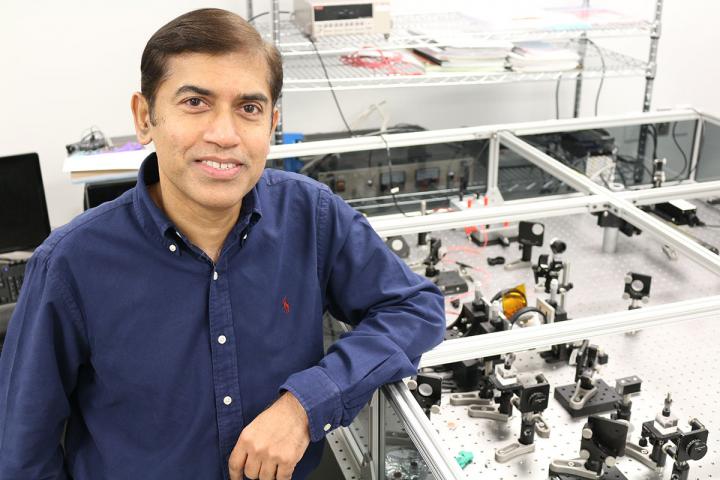
Credit: UCF, Karen Norum
Artificial Intelligence may be just the thing to accelerate spray-on solar cell technology, which could revolutionize how consumers use energy.
A research team at the University of Central Florida used Machine Learning, aka Artificial Intelligence to optimize the materials used to make perovskite solar cells (PSC). The Organic-Inorganic halide perovskites material used in PSC converts photovoltaic power into consumable energy.
These perovskites can be processed in solid or liquid state, offering a lot of flexibility. Imagine being able to spray or paint bridges, houses and skyscrapers with the material, which would then capture light, turn it into energy and feed it into the electrical grid. Until now, the solar cell industry has relied on silicon because of its efficiency. But that’s old technology with limits. Using perovskites, however, has one big barrier. They are difficult to make in a usable and stable material. Scientists spend a lot of time trying to find just the right recipe to make them with all the benefits – flexibility, stability, efficiency and low cost. That’s where artificial intelligence comes in.
The team’s work is so promising that its findings are the cover story Dec. 13 in the Advanced Energy Materials journal.
The team reviewed more than 2,000 peer-reviewed publications about perovskites and collected more than 300 data points then fed into the AI system they created. The system was able to analyze the information and predict which perovskites recipe would work best.
“Our results demonstrate that machine learning tools can be used for crafting perovskite materials and investigating the physics behind developing highly efficient PSCs,” says Jayan Thomas, the study’s lead author and an associate professor at the NanoScience Technology Center with multiple affiliations. “This can be a guide to design new materials as evidenced by our experimental demonstration.”
If this model bears out, it means researchers could identify the best formula to create a world standard. Then spray-on solar cells may happen in our lifetime, the researchers say.
“This is a promising finding because we use data from real experiments to predict and obtain a similar trend from the theoretical calculation, which is new for PSCs. We also predicted the best recipe to make PSC with different bandgap perovskites,” says Thomas and his graduate student, Jinxin Li, who is the first author of this paper. “Perovskites have been a hot research topic for the past 10 years, but we think we really have something here that can move us forward.”
###
Others on the research team include: Basudev Pradhan from the NanoScience Technology Center and Surya Gaur from the College of Engineering and Computer Science. Pradhan is currently a faculty member at Centre of Excellence in Green and Efficient Energy Technology, at the Central University of Jharkhand in India
Thomas joined UCF in 2011 and is a part of the NanoScience Technology Center with a joint appointment in the College of Optics and Photonics and the Department of Materials Science and Engineering in the College of Engineering. His previous work resulted in a variety of innovations, including material that could help keep pilots and sensitive equipment safe from destructive lasers, a way to both transmit and store electricity in a lightweight copper wire, and filaments that harvest and store the sun’s energy and can be woven into textiles.
Previously, Thomas was at the University of Arizona in its College of Optical Sciences. He has several degrees including a doctorate in chemistry/materials science from Cochin University of Science and Technology in India. He’s published dozens of studies and earned several grants and awards including a National Science Foundation CAREER Grant and an R&D 100 award.
Media Contact
Zenaida Gonzalez Kotala
[email protected]
407-823-6120
Related Journal Article
http://dx.