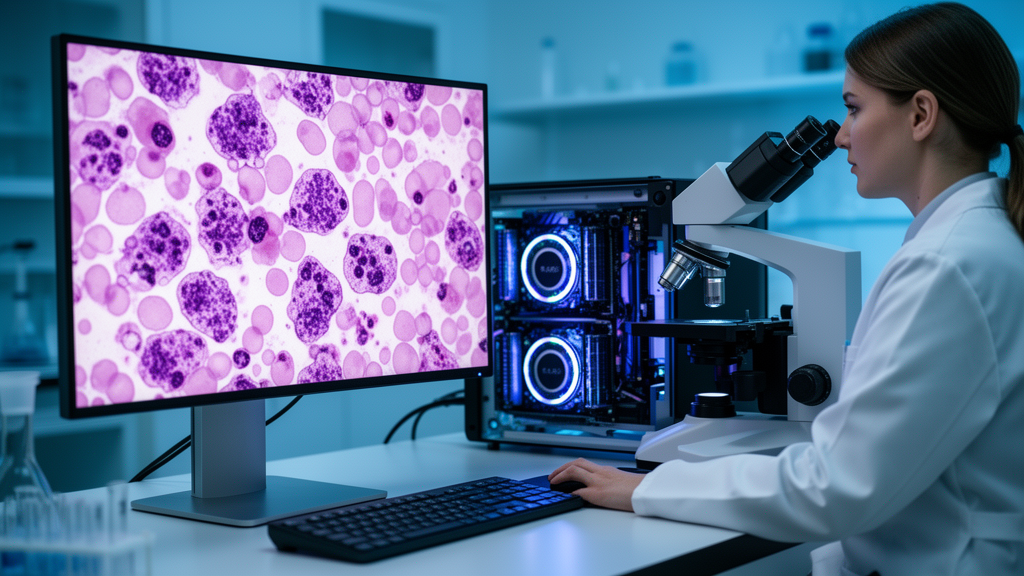
Bone marrow diagnosis has always been a team effort between technologies. A hematopathologist weighs peripheral blood counts, aspirate smear cytology, trephine biopsy histology, flow cytometry, cytogenetics and molecular genetics before signing out a single interpretation. Now a comprehensive review published in Blood Research argues that artificial intelligence must rise to that same integrated standard—and finds that, despite striking progress in individual modalities, genuinely fused multimodal AI for marrow examination remains largely unrealized.
The review, authored by Seung Yeob Lee and published open access on October 16, 2026, examines the field through an explicit three-part framework. Mature single-modality tools form the first category; cross-modal prediction, in which one modality is used to estimate another, forms the second; and genuine multimodal fusion, in which several measured modalities are jointly ingested by a single model, forms the third. The author concludes that evidence is strongest at the single-modality level, cross-modal prediction is expanding rapidly, and true fusion systems that yield unified, guideline-aligned recommendations have yet to materialize in peer-reviewed, prospectively validated form.
The distinction matters because many highly cited “multimodal” systems are, on close inspection, unimodal image models predicting multimodal clinical truth labels. A network that infers an NPM1 mutation from a digitized smear is performing cross-modal inference, not fusion. The review insists that image-only biomarker prediction should not be labeled fusion unless additional modalities are genuinely consumed at inference—a clarification with direct consequences for how claims in the literature should be read and regulated.
Within single modalities, the achievements are real. In digital cytology, deep learning approaches expert performance in aspirate smear analysis. The field’s defining resource is the Matek dataset: 171,374 expert-annotated single-cell images covering 21 cytomorphological classes from 945 patients. Commercial systems follow a pre-classification-plus-verification paradigm, but reported accuracy is uneven. One platform reached 99.0 percent overall accuracy yet only 81.0 percent average sensitivity, with only moderate agreement for the immature and blast-like classes that drive diagnosis. Clinically decisive failures, such as misclassifying blasts as lymphocytes and underestimating blast counts, have been documented even for mature peripheral blood preclassifiers.
Regulatory translation has begun. The Scopio Labs X100 with Full-Field Bone Marrow Aspirate became the first AI-assisted digital BMA device to receive U.S. Food and Drug Administration De Novo authorization, decided on March 22, 2024, establishing a new Class II device category for automated cell-locating devices. In multicenter validation, high overall test–reference agreement was tempered by a fall in blast-count specificity when moving from acute leukemia to MDS and MPN samples. Critically, the clearance mandates that AI remain assistive: the operator must verify results, and confirmation of acute leukemia still requires human synthesis.
In trephine histology, the open-source MarrowQuant workflow segments hematopoietic, adipocytic, bony and interstitial compartments and derives cellularity mathematically, tracking hematopathologists’ estimations closely with an intraclass correlation coefficient of roughly 0.98—though its authors cautioned against use where megakaryocyte hyperplasia is expected, including myeloproliferative neoplasms. A complementary deep-learning tool showed only moderate agreement with expert cellularity assessments, at 0.78, and systematically underestimated cellularity. In flow cytometry, attention-based multiple-instance learning applied to 1,820 samples achieved an AUROC of 0.96 for diagnosis and 0.97 for distinguishing AML from lymphoblastic leukemia, and predicted nine cytogenetic aberrancies from flow data alone, though performance was strong only for select lesions.
Cross-modal prediction, sometimes called virtual molecular profiling or histogenomics, is the fastest-growing category. Deep networks detect sub-visual morphological signatures that correlate with underlying mutations. One study detected AML from smears with an AUROC of 0.97 and predicted NPM1 status from images alone at 0.92. A larger pipeline spanning more than two million single-cell images from 408 AML patients predicted therapy-relevant groups with uneven accuracy: the CBFB::MYH11 fusion was well predicted at a median AUROC near 0.91, while NPM1 status, cytogenetic risk and ELN 2017 favorable risk hovered around 0.64 to 0.70—confirming that morphology carries only a limited genetic signal for most lesions.
Genuine fusion attempts are rare and their findings mixed. In one comparison, image-only and comprehensive models achieved the same internal macro-AUROC of 0.96, though average precision rose numerically from 0.75 to 0.81 with fusion, and only the image-only model was externally validated. Another found significantly higher AUROCs with fusion for some MPN classifications but not consistently across subtypes. The review identified no peer-reviewed, prospectively validated marrow AI system that jointly ingests matched slide data, raw flow cytometry events, cytogenetic or molecular outputs and structured clinical metadata to produce a unified WHO-HAEM5 or ICC-aligned recommendation. Notably, even the Munich Leukemia Laboratory, which routinely issues combined morphology–flow–cytogenetics–molecular reports, has pursued machine learning in a genomics-first manner rather than fusing modalities.
The obstacles are formidable. Models are hypersensitive to pre-analytical variation—smear preparation, staining, scanner optics, image compression—which induces batch effects that can degrade strong internal discrimination to clinically inadequate levels at new institutions. A deployed flow cytometry AML classifier showed lower sensitivity in real-world use than in validation, 69.0 percent versus 77.0 percent. Datasets lack the case-level pairing that integration requires; class imbalance is extreme for decisive rare cells; and guideline-level instability persists, since WHO-HAEM5 specifies no minimum blast threshold for AML with mutated NPM1 while ICC 2022 requires at least 10 percent. Uncertainty quantification and calibrated abstention remain exceptions rather than defaults, though one flow cytometry model raised accuracy from 91.4 to 97.9 percent by abstaining on low-confidence cases.
The review’s roadmap is measured rather than breathless. It calls for paired multi-institutional datasets, explicit fusion architectures that handle missing and asynchronous modalities, calibrated abstention-aware models, and staged prospective validation—beginning with retrospective external validation, proceeding through silent real-time studies that do not affect care, and culminating in live clinical-impact trials against multidisciplinary, case-level reference standards. By June 2025, the FDA had authorized 20 AI-enabled devices in the hematology category, none cleared for standalone autonomous diagnosis of acute leukemia. The author, who notes the review is a non-systematic narrative review by a single author, concludes that integrated multimodal marrow AI has entered a promising but early translational phase—one that should be pursued with disciplined ambition and reported with transparency.
Subject of Research: The current state and challenges of integrated multimodal artificial intelligence in bone marrow examination
Article Title: Toward integrated multimodal artificial intelligence in bone marrow examination: current state and open challenges
Article References: Lee, S. Y. (2026). Toward integrated multimodal artificial intelligence in bone marrow examination: current state and open challenges. Blood Research, 61(1), Article 66. https://doi.org/10.1007/s44313-026-00177-8
Image Credits: AI Generated
DOI: 10.1007/s44313-026-00177-8
Keywords: artificial intelligence, bone marrow examination, multimodal fusion, hematopathology, flow cytometry, digital cytology, FDA authorization, cross-modal prediction, WHO-HAEM5, machine learning, computational pathology, prospective validation
News Source: Ophelia Keating. (October 28, 2026). Artificial intelligence inches toward true multimodal bone marrow diagnosis. Scienmag.