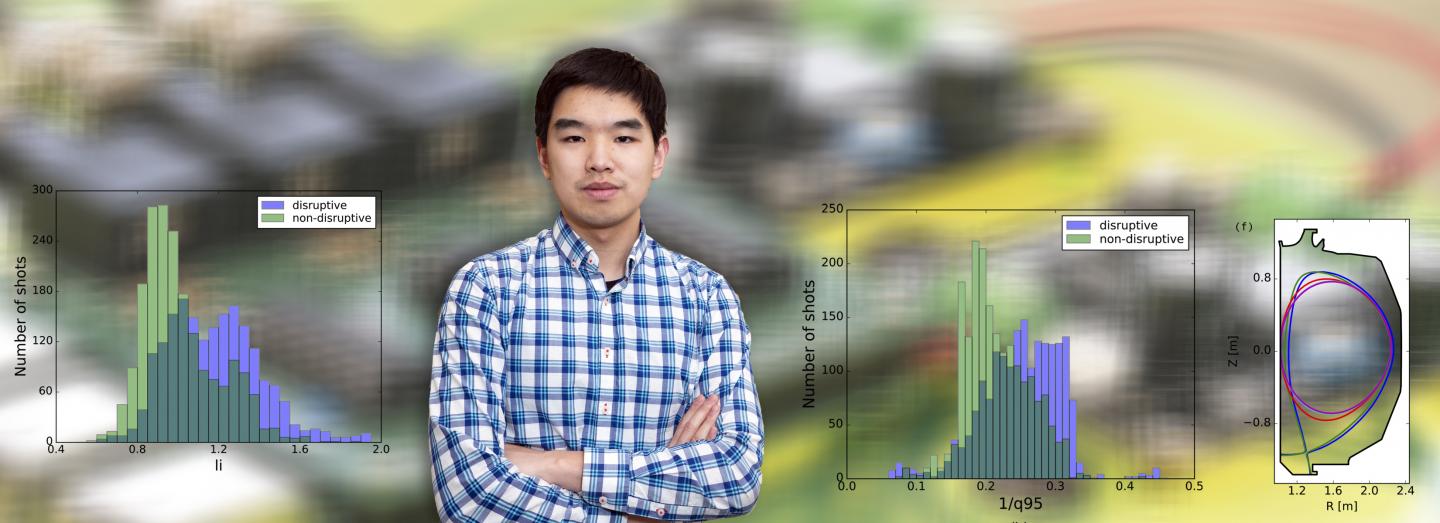
Credit: Photo and collage by Elle Starkman/PPPL Office of Communications.
An international team of scientists led by a graduate student at the U.S. Department of Energy’s (DOE) Princeton Plasma Physics Laboratory (PPPL) has demonstrated the use of Artificial Intelligence (AI), the same computing concept that will empower self-driving cars, to predict and avoid disruptions — the sudden release of energy stored in the plasma that fuels fusion reactions — that can halt the reactions and severely damage fusion facilities.
Risk of disruptions
Fusion devices called tokamaks run increased risk of disruptions as researchers, aiming to maximize fusion power to create on Earth the fusion that powers the sun and stars, bump up against the operational limits of the facilities. Scientists thus must be able to boost fusion power without hitting those limits. This capability will be crucial for ITER, the large international tokamak under construction in France to demonstrate the practicality of fusion energy.
Fusion reactions combine light elements in the form of plasma — the hot, charged state of matter composed of free electrons and atomic nuclei that makes up 99 percent of the visible universe — to generate massive amounts of energy. Scientists around the world are seeking to create fusion for a virtually inexhaustible supply of safe and clean power to generate electricity.
The researchers trained an AI machine learning algorithm, or set of rules, on thousands of previous experiments on the DIII-D National Fusion Facility that General Atomics operates for the DOE. Scientists then applied the rules in real-time to ongoing DIII-D experiments and found the algorithm capable of forecasting the likelihood of disruptions and initiating actions that averted the onset of disruptions.
Relatively simple model
“It’s fascinating to see that a relatively simple machine learning model could accurately predict the complicated behavior of fusion plasma,” said Yichen Fu, a graduate student in the Princeton Program in Plasma Physics at PPPL and lead author of a paper describing the findings (link is external) in Physics of Plasmas and showcased in a featured American Institute of Physics publication called “SciLight.” “It’s great to see students leading multi-institutional teams and making a real impact on the development of machine learning methods for the control of fusion plasmas,” said PPPL physicist Egemen Kolemen, supervisor of Yichen’s work and an assistant professor of Mechanical and Aerospace Engineering at Princeton University.
The results mark another step toward preventing disruptions in ITER and next-generation facilities, said physicist Raffi Nazikian, head of the ITER and Tokamak department at PPPL. “This work represents significant progress in the use of machine learning to develop a disruption prediction and avoidance method in fusion devices,” Nazikian said. “However, a great deal of R&D is still required to improve the accuracy of the predictions and to develop fail-safe control methods to avoid disruptions in ITER and future reactors.”
###
Coauthors of this work include researchers from Princeton University, General Atomics, Eindhoven University of Technology in the Netherlands, and Yale University, together with Kolemen. Support for this research comes from the Euratom research and training program, with support for the use of DIII-D provided by the DOE Office of Science.
PPPL, on Princeton University’s Forrestal Campus in Plainsboro, N.J., is devoted to creating new knowledge about the physics of plasmas — ultra-hot, charged gases — and to developing practical solutions for the creation of fusion energy. The Laboratory is managed by the University for the U.S. Department of Energy’s Office of Science, which is the single largest supporter of basic research in the physical sciences in the United States and is working to address some of the most pressing challenges of our time. For more information, visit energy.gov/science.
About the DIII-D National Fusion Facility. DIII-D, the largest magnetic fusion research facility in the U.S., has been the site of numerous pioneering contributions to the development of fusion energy science. DIII-D continues the drive toward practical fusion energy with critical research conducted in collaboration with more than 600 scientists representing over 100 institutions worldwide. For more information, visit http://www.
Media Contact
John Greenwald
[email protected]
609-610-6480
Original Source
https:/
Related Journal Article
http://dx.