A comprehensive review published in the Journal of Materials Science: Materials Theory outlines how artificial intelligence frameworks can address core operational inefficiencies in lithium-ion battery recycling, spanning automated sorting, chemical extraction, and second-life evaluation. Authored by Junaid Aslam and colleagues, the paper synthesizes current research across machine learning, deep learning, computer vision, and digital twins to illustrate how computational intelligence can transform end-of-life battery management. The researchers emphasize that the rapid expansion of lithium-ion batteries across electric vehicles, portable electronics, and stationary grid storage has accelerated critical material depletion and accumulated complex waste streams. Although conventional pyrometallurgical, hydrometallurgical, and direct recycling methods enable elemental recovery, these legacy approaches struggle to adapt dynamically to diverse cell chemistries, degradation states, and varying structural architectures that characterize retired commercial packs.
The review identifies the profound structural and chemical heterogeneity of spent lithium-ion batteries as the fundamental bottleneck confronting traditional recycling facilities. Compounding this challenge is the ongoing diversification of commercial chemistries, including lithium cobalt oxide, lithium nickel manganese cobalt oxide, lithium nickel cobalt aluminium oxide, and lithium iron phosphate. Conventional industrial recycling systems rely predominantly on rigid, predetermined operational parameters that cannot effectively interpret or adjust to feedstock variations, leading to reduced resource yields, material contamination, and suboptimal processing economics.
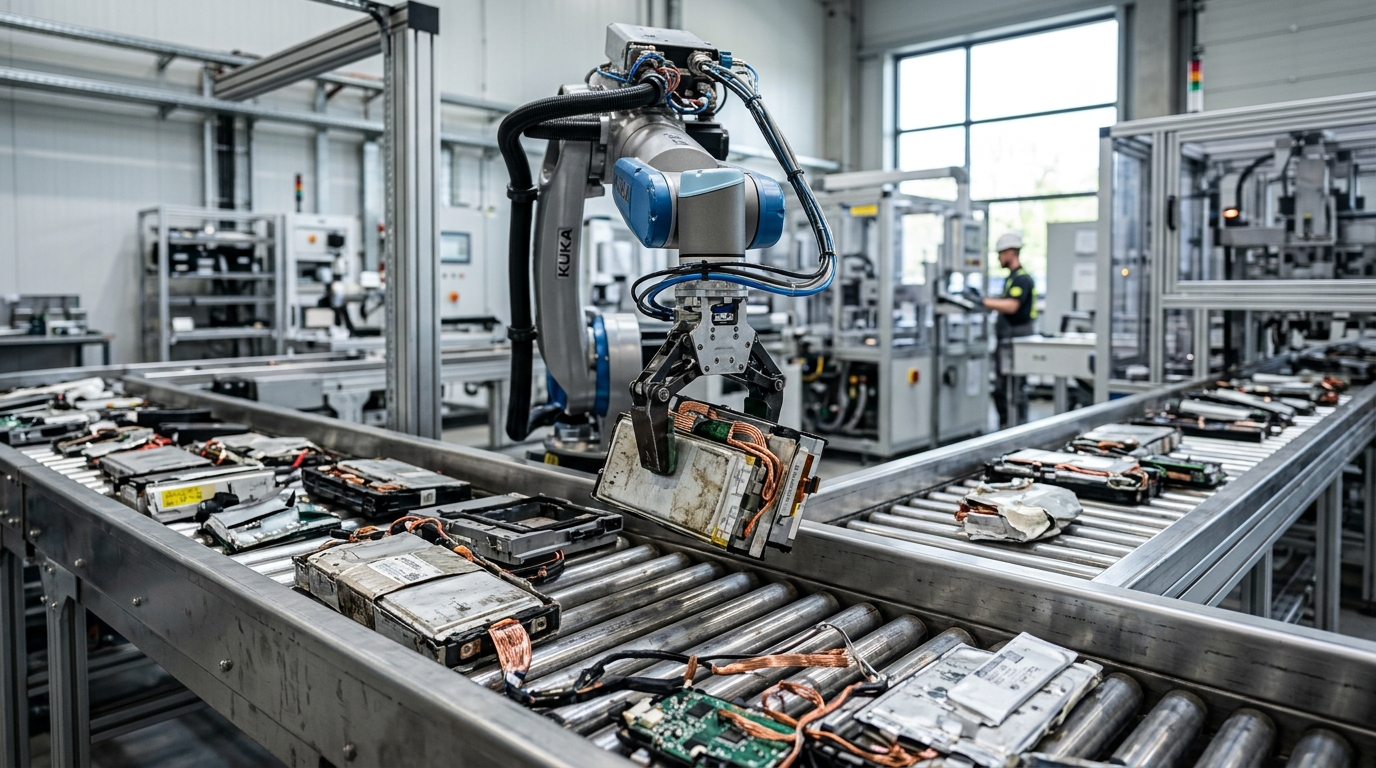
To overcome these limitations, the authors map the application of specific computational methods across the major stages of the battery recycling value chain, beginning with automated identification and sorting. Manual disassembly and visual inspection frequently fail to differentiate exterior battery cells that share identical form factors but contain drastically divergent interior electrochemical compositions. Integrating computer vision with convolutional neural networks allows recycling systems to identify cell formats, surface damage, and manufacturer markings with high accuracy, minimizing human error and occupational hazards.
Within chemical extraction stages, the review documents how supervised machine learning algorithms optimize complex operational parameters in hydrometallurgical and pyrometallurgical circuits. Predictive algorithms such as artificial neural networks, random forests, and support vector machines can model multi-variable recovery surfaces to forecast extraction yields of lithium, nickel, cobalt, and manganese while minimizing chemical reagent consumption.
The authors also examine the unique potential of artificial intelligence in direct recycling, an emerging pathway designed to recover and regenerate intact cathode materials without complete chemical decomposition into elemental precursors.
Artificial intelligence further expands resource circularity by facilitating data-driven second-life screening before spent batteries enter destructive recycling pathways. Retired packs from electric vehicles frequently retain substantial operational capacity, making them suitable for less demanding stationary energy storage or backup power applications. Recurrent neural networks, long short-term memory networks, and transformer architectures can analyze historic voltage profiles, operating temperature curves, and charge-discharge cycling behavior to estimate state of health and forecast remaining useful life, preventing premature recycling and maximizing the lifecycle utilization of manufactured assets.
Deep learning and image-based architectures deliver superior results in physical classification, structural feature extraction, and automated handling where high-dimensional spatial imagery dominates. For complex, high-temperature pyrometallurgical furnaces and dynamic plant environments, digital twin architectures and reinforcement learning frameworks offer virtual process simulation and adaptive closed-loop control. The authors highlight that no single algorithmic framework can govern the entirety of recycling operations, necessitating modular integration tailored to specific unit operations.
To connect these disparate processing stages, the review proposes a modular data-sharing framework anchored by digital battery passports that track vital lifecycle metrics across supply chain actors. Under this architecture, decommissioners, dismantlers, pre-processors, hydrometallurgical refiners, and active material manufacturers operate distinct computational modules connected through standardized digital records. When spent packs are decommissioned, initial diagnostic systems generate digital profiles documenting cell chemistry, operating cycle history, remaining capacity, and recommended end-of-life routes.
Despite significant laboratory-scale demonstrations, the authors identify critical technical, computational, and institutional barriers restricting the widespread industrial deployment of artificial intelligence in battery recycling. The primary constraint centers on data scarcity and fragmentation: current operational datasets remain siloed among manufacturers, research laboratories, and commercial recyclers, characterized by incompatible formatting, missing historical variables, and unstandardized experimental protocols. Furthermore, many high-performing deep learning models operate as opaque black boxes, lacking mechanistic interpretability that plant operators and regulatory bodies require when making decisions that directly affect worker safety, thermal hazards, and emission limits.
The review also underscores practical economic and infrastructural constraints, noting that implementing comprehensive artificial intelligence architectures demands substantial capital investment in sensory equipment, high-throughput data pipelines, and specialized technical expertise. Many existing recycling facilities operate with legacy machinery devoid of digital communication interfaces, making full system integration cost-prohibitive without phased modernization pathways. To address these data and infrastructure deficits, the authors outline minimum reporting standards for artificial intelligence-ready datasets, emphasizing the mandatory inclusion of cell form factor, chemical composition, operational cycle history, degradation state, measurement uncertainties, and standardized process outputs across all reported recycling literature.
In their final synthesis, the authors conclude that transitioning lithium-ion battery recycling toward an intelligent circular model requires deep interdisciplinary cooperation connecting materials scientists, electrochemists, data specialists, and industrial operators. Rather than functioning as isolated computational exercises, artificial intelligence systems must be embedded within automated equipment, standardized data platforms, and validated safety monitoring networks. Overcoming fragmentation across data ownership, industrial standardization, and model interpretability will determine whether computational intelligence can successfully convert variable end-of-life battery streams into predictable, high-value reservoirs of critical energy materials for next-generation manufacturing systems.
Subject of Research: Artificial intelligence applications and implementation challenges across lithium-ion battery recycling systems
Article Title: Artificial intelligence driven lithium-ion battery recycling: from materials recovery to intelligent circular energy systems
Article References: Aslam, J., Khan, M. A., Usman, A., Javed, M., & Usman, M. (2026). Artificial intelligence driven lithium-ion battery recycling: from materials recovery to intelligent circular energy systems. Journal of Materials Science: Materials Theory, 10(1), Article 23. https://doi.org/10.1186/s41313-026-00096-2
Image Credits: AI Generated
DOI: 10.1186/s41313-026-00096-2
Keywords: Lithium-ion batteries, Battery recycling, Artificial intelligence, Machine learning, Computer vision, Deep learning, Hydrometallurgical recycling, Pyrometallurgical processing, Direct recycling, Battery sorting, State of health, Remaining useful life, Digital battery passport, Circular economy, Cathode active materials, Secondary energy storage, Process parameter optimization
News Source: Blake Davidson. (November 17, 2026). Artificial Intelligence Frameworks Show Potential to Optimize Lithium-Ion Battery Recycling Systems. Scienmag.