• HOME
  • NEWS
  • EXPLORE
    • CAREER
      • Companies
      • Jobs
    • EVENTS
    • iGEM
      • News
      • Team
    • PHOTOS
    • VIDEO
    • WIKI
  • BLOG
  • COMMUNITY
    • FACEBOOK
    • INSTAGRAM
    • TWITTER
Tuesday, July 7, 2026
BIOENGINEER.ORG
No Result
View All Result
  • Login
  • HOME
  • NEWS
  • EXPLORE
    • CAREER
      • Companies
      • Jobs
        • Lecturer
        • PhD Studentship
        • Postdoc
        • Research Assistant
    • EVENTS
    • iGEM
      • News
      • Team
    • PHOTOS
    • VIDEO
    • WIKI
  • BLOG
  • COMMUNITY
    • FACEBOOK
    • INSTAGRAM
    • TWITTER
  • HOME
  • NEWS
  • EXPLORE
    • CAREER
      • Companies
      • Jobs
        • Lecturer
        • PhD Studentship
        • Postdoc
        • Research Assistant
    • EVENTS
    • iGEM
      • News
      • Team
    • PHOTOS
    • VIDEO
    • WIKI
  • BLOG
  • COMMUNITY
    • FACEBOOK
    • INSTAGRAM
    • TWITTER
No Result
View All Result
Bioengineer.org
No Result
View All Result
Home NEWS Science News Biology

Artificial intelligence enhances brain tumour diagnosis

Bioengineer by Bioengineer
June 9, 2020
in Biology
Reading Time: 3 mins read
0
IMAGE
Share on FacebookShare on TwitterShare on LinkedinShare on RedditShare on Telegram

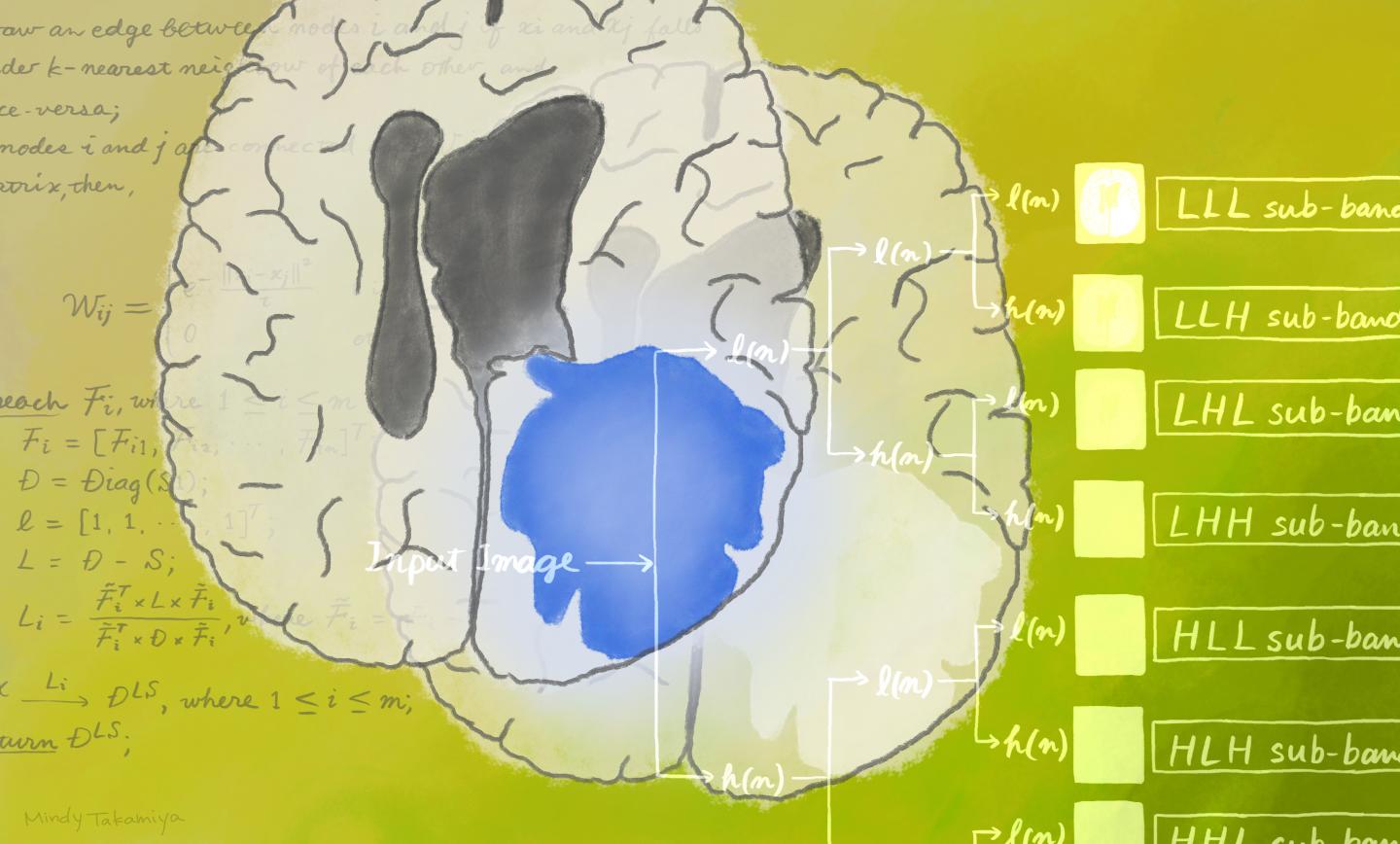
A highly accurate machine learning tool could help doctors tailor individualized treatments for people with glioma brain tumours
IMAGE

Credit: Mindy Takamiya/Kyoto University iCeMS

A new machine learning approach classifies a common type of brain tumour into low or high grades with almost 98% accuracy, researchers report in the journal IEEE Access. Scientists in India and Japan, including from Kyoto University’s Institute for Integrated Cell-Material Sciences (iCeMS), developed the method to help clinicians choose the most effective treatment strategy for individual patients.

Gliomas are a common type of brain tumour affecting glial cells, which provide support and insulation for neurons. Patient treatment varies depending on the tumour’s aggressiveness, so it’s important to get the diagnosis right for each individual. Radiologists obtain a very large amount of data from MRI scans to reconstruct a 3D image of the scanned tissue. Much of the data available in MRI scans cannot be detected by the naked eye, such as details related to the tumour shape, texture, or the image’s intensity. Artificial intelligence (AI ) algorithms help extract this data. Medical oncologists have been using this approach, called radiomics, to improve patient diagnoses, but accuracy still needs to be enhanced.

iCeMS bioengineer Ganesh Pandian Namasivayam collaborated with Indian data scientist Balasubramanian Raman from Roorkee to develop a machine learning approach that can classify gliomas into low or high grade with 97.54% accuracy. Low grade gliomas include grade I pilocytic astrocytoma and grade II low-grade glioma. These are the less aggressive and less malignant of the glioma tumours. High grade gliomas include grade III malignant glioma and grade IV glioblastoma multiforme, which are much more aggressive and more malignant with a relatively short post-diagnosis survival time. The choice of patient treatment largely depends on being able to determine the glioma’s grading.

The team, including Rahul Kumar, Ankur Gupta and Harkirat Singh Arora, used a dataset from MRI scans belonging to 210 people with high grade gliomas and another 75 with low grade gliomas. They developed an approach called CGHF, which stands for: computational decision support system for glioma classification using hybrid radiomics and stationary wavelet-based features. They chose specific algorithms for extracting features from some of the MRI scans and then trained another predictive algorithm to process this data and classify the gliomas. They then tested their model on the rest of the MRI scans to assess its accuracy.

“Our method outperformed other state-of-the-art approaches for predicting glioma grades from brain MRI scans,” says Balasubramanian. “This is quite considerable.”

“We hope AI helps develop a semi-automatic or automatic machine predictive software model that can help doctors, radiologists, and other medical practitioners tailor the best approaches for their individual patients,” adds Ganesh.

###

DOI: 10.1109/ACCESS.2020.2989193

About Kyoto University’s Institute for Integrated Cell-Material Sciences (iCeMS):

At iCeMS, our mission is to explore the secrets of life by creating compounds to control cells, and further down the road to create life-inspired materials.
https://www.icems.kyoto-u.ac.jp/

For more information, contact:

I. Mindy Takamiya/Mari Toyama

[email protected]

Media Contact
Mindy Takamiya
[email protected]

Related Journal Article

http://dx.doi.org/10.1109/ACCESS.2020.2989193

Tags: BiologyBiomedical/Environmental/Chemical EngineeringBiotechnologyCell BiologyDiagnosticsGeneticsneurobiologyTechnology/Engineering/Computer Science
Share12Tweet8Share2ShareShareShare2

Related Posts

Here are a few rewritten headlines for a science magazine post, each with a slightly different tone: Intriguing & poetic: How do organs sculpt themselves? Sea stars hold the secret Direct & research-focused: Sea stars reveal the hidden rules of organ formation Metaphorical & inviting: Tiny architects beneath the waves: What sea stars teach us about building organs Short & punchy: Star-shaped clues to how our organs take shape Question-led: Could a sea star show us how organs form? Elegant & feature-style: The body’s blueprint, glimpsed in a sea star’s arm

July 6, 2026
Bacteria evolve faster with unconventional gene copies — Biology

Bacteria evolve faster with unconventional gene copies

July 6, 2026

Neighbours rewire soil feedback via root microbiome shifts

July 6, 2026

Evolution-Inspired Biosensors Revolutionize Lipid Tracking in Real Time

July 2, 2026
Please login to join discussion

POPULAR NEWS

  • Detection of EDCs in Breast Milk and Infant Urine Up to Six Months Highlights Early Exposure Risks

    77 shares
    Share 31 Tweet 19
  • New Drug Candidate Developed at McMaster Shows Potential for Treating Brain Cancer

    58 shares
    Share 23 Tweet 15
  • Saying Goodbye to PGY-6: Pediatric Fellowship Realities

    103 shares
    Share 41 Tweet 26
  • KTU Researchers Explore Ultrasound’s Role in Enhancing Blood Flow Beyond Diagnostics

    53 shares
    Share 21 Tweet 13

About

We bring you the latest biotechnology news from best research centers and universities around the world. Check our website.

Follow us

Recent News

Flame retardant BDE-209 targets molecularly linked to ulcerative colitis

Ultra-high frequency particle impacts mimic rockbursts to shatter hard rock

Kidney transplant outcomes in older adults studied by German researchers

Subscribe to Blog via Email

Success! An email was just sent to confirm your subscription. Please find the email now and click 'Confirm' to start subscribing.

Join 83 other subscribers
  • Contact Us

Bioengineer.org © Copyright 2023 All Rights Reserved.

Welcome Back!

Login to your account below

Forgotten Password?

Retrieve your password

Please enter your username or email address to reset your password.

Log In
No Result
View All Result
  • Homepages
    • Home Page 1
    • Home Page 2
  • News
  • National
  • Business
  • Health
  • Lifestyle
  • Science

Bioengineer.org © Copyright 2023 All Rights Reserved.