• HOME
  • NEWS
  • EXPLORE
    • CAREER
      • Companies
      • Jobs
    • EVENTS
    • iGEM
      • News
      • Team
    • PHOTOS
    • VIDEO
    • WIKI
  • BLOG
  • COMMUNITY
    • FACEBOOK
    • INSTAGRAM
    • TWITTER
Monday, May 11, 2026
BIOENGINEER.ORG
No Result
View All Result
  • Login
  • HOME
  • NEWS
  • EXPLORE
    • CAREER
      • Companies
      • Jobs
        • Lecturer
        • PhD Studentship
        • Postdoc
        • Research Assistant
    • EVENTS
    • iGEM
      • News
      • Team
    • PHOTOS
    • VIDEO
    • WIKI
  • BLOG
  • COMMUNITY
    • FACEBOOK
    • INSTAGRAM
    • TWITTER
  • HOME
  • NEWS
  • EXPLORE
    • CAREER
      • Companies
      • Jobs
        • Lecturer
        • PhD Studentship
        • Postdoc
        • Research Assistant
    • EVENTS
    • iGEM
      • News
      • Team
    • PHOTOS
    • VIDEO
    • WIKI
  • BLOG
  • COMMUNITY
    • FACEBOOK
    • INSTAGRAM
    • TWITTER
No Result
View All Result
Bioengineer.org
No Result
View All Result
Home NEWS Science News

Army scientists create quantum sensor that covers entire radio frequency spectrum

Bioengineer by Bioengineer
March 19, 2020
in Science News
Reading Time: 3 mins read
0
IMAGE
Share on FacebookShare on TwitterShare on LinkedinShare on RedditShare on Telegram

IMAGE

Credit: U.S. Army photo


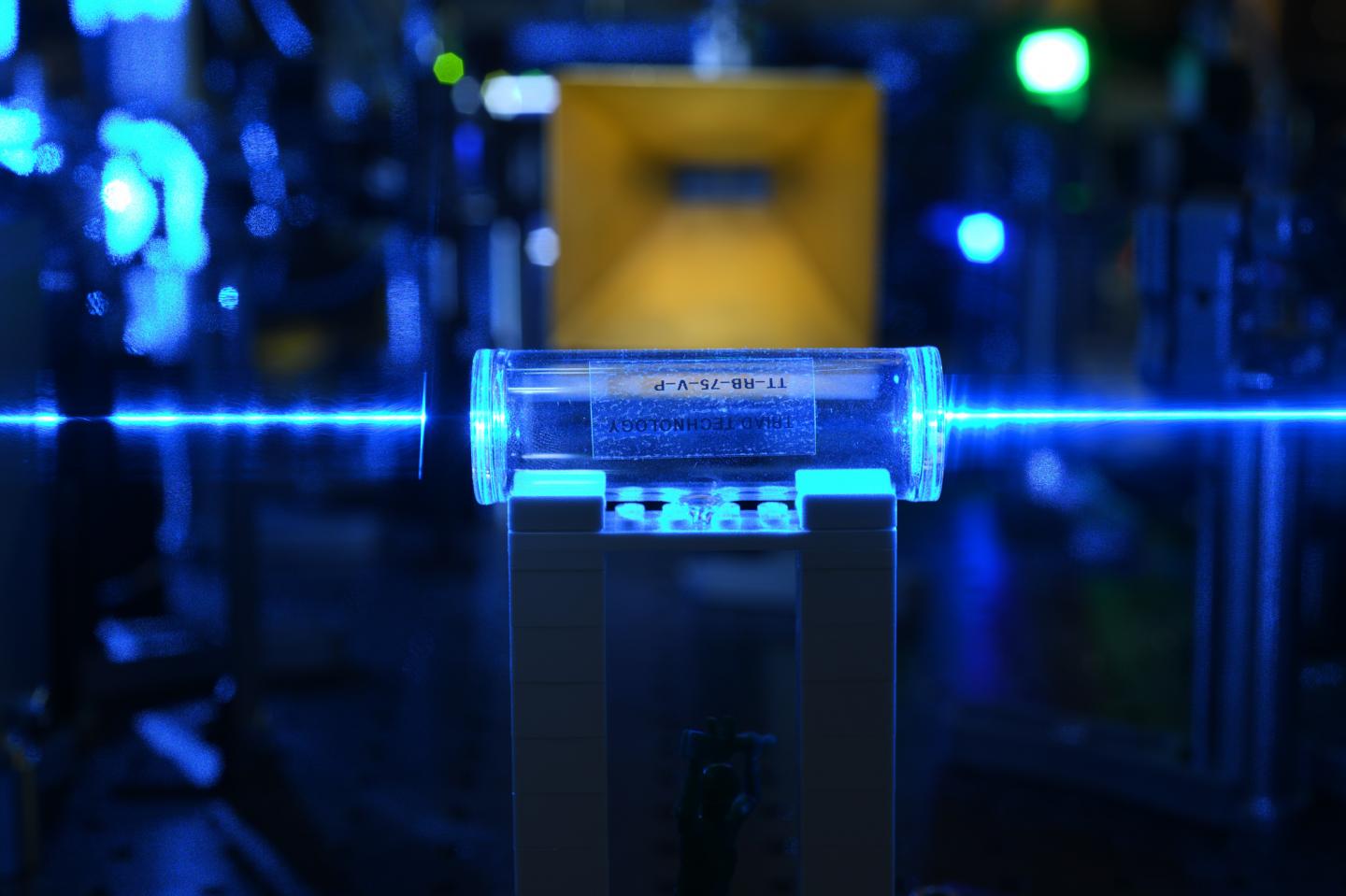
ADELPHI, Md. (March 19, 2020) – A quantum sensor could give Soldiers a way to detect communication signals over the entire radio frequency spectrum, from 0 to 100 GHz, said researchers from the Army.

Such wide spectral coverage by a single antenna is impossible with a traditional receiver system, and would require multiple systems of individual antennas, amplifiers and other components.

In 2018, Army scientists were the first in the world to create a quantum receiver that uses highly excited, super-sensitive atoms–known as Rydberg atoms–to detect communications signals, said David Meyer, a scientist at the U.S. Army Combat Capabilities Development Command’s Army Research Laboratory. The researchers calculated the receiver’s channel capacity, or rate of data transmission, based on fundamental principles, and then achieved that performance experimentally in their lab–improving on other groups’ results by orders of magnitude, Meyer said.

“These new sensors can be very small and virtually undetectable, giving Soldiers a disruptive advantage,” Meyer said. “Rydberg-atom based sensors have only recently been considered for general electric field sensing applications, including as a communications receiver. While Rydberg atoms are known to be broadly sensitive, a quantitative description of the sensitivity over the entire operational range has never been done.”

To assess potential applications, Army scientists conducted an analysis of the Rydberg sensor’s sensitivity to oscillating electric fields over an enormous range of frequencies–from 0 to 1012 Hertz. The results show that the Rydberg sensor can reliably detect signals over the entire spectrum and compare favorably with other established electric field sensor technologies, such as electro-optic crystals and dipole antenna-coupled passive electronics.

“Quantum mechanics allows us to know the sensor calibration and ultimate performance to a very high degree, and it’s identical for every sensor,” Meyer said. “This result is an important step in determining how this system could be used in the field.”

This work supports the Army’s modernization priorities in next-generation computer networks and assured position, navigation and timing, as it could potentially influence novel communications concepts or approaches to detection of RF signals for geolocation.

In the future, Army scientists will investigate methods to continue to improve the sensitivity to detect even weaker signals and expand detection protocols for more complicated waveforms.

###

The Journal of Physics B published the research, “Assessment of Rydberg atoms for wideband electric field sensing”, in its special issue on interacting Rydberg atoms. Army scientists David H. Meyer, Kevin C. Cox and Paul D. Kunz led this research, as well as Zachary A. Castillo from the University of Maryland. This work was supported by the Defense Advanced Research Projects Agency.

U.S. Army CCDC Army Research Laboratory is an element of the U.S. Army Combat Capabilities Development Command. As the Army’s corporate research laboratory, ARL discovers, innovates and transitions science and technology to ensure dominant strategic land power. Through collaboration across the command’s core technical competencies, CCDC leads in the discovery, development and delivery of the technology-based capabilities required to make Soldiers more lethal to win our nation’s wars and come home safely. CCDC is a major subordinate command of the U.S. Army Futures Command.

Media Contact
Patti Riippa
[email protected]
410-278-2156

Related Journal Article

http://dx.doi.org/10.1088/1361-6455/ab6051

Tags: Atomic PhysicsAtomic/Molecular/Particle PhysicsComputer ScienceElectrical Engineering/ElectronicsElectromagneticsResearch/DevelopmentTechnology/Engineering/Computer Science
Share12Tweet8Share2ShareShareShare2

Related Posts

Humans and Zebra Finches Share Similar Speech Learning Techniques #ASA190 — Chemistry

Humans and Zebra Finches Share Similar Speech Learning Techniques #ASA190

May 11, 2026
New Study Uncovers How Fungal Parasites Attack Strawberries and Raspberries — Agriculture

New Study Uncovers How Fungal Parasites Attack Strawberries and Raspberries

May 11, 2026

City of Hope Researchers to Present Groundbreaking Immunotherapy and Precision Medicine Advances Across Multiple Cancer Types at ASCO 2026

May 11, 2026

Medicaid Expansion Reduces Mortality in Young Adults with Kidney Failure

May 11, 2026
Please login to join discussion

POPULAR NEWS

  • Research Indicates Potential Connection Between Prenatal Medication Exposure and Elevated Autism Risk

    841 shares
    Share 336 Tweet 210
  • New Study Reveals Plants Can Detect the Sound of Rain

    728 shares
    Share 290 Tweet 182
  • Salmonella Haem Blocks Macrophages, Boosts Infection

    62 shares
    Share 25 Tweet 16
  • Breastmilk Balances E. coli and Beneficial Bacteria in Infant Gut Microbiomes

    57 shares
    Share 23 Tweet 14

About

We bring you the latest biotechnology news from best research centers and universities around the world. Check our website.

Follow us

Recent News

Humans and Zebra Finches Share Similar Speech Learning Techniques #ASA190

New Study Uncovers How Fungal Parasites Attack Strawberries and Raspberries

City of Hope Researchers to Present Groundbreaking Immunotherapy and Precision Medicine Advances Across Multiple Cancer Types at ASCO 2026

Subscribe to Blog via Email

Enter your email address to subscribe to this blog and receive notifications of new posts by email.

Join 82 other subscribers
  • Contact Us

Bioengineer.org © Copyright 2023 All Rights Reserved.

Welcome Back!

Login to your account below

Forgotten Password?

Retrieve your password

Please enter your username or email address to reset your password.

Log In
No Result
View All Result
  • Homepages
    • Home Page 1
    • Home Page 2
  • News
  • National
  • Business
  • Health
  • Lifestyle
  • Science

Bioengineer.org © Copyright 2023 All Rights Reserved.