Alexandra Navrotsky to receive the 2020 Jan Czochralski Award from the European Materials Research Society
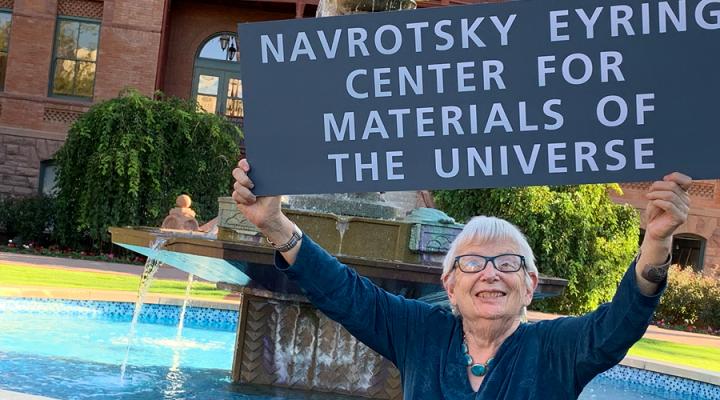
Credit: Mary Zhu
Arizona State University Professor Alexandra Navrotsky will be honored with the European Materials Research Society (E-MRS) 2020 Jan Czochralski Award.
The award is presented every year to a scientist based on their achievements in advanced materials science. Other eminent American awardees include Mildred Dresselhaus, a physics professor emerita from MIT, in 2010, who also received the 2012 Enrico Fermi Award and the U.S. Presidential Medal of Freedom in 2014. Distinguished Harvard Professor George Whitesides also received the award in 2014.
Navrotsky is a professor in the the School of Molecular Sciences, part of The College of Liberal Arts and Sciences, and in the School for Engineering of Matter, Transport and Energy, part of the Ira A. Fulton Schools of Engineering)
A member of the National Academy of Sciences, Navrotsky, who began her academic career at ASU in 1969, left in 1985 for Princeton University and officially returned on Oct. 1, 2019, to head the new one-of-a-kind Center for Materials of the Universe.
“Professor Navrotsky and her group are world leaders in many areas of solid state science, from microscopic features of structure and bonding to macroscopic thermodynamic behavior in minerals, ceramics, and other complex materials,” said President’s Professor Ian Gould, interim director of the School of Molecular Sciences. “I am very happy to see her recognized with this prestigious and well-deserved award.”
“Receiving the E-MRS Jan Czochralski Award was an utter surprise and is a great honor,” Navrotsky said. “Czochralski was a pioneer in chemical engineering, Poland has a great tradition in catalysis and materials science, and it will be wonderful to visit Warsaw again and see some of my friends there.”
The E-MRS Czochralski Award is comprised of the Czochralski Gold Medal, a plaque and a commemorative diploma which will all be presented to Navrotsky on Sept. 16 of this year at the European Materials Research Society Fall Meeting (Warsaw University of Technology, Warsaw, Poland) where she will deliver a lecture during the plenary session.
Professor Jan Czochralski was one of Poland’s most famous scientists. In 1916 after serendipitously dipping a pen into a small crucible of molten aluminum instead of an inkwell, and withdrawing it, he noticed that a thread of aluminum hung from the nib. The thread of aluminum turned out to be a single crystal and so the Czochralski method for single crystal growth was born. His method is currently used for the growth of single crystals of germanium and silicon which are the basis of a vast range of modern electronic equipment and devices.
By advancing high- and low-temperature reaction calorimetry as a foundational research tool, Navrotsky has contributed to a broad spectrum of applications, from mineral thermodynamics to ceramic processing to zeolites.
Navrotsky has published more than 900 scientific papers and received many honors, including the Harry Hess Medal, the Goldschmidt Medal and the Kingery Award. She serves on numerous advisory committees and panels in government and academia, promoting collaborative research across disciplines and institutions.
It was also just announced that Navrotsky’s recent article, “Thermochemical Investigation of Lithium Borate Glasses and Crystals,” has been selected for one of the Best Paper awards from the Journal of the American Ceramic Society for the past year. The award will be presented during the Journal of the American Ceramic Society awards symposium at MS&T 2020 held Oct. 4-8, 2020 in Pittsburgh.
“In science as in life, every day is a new adventure!” Navrotsky said.
###
Media Contact
Jenny Green
[email protected]
480-241-6608
Original Source
https:/