Engineers who glue plastic parts together know the frustration: many of the toughest engineering thermoplastics are also the hardest to bond. Their chemically inert, low-energy surfaces shrug off adhesives, so manufacturers routinely reach for surface activation tricks before assembly. A new open-access study published in Discover Mechanical Engineering now offers one of the most direct head-to-head comparisons available, testing two atmospheric-pressure plasma gases — argon and nitrogen — on five common engineering plastics under identical processing conditions, and measuring both wettability and real lap-shear bond strength.
The research team, led by Péter Péczi-Kovács with co-author Eszter Kókai, selected polypropylene (PP), high-impact polystyrene (HIPS), poly(vinyl chloride) (PVC), polycarbonate (PC) and polyethylene terephthalate (PET, used as commercial PET-G sheet) precisely because their surface chemistries differ so widely. PP is a non-polar polyolefin with a surface free energy of roughly 29–31 mJ/m² and a water contact angle of 95–105°, making it notoriously difficult to bond. HIPS and PVC sit in the mid-30s to low-40s mJ/m² range, while PC and PET carry polar carbonate and ester groups that give them somewhat better intrinsic wettability, with contact angles around 70–82° and 70–80° respectively. Even so, the authors note, none of these untreated surfaces is good enough for demanding structural adhesive applications.
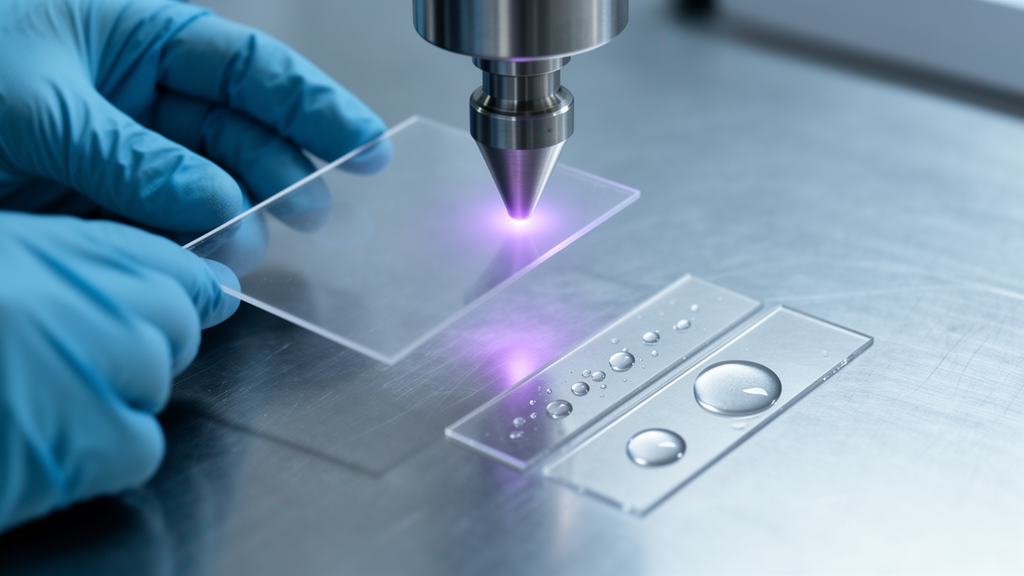
The treatments themselves were deliberately industrial in character. Specimens cut to 100 × 25 mm were cleaned with isopropyl alcohol and passed under a FARI PM-G13A atmospheric rotating cold plasma head operating at a measured discharge power of 529 ± 1 W, with nitrogen of 99.995% purity or argon of 99.996% purity fed at 3.5 bar. The nozzle-to-surface distance was held at 5 mm, and the plasma head swept the samples at speeds from 100 to 2000 mm/min, corresponding to treatment times from about 51 seconds down to 2.55 seconds. Contact angles were measured immediately after treatment with distilled water using the sessile drop method, minimizing any hydrophobic recovery effects, and adhesive joints were bonded straight away as well.
The wettability results were striking. Untreated samples showed contact angles of about 94° for PP, 90° for PVC, 80° for HIPS, 78° for PET and 74° for PC. After nitrogen plasma treatment, even at the fastest head speed of 2000 mm/min, those angles plummeted to 18° for PP, 54° for PVC, essentially complete wetting (about 0°) for HIPS, 15° for PET and 27° for PC. Slowing the head further produced only marginal additional gains — PVC stayed between 53° and 54°, PC crept down from 27° to 22°, and PP hovered around 17–18° — indicating that once the surface is activated, extra exposure buys little.
But nitrogen plasma has a dark side: at slower speeds it visibly damages the surface. Burning first appeared on PP at 500 mm/min, and PVC and HIPS degraded at 250 mm/min; below 250 mm/min every polymer showed visible degradation such as burning or surface matting. Argon plasma behaved differently. It produced higher contact angles than nitrogen under the same conditions — for example HIPS fell from 80° untreated to 54° at 2000 mm/min and 36° at 100 mm/min, PET from 78° to 31°, PC from 74° to 48°, PVC from 90° to 60°, and PP from 94° to 60° — but crucially, no visible burning or surface damage occurred anywhere in the investigated parameter range. Reducing the stand-off distance from 5 to 3 mm at 100 mm/min helped only HIPS (down to 25°) and PC (down to 43°), leaving PET, PVC and PP essentially unchanged.
The mechanical payoff was measured with single-lap-shear joints built to the ISO 4587 standard, using a 12.5 mm overlap, clamped at 2 Nm for 24 hours, and tested at a 10 mm/s crosshead speed with three specimens per condition. Several structural adhesives were used, including a two-component epoxy (Loctite EA 9466, applied to all five polymers for a common baseline), hybrid polymer moisture-curing adhesives, and cyanoacrylates. Only surfaces free of visible plasma damage were bonded.
The headline mechanical result belongs to PVC and PP. For PVC bonded with the epoxy, nitrogen plasma lifted lap shear strength from 2.1 ± 0.3 MPa to 12.8 ± 2.3 MPa — a six-fold increase — with failure occurring in the polymer substrate itself, meaning the joint was stronger than the material. PP with the same epoxy jumped from just 0.5 ± 0.1 MPa to 11.6 ± 0.7 MPa after nitrogen treatment, again with substrate failure. Moderate gains appeared for PC (3.3 ± 0.7 to 4.9 ± 1.3 MPa), HIPS (3.2 ± 0.4 to 4.3 ± 0.4 MPa) and PET (3.3 ± 0.2 to 4.1 ± 0.8 MPa) with the epoxy, in each case accompanied by material failure during testing.
The most scientifically interesting finding, however, is that the lowest water contact angle did not reliably predict the strongest joint. With Soudal Fix All X-treme Power Express on HIPS, argon and nitrogen treatments produced identical 4.9 MPa bond strengths despite wildly different contact angles of 25° and 0°. For PET with Loctite 4860, argon plasma (contact angle 31°) delivered 2.4 ± 0.5 MPa while nitrogen plasma (13°) reached only 2.0 ± 0.1 MPa. And for PP with Soudal Fix All Flexi, argon plasma at a much higher contact angle of 60° yielded 0.8 MPa versus just 0.3 ± 0.05 MPa for nitrogen at 17°. Wettability, in other words, is necessary but not sufficient.
The authors attribute this to competing plasma mechanisms that a single water contact angle cannot disentangle. Drawing on prior literature, they note that argon plasma activates surfaces mainly through ion bombardment, radical formation and mild etching, with the radicals later grabbing oxygen from ambient air to form polar groups; nitrogen plasma adds chemical functionalization with nitrogen-containing species. For specific polymers, argon can trigger chain scission and etching at PP’s tertiary carbons, modify aromatic rings in polystyrene, strip chlorine-containing groups from PVC to form a crosslinked layer, and cleave carbonate and ether bonds in PC, while nitrogen plasma on PET introduces amide, amine and N–C=O groups. Functionalization, crosslinking, ablation and roughening can occur simultaneously or competitively, and the authors are candid that their WCA and lap-shear data alone cannot separate these contributions — a limitation they propose to address in future work with XPS, FTIR, SEM and AFM characterization.
The practical takeaway is a two-dimensional optimization problem rather than a one-variable race to the wettest surface. Nitrogen plasma is the tool of choice when maximum surface activation is needed and the substrate tolerates it, while argon plasma offers a wider, more forgiving processing window with no visible degradation — and, for several polymer–adhesive combinations, equal or better joints. Because the magnitude of improvement depended on both the polymer and the adhesive system, as demonstrated across the PVC, HIPS, PET and PP joints, the study concludes that successful plasma-assisted bonding requires jointly optimizing the plasma process and the adhesive chemistry for each specific substrate. For manufacturers bonding low-energy plastics in automotive, packaging or electronics assembly, that means the fastest treatment is not always the best one — and the shiniest puddle of water on the surface is not always the strongest glue line.
Subject of Research: Comparing atmospheric-pressure argon and nitrogen plasma treatment effects on wettability and adhesive bond strength of five engineering thermoplastics
Article Title: Effect of argon and nitrogen plasma surface treatment on wettability and adhesive bond strength of PP, HIPS, PVC, PC and PET
Article References: Péczi-Kovács, P., & Kókai, E. (2026). Effect of argon and nitrogen plasma surface treatment on wettability and adhesive bond strength of PP, HIPS, PVC, PC and PET. Discover Mechanical Engineering, 5(1), Article 204. https://doi.org/10.1007/s44245-026-00396-4
Image Credits: AI Generated
DOI: 10.1007/s44245-026-00396-4
Keywords: plasma treatment, adhesive bonding, wettability, polypropylene, polycarbonate, PVC, PET, HIPS, lap shear strength, surface activation, contact angle, engineering thermoplastics
News Source: Denise Maddox. (October 29, 2026). Argon and nitrogen plasma boost plastic adhesion, but lowest contact angle is not always best. Scienmag.