• HOME
  • NEWS
  • EXPLORE
    • CAREER
      • Companies
      • Jobs
    • EVENTS
    • iGEM
      • News
      • Team
    • PHOTOS
    • VIDEO
    • WIKI
  • BLOG
  • COMMUNITY
    • FACEBOOK
    • INSTAGRAM
    • TWITTER
Sunday, August 16, 2026
BIOENGINEER.ORG
No Result
View All Result
  • Login
  • HOME
  • NEWS
  • EXPLORE
    • CAREER
      • Companies
      • Jobs
        • Lecturer
        • PhD Studentship
        • Postdoc
        • Research Assistant
    • EVENTS
    • iGEM
      • News
      • Team
    • PHOTOS
    • VIDEO
    • WIKI
  • BLOG
  • COMMUNITY
    • FACEBOOK
    • INSTAGRAM
    • TWITTER
  • HOME
  • NEWS
  • EXPLORE
    • CAREER
      • Companies
      • Jobs
        • Lecturer
        • PhD Studentship
        • Postdoc
        • Research Assistant
    • EVENTS
    • iGEM
      • News
      • Team
    • PHOTOS
    • VIDEO
    • WIKI
  • BLOG
  • COMMUNITY
    • FACEBOOK
    • INSTAGRAM
    • TWITTER
No Result
View All Result
Bioengineer.org
No Result
View All Result
Home NEWS Science News Chemistry

Architecture of a bacterial power plant decrypted

Bioengineer by Bioengineer
November 14, 2019
in Chemistry
Reading Time: 2 mins read
0
IMAGE
Share on FacebookShare on TwitterShare on LinkedinShare on RedditShare on Telegram

IMAGE

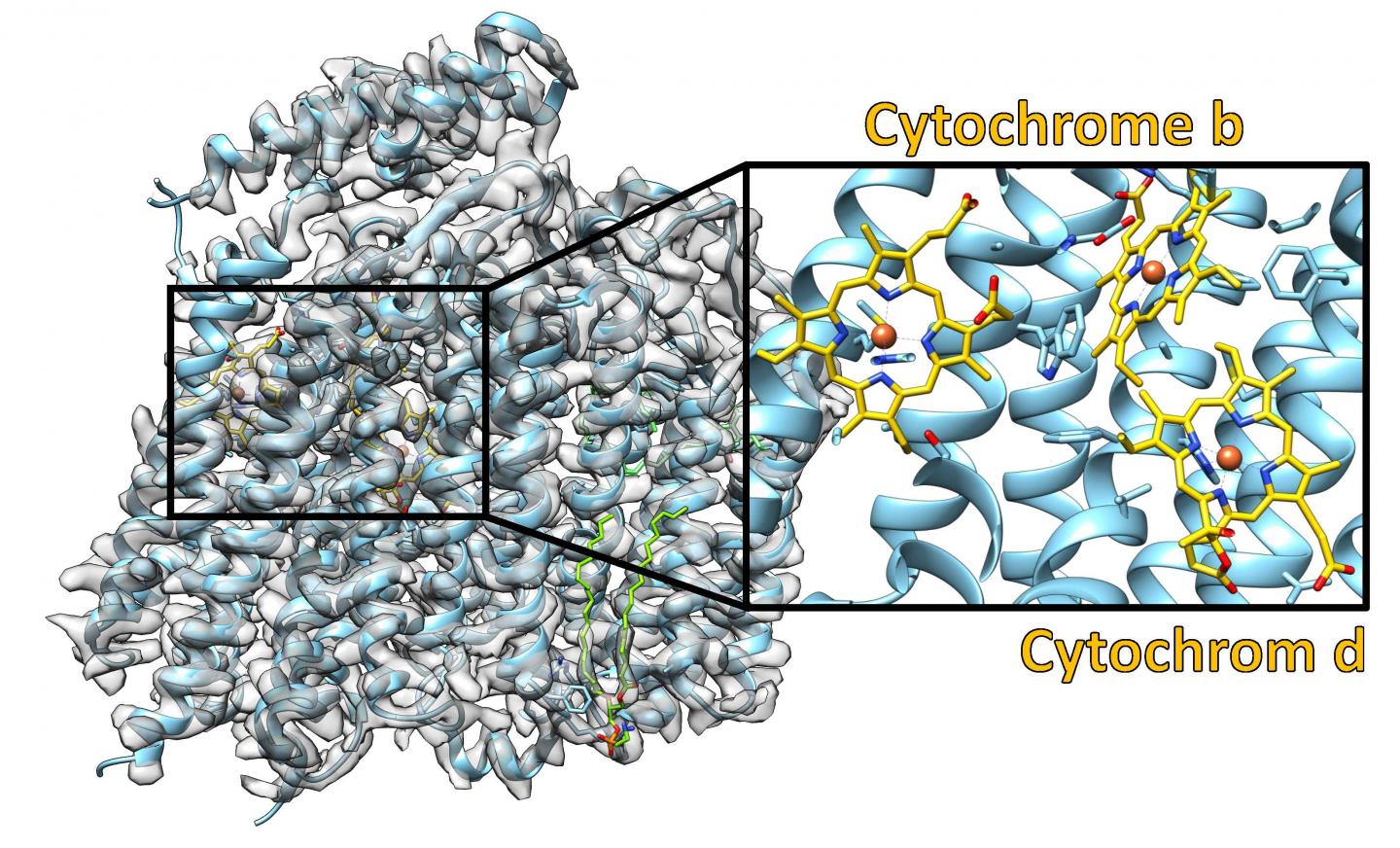
Credit: Rudolf-Virchow-Zentrum / University of Würzburg

Both humans and many other creatures need oxygen for survival. In the conversion of nutrients into energy, the oxygen is converted to water, for which the enzyme oxidase is responsible. It represents the last step of the so-called respiratory chain.

While humans have only one type of these oxidases, the bacterial model organism Escherichia coli (E. coli) has three alternative enzymes available. In order to better understand why E. coli and other bacteria need multiple oxidases, Prof. Bettina Böttcher from the Rudolf Virchow Center in collaboration with Prof. Thorsten Friedrich (University of Freiburg) have determined the molecular structure of the cytochrome bd oxidase from E. coli. This type of oxidase is found only in bacteria and microbial archaea.

Bacteria have other types of oxidase

The eponymous cytochromes, two of type b and one of type d, are the key iron-containing groups that enable the function of oxidase. At the cytochrome d, the oxygen is bound and converted to water. The structure determination revealed that the architecture of cytochrome bd oxidase from E. coli is very similar to the structure of another bacterium, Geobacillus thermodenitrificans. “However, to our great surprise, we discovered that a cytochrome b and cytochrome d have changed positions and thus the site of oxygen conversion within the enzyme,” reports Prof. Thorsten Friedrich.

The cause of this change could be that the cytochrome bd oxidase might fulfill a second function: in addition to the energy production, it can serve to protect against oxidative stress and stress by nitroxides. Particularly pathogenic bacterial strains show a high activity of cytochrome bd oxidase. Since humans do not have this type of oxidase, these results might furthermore provide important indications on the development of new antimicrobials that target the cytochrome bd oxidase of pathogens such as Mycobacteria.

Important for this success was the new high-performance electron microscope, which has been operated since 2018 under the direction of Prof. Böttcher at the Rudolf Virchow Center. “Cytochrome bd oxidase was a challenging sample for cryo-electron microscopy because it is one of the smallest membrane proteins whose structure has been determined with this technique,” explains Prof. Bettina Böttcher.

Special features of this technique are extremely low temperatures down to minus 180 degrees Celsius and a resolution that moves in the order of atoms. It makes it possible to study biological molecules and complexes in solution that have been previously snap frozen and to reconstruct their three-dimensional structure. With a voltage of 300,000 volts, the microscope accelerates the electrons with which it “scans” the samples.

###

The study was published in November 2019 in the journal Nature Communications.

Media Contact
Prof. Dr. Bettina Böttcher
[email protected]
49-931-318-4193

Related Journal Article

http://dx.doi.org/10.1038/s41467-019-13122-4

Tags: BacteriologyBiochemistryBiologyMedicine/Health
Share12Tweet8Share2ShareShareShare2

Related Posts

Butterfly-Inspired Technology Could Transform Air Quality Monitoring

August 15, 2026
Artesunate Targets GBA, Triggering Apoptosis in Liver Cancer Cells

Artesunate Targets GBA, Triggering Apoptosis in Liver Cancer Cells

August 15, 2026

New molecule may enable cleaner, more efficient metal recovery

August 15, 2026

Controlled sulfidation enhances supercapacitor electrode performance

August 15, 2026
Please login to join discussion

POPULAR NEWS

  • Imagining natural and extra robotic thumbs together strengthens kinesthetic sensorimotor networks

    29 shares
    Share 12 Tweet 7
  • PARP1 Drives Neuropathic Pain Through GPX4-Dependent Ferroptosis in Injured Mice’s Sensory Neurons

    29 shares
    Share 12 Tweet 7
  • Strubbelig–NHL3 Receptor Complex Helps Arabidopsis Respond to Cellulose Deficiency

    29 shares
    Share 12 Tweet 7
  • Bombyx mori Satellitome Analysis Reveals Evolutionary Stability, Dispersed Chromosomal Organization, Transposon Origins

    29 shares
    Share 12 Tweet 7

About

BIOENGINEER.ORG

We bring you the latest biotechnology news from best research centers and universities around the world. Check our website.

Follow us

Recent News

Imagining natural and extra robotic thumbs together strengthens kinesthetic sensorimotor networks

PARP1 Drives Neuropathic Pain Through GPX4-Dependent Ferroptosis in Injured Mice’s Sensory Neurons

Strubbelig–NHL3 Receptor Complex Helps Arabidopsis Respond to Cellulose Deficiency

Subscribe to Blog via Email

Enter your email address to subscribe to this blog and receive notifications of new posts by email.

Join 85 other subscribers
  • Contact Us

Bioengineer.org © Copyright 2023 All Rights Reserved.

Welcome Back!

Login to your account below

Forgotten Password?

Retrieve your password

Please enter your username or email address to reset your password.

Log In
No Result
View All Result
  • Homepages
    • Home Page 1
    • Home Page 2
  • News
  • National
  • Business
  • Health
  • Lifestyle
  • Science

Bioengineer.org © Copyright 2023 All Rights Reserved.