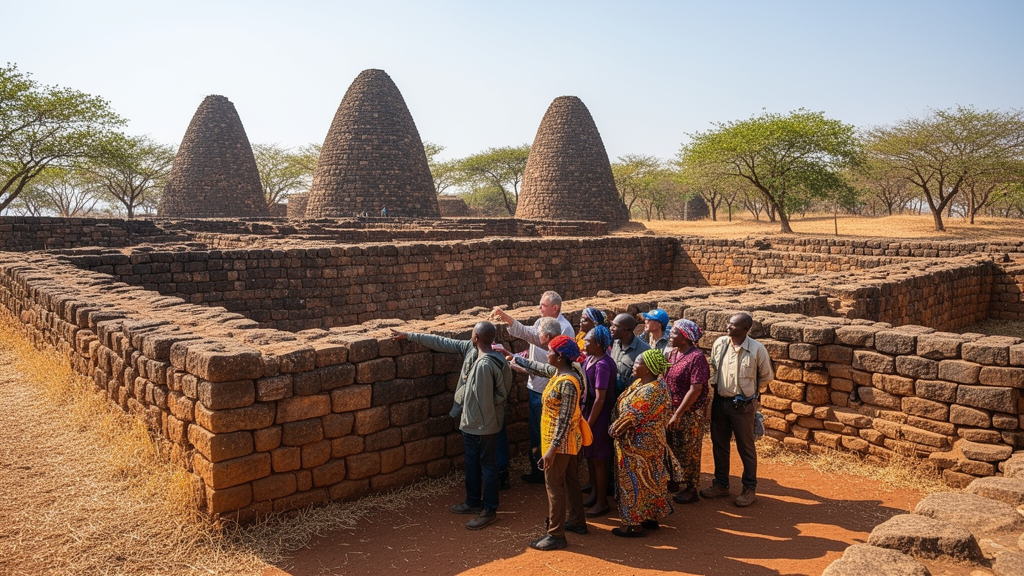
Archaeological surveys and ethnographic fieldwork conducted across northwestern Zimbabwe demonstrate that descendant communities selectively remember and conserve precolonial monumental dry-stone settlements based on direct ancestral linkages and ritual utility rather than physical architecture alone. Investigating the cultural landscape of Hwange district, researchers examined how populations descended from the precolonial Nambya state engage with monumental dry-stone structures belonging to the broader Zimbabwe Culture tradition. While state management frameworks evaluate monuments through structural preservation and formal antiquity, host communities apply lived social criteria that elevate specific burial places and political seats into sacred cultural landmarks while leaving dozens of architecturally comparable stone enclosures uncelebrated and uninherited across the regional landscape.
The study focused on the territory once occupied by the precolonial Nambya state, a complex sociopolitical formation that flourished in northwestern Zimbabwe until its decline during the early part of the twentieth century. Earlier regional records documented three prominent monumental stone-walled complexes associated with this polity, identified as Bumbusi, Shangano, and Matowa. However, systematic archaeological surveys conducted between 2017 and 2024 confirmed and documented an additional fourteen dry-stone-built places of varying sizes across communal lands and protected reserves. Despite sharing core masonry characteristics, construction styles, and cultural material such as graphite-burnished pottery sherds with the well-known centres, these newly recorded structures do not feature in living oral narratives or contemporary community rituals, illustrating how material preservation can diverge from cultural memory.
To investigate the mechanisms driving this differentiation, the research team implemented a multi-method field design combining archival textual analysis, archaeological landscape assessments, and in-depth qualitative interviews across Hwange district. Field surveys involved transect walks through communal settlements and dense tracts of Hwange National Park under the mandatory escort of armed game rangers from the Zimbabwe Parks and Wildlife Management Authority to ensure safety against elephants and lions. Textual analyses evaluated archival holdings, annual administrative reports, historical maps, and inspection dossiers curated at the Zimbabwe Museum of Human Sciences, the University of Zimbabwe libraries, and the National Archives of Zimbabwe. These documentary sources provided contextual records regarding statutory conservation initiatives under the National Museums and Monuments of Zimbabwe alongside historic descriptions of local cultural heritage places.
The ethnographic investigation gathered perspectives through in-depth interviews with 119 purposively selected participants across multiple community strata in the district. The study cohort comprised 92 men and 27 women ranging in age from 40 to 92 years, a demographic intentionally selected because older residents possess sustained experiential familiarity with regional landscapes, customary practices, and historical shifts. The gender composition reflected entrenched local sociopolitical structures in which public discussions of heritage custodianship and traditional governance remain predominantly male-directed. Participants were recruited through combined purposive and snowball sampling, incorporating community members such as Joshua Magomba in the Chisuma area, the five paramount chiefs of Hwange district, their aides, village heads, and traditional custodians recognized locally as authoritative connoisseurs of clan history.
Researchers also gathered testimony from active members of the Nambya Cultural Association, a civic lobby group founded in the early 1960s by educated Catholic-mission-trained Nambya men to document community history and compile inventories of significant ancestral settlements. The oral traditions gathered during fieldwork illustrate contested understandings regarding the origins of the polity. Certain written accounts and oral recollections suggest the founder Sawanga, who later assumed the hereditary title Whange, led a dissident faction away from the Rozvi state capital at Danamombe in central Zimbabwe. Alternate narratives and linguistic commonalities link the Nambya directly to migrations from Great Zimbabwe. Archaeological excavations and material analyses at Shangano indicate that the settlement was contemporaneous with regional centres such as Great Zimbabwe and Khami, showing that archaeological timelines can extend deeper into antiquity than the generations preserved within oral genealogies.
The collected field evidence clarifies why certain dry-stone monuments remain celebrated while nearby structures are allowed to fade from communal consciousness. At Shangano, traditional site custodian Martin Shoko emphasized during an onsite interview that community veneration focuses on the physical burial place of Chief Chilobamago rather than architectural ingenuity or ancient masonry skills. Because of this ancestral burial, access to Shangano requires strict spiritual protocols administered by a custodian appointed from the Chilanga clan according to customary lineage rules. Entering the enclosure without formal custodial permission is viewed as a serious breach of customary law that risks village court sanctions and ancestral retribution, maintaining Shangano as an active, sacred cultural sanctuary.
Similar dynamics of selective remembrance govern the other two major celebrated sites within Hwange National Park. Matowa, located approximately twenty kilometres south of Shangano, retains enduring prominence in oral histories as the recognized burial ground of Nyanga, a founding leader of the precolonial Nambya state, even though strict national park regulations limit access for recurring ritual ceremonies. Bumbusi is likewise revered as a politically and spiritually potent center linked to the Hwange kingship, rainmaking supplications, and historical accounts of armed resistance against nineteenth-century Ndebele incursions. Community elders such as village head Simon Move maintained that Bumbusi must not be characterized as an abandoned archaeological ruin, but rather understood as a living home for ancestral spirits requiring continuous communal engagement beyond sporadic periods of ecological crisis or drought petitioning.
In sharp contrast to the sacred protections surrounding Shangano, Matowa, and Bumbusi, the remaining fourteen documented stone-walled complexes receive minimal ceremonial reverence and are absent from oral tradition. Local residents readily recognize places such as Holobele as ancient settlements erected by ancestral populations, yet they do not impose custodial visitation restrictions or hold commemorative ceremonies at these locations. Consequently, surrounding communities routinely utilize the uncelebrated enclosures for everyday economic activities, including livestock grazing. Because these sites lack documented links to specific named royal ancestors or vital clan rituals, they function as uninherited pasts that hold acknowledged archaeological antiquity but lack immediate spiritual utility.
The vulnerability of these uninherited places is underscored by physical events within the landscape, such as the dismantling of Lwukwalwabashaninga in 2013. Situated in the Shangano communal area, Lwukwalwabashaninga possessed stone architecture comparable to the nearby Shangano complex, yet villagers dismantled its walls to repurpose dressed stone blocks for a local community dam and vehicle river crossings along the Lukosi River. Field interviews indicated that participating elders were unaware that extracting masonry breached Section 25 of the National Museums and Monuments Act Chapter 25:11, which penalizes the unauthorized alteration, damage, or removal of protected monuments. Former Nambya Cultural Association chairperson Gabriel Ncube explained that local valuation hinges upon chieftainship politics and ancestral attribution; when historical memory fails to identify which ruler was interred at a site such as Chimwala, ceremonial neglect and physical vulnerability typically follow.
These observations illustrate a systemic disconnect between state-administered preservation models and living community heritage practices. Official regulatory structures in Zimbabwe, operating through the National Museums and Monuments of Zimbabwe under statutory provisions established in 1972, align with what international heritage scholars define as the Authorised Heritage Discourse. This top-down administrative philosophy evaluates cultural remains primarily through physical monumentality, architectural integrity, and static material preservation overseen by bureaucratic and academic specialists. Concurrently, environmental administration by the Zimbabwe Parks and Wildlife Management Authority inside Hwange National Park prioritizes natural conservation and wildlife tourism across 54 percent of the district, leaving monumental walls exposed to elephant damage while park regulations impede local elders from conducting traditional ceremonies.
The study concludes that heritage significance is an ongoing, socially negotiated process shaped by immediate cultural usability rather than an inherent quality embedded in stone architecture. Dry-stone settlements that sustain the spiritual, political, and land legitimacy claims of contemporary chiefdoms are actively remembered, protected, and incorporated into living heritage. Conversely, monumental structures whose specific historical narratives have lapsed become uninherited and forgotten, regardless of their archaeological antiquity or legal monument status under national legislation. The authors emphasize that international heritage governance must move beyond rigid material-focused models to incorporate local memory systems, customary custodial authority, and ritual relationships into regional conservation strategies.
Subject of Research: Archaeological and ethnographic investigation of community heritage selection and precolonial stone settlements in northwestern Zimbabwe
Article Title: ‘Some pasts are more important than others’: remembering and conserving built heritage places among descendants of the precolonial Nambya state in northwestern Zimbabwe
Article References: Sagiya, M. E., & Shenjere-Nyabezi, P. (2026). ‘Some pasts are more important than others’: remembering and conserving built heritage places among descendants of the precolonial Nambya state in northwestern Zimbabwe. Built Heritage, 10(1), Article 36. https://doi.org/10.1186/s43238-026-00273-9
Image Credits: AI Generated
DOI: 10.1186/s43238-026-00273-9
Keywords: archaeology, precolonial history, Zimbabwe Culture, Nambya state, heritage management, cultural preservation, oral history, ethnography, Some, pasts, important, than
News Source: Courtney Benton. (November 9, 2026). Archaeologists Document Why Descendant Communities Selectively Remember Precolonial Zimbabwe Stone Settlements. Scienmag.