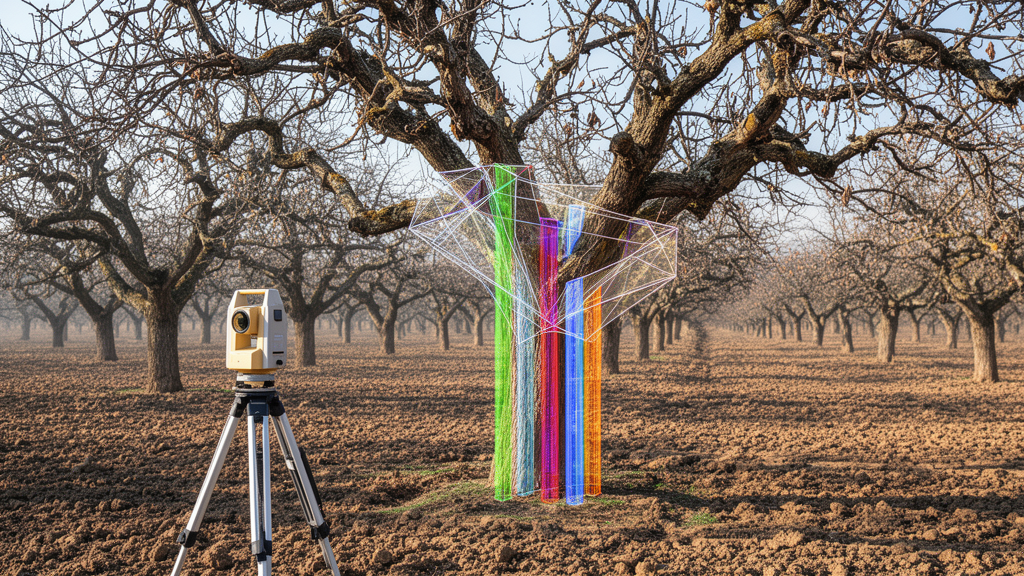
In an agricultural engineering study evaluating algorithmic structural modeling of fruit trees, researchers have demonstrated the first application of SmartQSM to reconstruct the intricate three-dimensional architecture of dormant walnut trees. Digital tree reconstruction serves as a critical technological foundation for modern orchard management, supporting computational simulations of light distribution, canopy ventilation evaluations, and precision automated pruning strategies. However, fruit trees such as walnuts present dense branch canopies and layered spatial intersections that create severe point cloud occlusions, frequently causing conventional modeling tools to miscalculate structural dimensions or fail to resolve branch hierarchies.
To rigorously assess how different algorithmic paradigms handle these complex branching architectures, the investigation systematically compared three distinct Quantitative Structure Model architectures: TreeQSM version 2.4.1, AdQSM version 1.7.5, and SmartQSM version 2.2.0. In addition, the research examined two internal operational schemes for SmartQSM, contrasting a deterministic traditional geometric approach based on flexible layerwise clustering with a deep learning framework that employs iterative point cloud contraction driven by a sparse convolutional residual U-shaped network. By comparing algorithmic predictions against manual field measurements across sixteen randomly selected sixteen-year-old walnut trees, the study established exact deviation profiles, computational requirements, and parameter dependencies for each modeling approach.
Field data collection was carried out in an experimental orchard situated in Aksu Prefecture within Xinjiang, China, utilizing sixteen-year-old trees of the ‘Wen 185’ walnut cultivar planted at spacings of approximately four to five meters. To eliminate noise interference caused by foliage, scans were performed at the end of November 2025 during the deciduous leaf-falling stage under clear, windless environmental conditions. The researchers acquired dense structural scans using two complementary systems: a LiGrip H300 handheld LiDAR scanner operated along a continuous S-shaped path at chest height, and a Zenmuse L2 sensor mounted on a DJI M350 RTK unmanned aerial vehicle operating at an altitude of forty meters with a non-repetitive five-echo scanning mode.
Following raw collection, data from both platforms underwent a rigorous preprocessing sequence. Orchard boundaries were manually cropped in CloudCompare software with a two-meter perimeter margin. The aerial and ground-based point clouds were merged through coarse point-pair matching and fine registration using the iterative closest point algorithm, achieving a residual alignment error of 0.042 meters across 53,561,722 merged points. The combined cloud was then subsampled with a uniform minimum point spacing of 0.0120 meters, filtered of ground surface points using the Cloth Simulation Filter algorithm with a 2.0-meter mesh resolution, and cleaned of aerial noise using Statistical Outlier Removal, yielding a final preprocessed dataset of 12,405,582 non-ground points that was segmented into individual tree files.
Computational performance varied substantially across the three evaluated structural frameworks during single-tree processing. AdQSM demonstrated the lowest resource requirement, completing individual tree reconstructions in approximately 10 seconds while consuming 30 megabytes of memory. In contrast, SmartQSM required roughly 35 seconds and 1.65 gigabytes of memory, while TreeQSM needed approximately 42 seconds and 123 megabytes of memory. While AdQSM exhibited the highest operational throughput, its generative spanning tree refinement approach struggled to accurately represent irregular lower trunk geometries and dense terminal twig clusters characteristic of mature orchard canopies.
Before conducting cross-model benchmarking, the team evaluated the internal parameter dynamics of SmartQSM using variance-based Sobol global sensitivity analysis implemented through the Python SALib library. For the deep learning contraction scheme, sensitivity indices stabilized at a base sample size of N = 128, corresponding to 1,024 model runs per tree across three core parameters. The voxel size parameter emerged as universally dominant across all ten tested structural metrics, displaying first-order and total sensitivity values exceeding 0.72 for branch count and internal stem volume, with minimal interactive effects. Conversely, the flexible layerwise clustering scheme exhibited strong multi-parameter interactions, where individual parameters showed low first-order effects but combined to exert dominant total effects on trunk and volume metrics.
When comparing algorithmic outputs against physical measurements, the deep learning configuration of SmartQSM demonstrated the highest overall accuracy for three-dimensional canopy and vertical parameters. For crown volume, it achieved a coefficient of determination of 0.905, a root mean square error of 16.429 cubic meters, and a relative root mean square error of 14.449 percent, outperforming TreeQSM, AdQSM, and the geometric clustering scheme. Tree-level bootstrap resampling across 5,000 iterations confirmed the stability of this volume prediction, yielding an estimated root mean square error of 16.365 cubic meters within a 95 percent confidence interval spanning 13.176 to 19.437 cubic meters.
Vertical structural parameters also showed exceptional precision under the deep learning SmartQSM model. Tree height estimation achieved a coefficient of determination of 0.904, a root mean square error of 0.264 meters, and a relative error of 3.287 percent, with a bootstrap 95 percent confidence interval of 0.171 to 0.344 meters. For bole height, which measures the distance from the tree base to the initial living crown branches, the deep learning configuration achieved an R² of 0.736 and a root mean square error of 0.182 meters. In contrast, AdQSM exhibited severe geometric distortion in bole height estimation, producing a root mean square error of 1.321 meters and an excessive relative error of 208.603 percent.
While the deep learning model dominated volumetric and height extractions, other models retained specific advantages for horizontal and stem attributes. In measuring mean crown diameter, TreeQSM achieved the highest linear fit with an R² of 0.614, though AdQSM maintained the lowest absolute error with a root mean square error of 0.439 meters and a bias of 0.191 meters. For diameter at breast height measured at 1.3 meters, the flexible layerwise clustering configuration of SmartQSM yielded the closest agreement, recording an R² of 0.537 and a root mean square error of 2.342 centimeters, whereas AdQSM generated extreme trunk overestimations with an error of 8.281 centimeters.
Visual inspection of the reconstructed geometric meshes revealed distinct structural characteristics reflecting each model’s foundational mathematics. SmartQSM preserved fine, multi-scale lateral branch hierarchies extending toward the outer canopy boundary, resulting in a realistic, detailed canopy surface. AdQSM accurately delineated primary structural limbs and trunk continuity but omitted or oversimplified fine higher-order twigs. Meanwhile, TreeQSM favored cylinder simplification across the primary trunk and major scaffold limbs, but its upper patch diameter limits caused adjacent small twigs in dense canopy zones to merge together, resulting in a noticeably sparse outer canopy representation.
The authors noted several operational limitations inherent in the current experimental design that warrant consideration when interpreting the results. The validation cohort was restricted to sixteen dormant trees from a single orchard cultivar, preventing immediate extrapolation to foliated summer canopies, alternative training regimes, or diverse fruit species. Additionally, the point cloud workflow relied entirely on fused sensor data without conducting ablation trials to measure the precise independent contributions of aerial versus handheld scanning, while internal branch-level topological accuracy was evaluated qualitatively due to the absence of destructive reference measurements.
Despite these constraints, the comparative findings confirm that deep learning contraction models provide a reliable computational framework for capturing the irregular, occluded crown architectures of dormant fruit trees. By producing accurate estimations of crown volume, overall tree height, and branch topological frameworks, the evaluated quantitative structure models establish an empirical baseline for digital orchard management, offering essential input geometries for computational light penetration modeling, yield forecasting, and robotic pruning systems.
Subject of Research: Comparative structural parameter extraction and 3D modeling of dormant walnut trees using quantitative structure models
Article Title: Comparative assessment of quantitative structure models for dormant walnut tree structure reconstruction
Article References: Luo, L., Guo, Z., Chen, J., Qi, J., Zhang, Y., Hu, H., Chen, Y., & Zhang, R. (2026). Comparative assessment of quantitative structure models for dormant walnut tree structure reconstruction. Smart Agricultural Technology, 15, Article 102676. https://doi.org/10.1016/j.atech.2026.102676
Image Credits: AI Generated
DOI: 10.1016/j.atech.2026.102676
Keywords: quantitative structure models, SmartQSM, AdQSM, TreeQSM, walnut trees, LiDAR point clouds, agricultural digitalization, canopy reconstruction, crown volume, tree height, diameter at breast height, bole height, sparse convolutional neural networks, Sobol sensitivity analysis, unmanned aerial vehicle LiDAR, handheld LiDAR scanner
News Source: Alan Morgan. (November 12, 2026). SmartQSM Improves 3D Structure Modeling in Dormant Orchard Walnut Trees. Scienmag.