Aptamers, nucleic acids capable of selectively binding to viruses, proteins, ions, small molecules, and various other targets, are garnering attention in drug development as potential antibody substitutes for their thermal and chemical stability as well as ability to inhibit specific enzymes or target proteins through three-dimensional binding. They also hold promise for swift diagnoses of colon cancer and other challenging diseases by targeting elusive biomarkers. Despite their utility, these aptamers are susceptible to easy degradation by multiple enzymes, presenting a significant challenge.
Credit: POSTECH
Aptamers, nucleic acids capable of selectively binding to viruses, proteins, ions, small molecules, and various other targets, are garnering attention in drug development as potential antibody substitutes for their thermal and chemical stability as well as ability to inhibit specific enzymes or target proteins through three-dimensional binding. They also hold promise for swift diagnoses of colon cancer and other challenging diseases by targeting elusive biomarkers. Despite their utility, these aptamers are susceptible to easy degradation by multiple enzymes, presenting a significant challenge.
Professor Seung Soo Oh and his team from the Department of Materials Science and Engineering at Pohang University of Science and Technology (POSTECH), including Dr. Byunghwa Kang, and Dr. Soyeon V Park, have introduced a breakthrough approach using ionic liquids to address the challenges in functional nucleic acid research, paving the way for diverse applied research. Their findings have been published in Nucleic Acids Research.
Functional nucleic acids are termed as such for their versatility in not only storing and transmitting genetic information in living organisms but also in performing varied functions, such as detecting target molecules or catalyzing biochemical reactions similar to aptamers. However, these nucleic acids face obstacles in research applications due to vulnerability to degradation by hydrolases.3 Conventional preservation methods such as ultra-low-temperature cryogenic storage or chemical modification of nucleic acids fail to inhibit a wide array of enzymes, resulting in significant impairment of the nucleic acids’ useful functions.
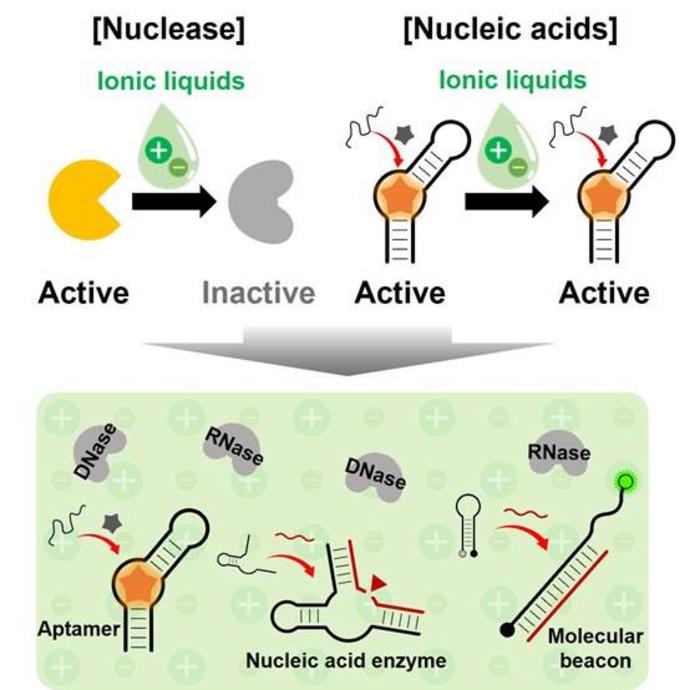
The team shifted away from the conventional belief that “water is essential.” Although nucleic acids serve various roles and exhibit multiple functions in water, enzymes that break them down remain active in this medium. Hence, water acts as both the “home” and the “graveyard” for nucleic acids. The research team marked a significant milestone by globally validating the capability of nucleic acids to retain multiple functions in a choline dihydrogen phosphate-based ionic liquid. This ionic liquid, also present in our bodies, exhibits exceptional biocompatibility. The choline cation within the liquid effectively shields the negative charge of nucleic acids, preventing their contact with water and thereby fundamentally impeding hydrolysis.
In experiments, this liquid created an environment where nucleic acids resisted degradation regardless of the enzyme type, extending their half-life up to 6.5 million times. Even in extreme environments with a mix of seven different hydrolases, the nucleic acids remained completely intact and functional.
Furthermore, the team applied this innovation to enable aptamer-based biomolecular diagnostics within biological solutions for the first time. Previously, saliva containing numerous nucleic acid hydrolases made it impossible to use functional nucleic acids for biomarker detection. However, the team shielded the aptamers with an ionic liquid added to the saliva sample to achieve simple molecular diagnostics.
Professor Seung Soo Oh emphasized, “By demonstrating that nucleic acids can maintain functionality even in unexplored or contaminated samples and body fluids, we’ve demonstrated their limitless application potential.” Dr. Byunghwa Kang expressed hope, stating, “This research will significantly benefit the application of not only nucleic acids but also other molecules susceptible to hydrolysis.”
This research was conducted with support from various institutions, including grants from the National Research Foundation of Korea funded by the Ministry of Science and ICT, the Korea Evaluation Institute of Industrial Technology, the Institute of Civil Military Technology Cooperation funded by the Defense Acquisition Program Administration and the Ministry of Trade, Industry & Energy, the Korea Basic Science Institute, and the Brain Korea 21 FOUR project.
Journal
Nucleic Acids Research
DOI
10.1093/nar/gkad1093
Article Title
Ionic liquid-caged nucleic acids enable active folding-based molecular recognition with hydrolysis resistance
Article Publication Date
22-Nov-2023