• HOME
  • NEWS
  • EXPLORE
    • CAREER
      • Companies
      • Jobs
    • EVENTS
    • iGEM
      • News
      • Team
    • PHOTOS
    • VIDEO
    • WIKI
  • BLOG
  • COMMUNITY
    • FACEBOOK
    • INSTAGRAM
    • TWITTER
Sunday, June 28, 2026
BIOENGINEER.ORG
No Result
View All Result
  • Login
  • HOME
  • NEWS
  • EXPLORE
    • CAREER
      • Companies
      • Jobs
        • Lecturer
        • PhD Studentship
        • Postdoc
        • Research Assistant
    • EVENTS
    • iGEM
      • News
      • Team
    • PHOTOS
    • VIDEO
    • WIKI
  • BLOG
  • COMMUNITY
    • FACEBOOK
    • INSTAGRAM
    • TWITTER
  • HOME
  • NEWS
  • EXPLORE
    • CAREER
      • Companies
      • Jobs
        • Lecturer
        • PhD Studentship
        • Postdoc
        • Research Assistant
    • EVENTS
    • iGEM
      • News
      • Team
    • PHOTOS
    • VIDEO
    • WIKI
  • BLOG
  • COMMUNITY
    • FACEBOOK
    • INSTAGRAM
    • TWITTER
No Result
View All Result
Bioengineer.org
No Result
View All Result
Home NEWS Science News Chemistry

Applying precious metal catalysts economically

Bioengineer by Bioengineer
May 15, 2019
in Chemistry
Reading Time: 3 mins read
0
IMAGE
Share on FacebookShare on TwitterShare on LinkedinShare on RedditShare on Telegram

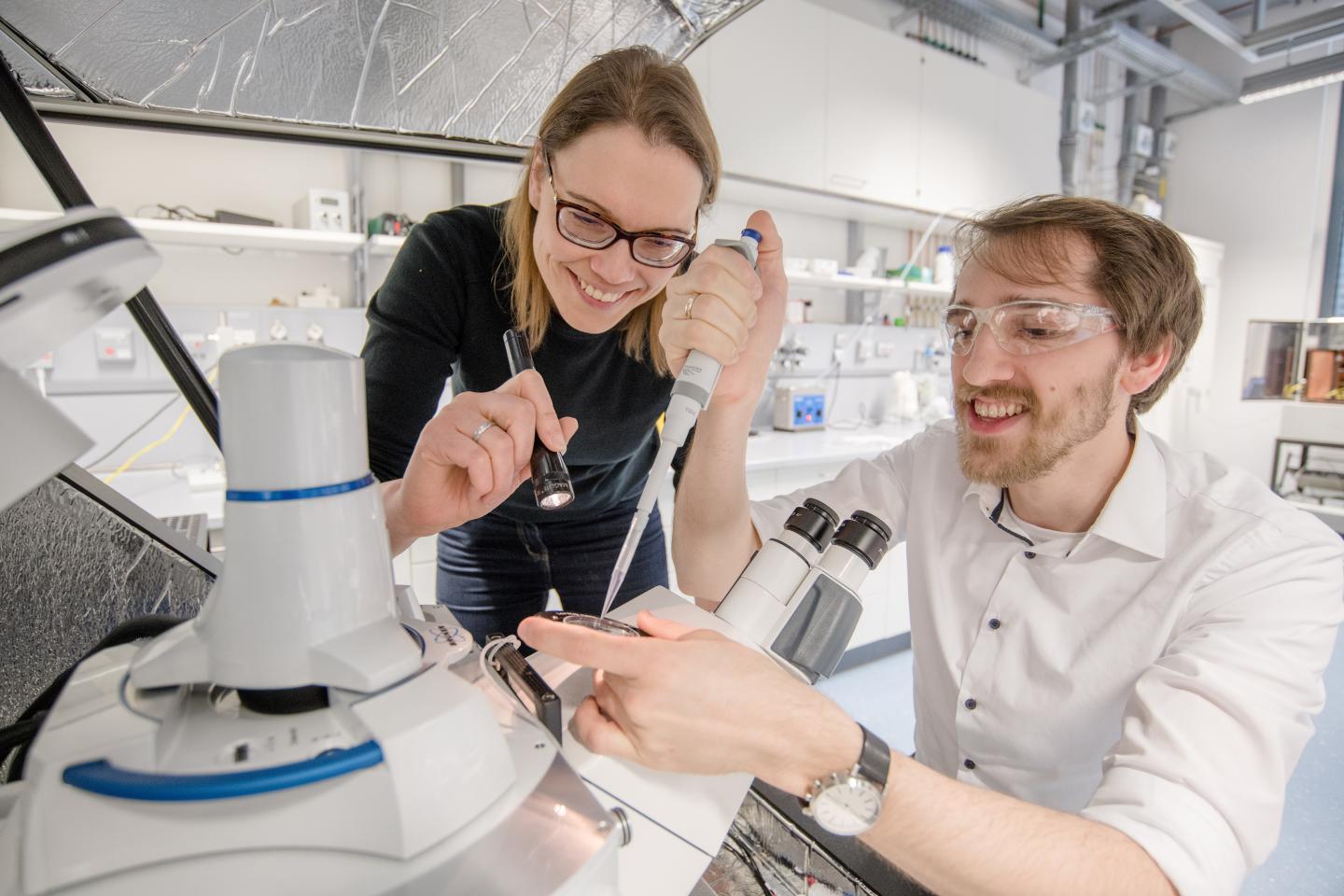
This new method makes it possible to save material
IMAGE

Credit: RUB, Marquard

Researchers at Ruhr-Universität Bochum and the Fritz Haber Institute Berlin have developed a new method of using rare and expensive catalysts as sparingly as possible. They enclosed a precious metal salt in outer shells, tiny micelles, and had them strike against a carbon electrode, thus coating the surface with nanoparticles of the precious metal contained in the micelles. At the same time, the team was able to precisely analyse how much of the metal was deposited. The researchers then showed that the electrode coated in this manner could efficiently catalyse the oxygen reduction, which is the limiting chemical process in fuel cells.

The team led by Professor Kristina Tschulik and Mathies Evers from the Bochum Research Group for Electrochemistry and Nanoscale Materials describes the process in the journal Angewandte Chemie, published online in advance on 11 April 2019.

Producing particles of the same size

The research group produced the gold nanoparticles with the help of micelles. The particles initially consisted of a precursor substance, chloroauric acid, which was wrapped in an outer polymer shell. The benefit: “When we produce gold nanoparticles using micelles, the nanoparticles are all of an almost identical size,” says Kristina Tschulik, a Principal Investigator of the Cluster of Excellence Ruhr Explores Solvation (Resolv). Only a certain load of the precursor material, from which a single particle of a certain size is produced, fits inside the small micelles. “As particles of different sizes have different catalytic properties, it is important to control the particle size by means of the load quantity of the micelle,” adds Tschulik.

Uniform coating, even on complex surfaces

To coat the cylindrical electrode, the researchers immersed it in a solution containing the loaded micelles and applied a voltage to the electrode. The random motion of the micelles in the solution caused them to strike against the electrode surface over time. There, the outer shell burst open and the gold ions from the chloroauric acid reacted to form elemental gold, which adhered to the electrode surface as a uniform layer of nanoparticles. “Only flat substrates can be coated uniformly with nanoparticles using standard methods,” explains Tschulik. “Our process means that even complex surfaces can be loaded uniformly with a catalyst.”

Separated quantity precisely controllable

While the gold ions from the chloroauric acid react to form elemental gold, electrons flow. By measuring the resulting current, the chemists can determine exactly how much material was used to coat the electrode. At the same time, the method registers the impact of each individual particle and its size.

The researchers successfully tested the oxygen reduction reaction of the electrodes coated using the new process. They achieved an activity as high as that of naked gold nanoparticles without an outer shell. Due to the uniform coating of the surface, they also observed a reaction rate almost as high as that of electrodes completely covered with gold and solid gold electrodes at just eleven percent coverage.

###

Media Contact
Kristina Tschulik
[email protected]

Original Source

https://news.rub.de/english/press-releases/2019-05-15-chemistry-applying-precious-metal-catalysts-economically

Related Journal Article

http://dx.doi.org/10.1002/anie.201813993

Tags: Chemistry/Physics/Materials SciencesIndustrial Engineering/ChemistryMaterialsNanotechnology/Micromachines
Share12Tweet8Share2ShareShareShare2

Related Posts

AI and Physics Collaborate to Design Advanced Hydrogen Storage Materials

June 25, 2026

International Team Including Dresden Scientists Develops Novel Designer Proteins for Advanced Study of Living Tissue

June 25, 2026

New Study Uncovers Key Factors Driving Water Chemistry in Nanoscale Environments

June 25, 2026

Plasma Technology Extends Catalyst Lifespan in Hydrogen Production

June 24, 2026
Please login to join discussion

POPULAR NEWS

  • Saying Goodbye to PGY-6: Pediatric Fellowship Realities

    103 shares
    Share 41 Tweet 26
  • Multi-Hospital Study Reveals Long Covid Burden Is Twice as High as Current Estimates

    92 shares
    Share 36 Tweet 23
  • Detection of EDCs in Breast Milk and Infant Urine Up to Six Months Highlights Early Exposure Risks

    77 shares
    Share 31 Tweet 19
  • New Drug Candidate Developed at McMaster Shows Potential for Treating Brain Cancer

    58 shares
    Share 23 Tweet 15

About

We bring you the latest biotechnology news from best research centers and universities around the world. Check our website.

Follow us

Recent News

Tracking Lanthanide-Labeled Microplastics in Plants

POSTECH Researchers Slash Cost of Reconstituted Cell-Free Systems by 95%

AI and Physics Collaborate to Design Advanced Hydrogen Storage Materials

Subscribe to Blog via Email

Success! An email was just sent to confirm your subscription. Please find the email now and click 'Confirm' to start subscribing.

Join 82 other subscribers
  • Contact Us

Bioengineer.org © Copyright 2023 All Rights Reserved.

Welcome Back!

Login to your account below

Forgotten Password?

Retrieve your password

Please enter your username or email address to reset your password.

Log In
No Result
View All Result
  • Homepages
    • Home Page 1
    • Home Page 2
  • News
  • National
  • Business
  • Health
  • Lifestyle
  • Science

Bioengineer.org © Copyright 2023 All Rights Reserved.