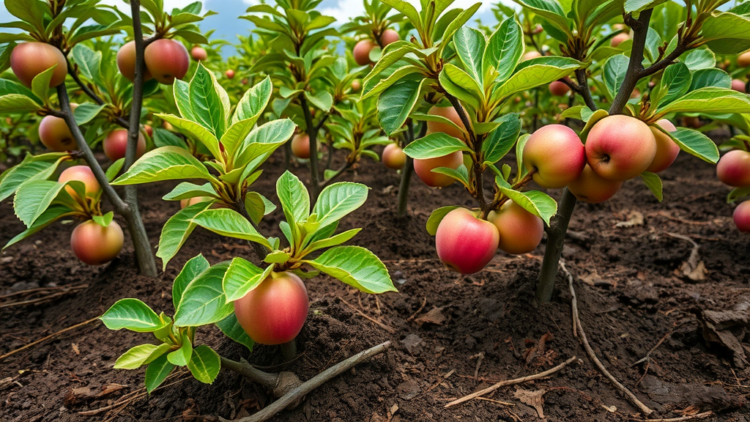
In the steep, rain-washed valleys of the northwestern Himalayas, a quiet contest is underway beneath farmers’ feet. A new field study from the Rohru region of Himachal Pradesh, India, shows that the way land is used — whether under annual crops, apple orchards, mixed apple-and-crop agroforestry, or left barren — leaves a deep and measurable imprint on the soil’s capacity to store carbon and nitrogen. The findings, published in the Journal of Agriculture and Food Research, offer some of the most detailed evidence yet that tree-based farming systems in wet temperate mountains can dramatically outperform conventional agriculture as repositories of climate-stabilizing soil organic matter.
The research team, led by Alisha Keprate with D.R. Bhardwaj, Prashant Sharma, and Rushal Dogra, sampled soils across four contrasting land-use systems at two topographic positions — sheltered valley floors and cooler mountain slopes — and at three depths reaching down to 60 centimeters. Their study area, spanning roughly 1,543 to 2,396 meters above sea level in the Lesser Himalayan range, receives about 850 millimeters of annual precipitation, mostly from the southwest monsoon, and its Brown Podzolic soils sit on slopes of 15 to 35 percent. This combination of high rainfall, rugged relief, and intensive smallholder farming makes the region a natural laboratory for studying how land management reshapes one of the planet’s largest terrestrial carbon pools.
Soil organic carbon is not a single substance but a family of fractions that differ sharply in how quickly they turn over. The researchers used a modified Walkley-Black oxidation procedure, applying sulfuric acid at increasing concentrations to separate very labile, labile, less labile, and non-labile carbon pools. The two most easily oxidized fractions together form the active pool, which fuels rapid nutrient cycling, while the more resistant fractions make up the passive pool, the long-term reservoir that locks carbon away for decades or centuries. Alongside these fractions, the team computed the lability index, carbon pool index, and carbon management index — composite metrics that translate raw chemistry into practical measures of soil health and management performance.
The results were striking. Agroforestry plots, in which ten-to-fifteen-year-old apple trees grow alongside annual crops such as peas, beans, rajmash, potatoes, and barley, recorded the highest total organic carbon at 19.83 milligrams per gram of soil — roughly 50 percent more than adjacent agricultural plots growing potatoes, peas, and barley, and more than double the 9.72 milligrams per gram found on barren reference land. Apple monoculture orchards fell in between at 17.71 milligrams per gram. The same hierarchy held for nearly every carbon fraction: the active carbon pool reached 11.26 milligrams per gram under agroforestry compared with just 4.38 on barren land, while the passive pool peaked at 8.57 milligrams per gram in the tree-based system. Soil carbon density followed suit, climbing to 48.59 megagrams per hectare under agroforestry against a meager 25.59 on barren ground.
The carbon management index told an even more compelling story. Relative to the barren reference, the index rose by 137 percent under agroforestry, 114 percent under horticulture, and 44 percent under agriculture. Because this index integrates both the size of the carbon pool and the lability of its constituent fractions, the authors argue it captures a genuine improvement in the quantity and quality of soil carbon under tree-based management. The mechanism, they suggest, is a steady supply of organic matter — leaf litter, pruning residues, root biomass, and root exudates — that feeds microbial communities, promotes stable soil aggregates, and builds organo-mineral associations. Apple leaf litter, rich in phenolic compounds, may further slow decomposition and favor gradual nutrient release, tipping the balance toward carbon stabilization rather than loss.
Topography proved to be a second, independent sculptor of soil carbon. Valley soils, warmer and biologically livelier, held more of the fast-cycling active fractions: very labile carbon reached 5.14 milligrams per gram there, against 3.99 on mountain slopes, and the active pool overall measured 9.08 versus 6.73 milligrams per gram. Mountain soils, by contrast, accumulated more of the recalcitrant material — the passive pool reached 9.04 milligrams per gram on slopes compared with 5.39 in valleys, and non-labile carbon rose to 3.65 milligrams per gram. The researchers attribute this split to cooler slope temperatures that suppress microbial mineralization, strengthen the adsorption of organic matter onto clay minerals, and favor fungal communities that convert labile substrates into stable, microbial-derived organic matter. In effect, valleys recycle carbon quickly while mountains bank it.
Depth added a third dimension to the pattern. Total organic carbon declined steadily from 17.64 milligrams per gram in the surface 0-to-20-centimeter layer to 12.86 at 40-to-60 centimeters, and the active fractions fell in parallel, reflecting the concentration of litter and root inputs near the surface. Yet the non-labile fraction moved in the opposite direction, rising from 2.10 to 3.88 milligrams per gram with depth — a signature of older, more persistent carbon that has escaped rapid decomposition in the subsoil. A principal component analysis confirmed the split, with the first two axes explaining 56.4 percent of total variance and cleanly separating surface, labile, nitrogen-rich soils from deeper horizons dominated by passive fractions.
Nitrogen dynamics mirrored the carbon story. Total nitrogen was highest under agroforestry at 0.092 percent, and soil nitrogen density peaked at 2.27 megagrams per hectare in the tree-crop system, compared with 1.93 under agriculture and 1.94 on barren land. Valley soils again outpaced mountain soils, and all nitrogen measures declined with depth. Ammoniacal nitrogen reached 66.11 milligrams per kilogram under agroforestry, while nitrate nitrogen was highest in horticultural orchards at 61.44 milligrams per kilogram — a difference the authors link to heavy fertilizer inputs and the absence of intercropped plants competing for nitrate uptake in monoculture orchards. Correlation analysis reinforced the coupling of the two nutrient cycles: total organic carbon and total nitrogen were strongly positively correlated, and the carbon management index tracked closely with both carbon lability and nitrogen availability.
Taken together, the findings carry a clear message for the fragile mountains of the Himalayas and beyond: converting conventional annual agriculture to apple-based agroforestry could simultaneously enlarge the soil’s carbon bank, improve its nitrogen capital, and boost the overall carbon management index — a trifecta for climate-resilient mountain farming. The authors caution that their study reflects a single sampling period and that the underlying biological and physicochemical mechanisms were inferred rather than directly measured. Even so, in a region where steep slopes, erodible soils, and shifting land use threaten both livelihoods and carbon stocks, the evidence that mixing trees with crops builds richer, more stable ground adds scientific weight to a strategy many Himalayan farmers have practiced for generations — and gives policymakers a quantified reason to encourage it.
Subject of Research: Effects of land-use type, topographic position, and soil depth on soil organic carbon fractions and nitrogen dynamics in the wet temperate northwestern Himalayas
Article Title: Land-use and topographic effects on soil carbon and nitrogen fractions across contrasting land-use systems in the wet temperate northwestern Himalayas
Article References: Keprate, A., Bhardwaj, D., Sharma, P., & Dogra, R. (2026). Land-use and topographic effects on soil carbon and nitrogen fractions across contrasting land-use systems in the wet temperate northwestern Himalayas. Journal of Agriculture and Food Research, 31, Article 103262. https://doi.org/10.1016/j.jafr.2026.103262
Image Credits: AI Generated
DOI: 10.1016/j.jafr.2026.103262
Keywords: soil organic carbon, agroforestry, carbon fractions, carbon management index, soil nitrogen, northwestern Himalayas, land use change, topography, apple orchards, carbon sequestration, soil depth, climate-resilient agriculture
Cite Scienmag News
APA
MLA
Chicago
Alan Morgan. (September 12, 2026). Apple-Based Agroforestry Emerges as a Soil Carbon Champion in the Himalayas. Scienmag. https://scienmag.com/apple-based-agroforestry-emerges-as-a-soil-carbon-champion-in-the-himalayas/
Alan Morgan. “Apple-Based Agroforestry Emerges as a Soil Carbon Champion in the Himalayas.” Scienmag, 12 September 2026, https://scienmag.com/apple-based-agroforestry-emerges-as-a-soil-carbon-champion-in-the-himalayas/. Accessed 12 September 2026.
Alan Morgan. “Apple-Based Agroforestry Emerges as a Soil Carbon Champion in the Himalayas.” Scienmag. September 12, 2026. https://scienmag.com/apple-based-agroforestry-emerges-as-a-soil-carbon-champion-in-the-himalayas/
Copy citation
Download RIS
Tags: agroforestryapple agroforestryapple orchardscarbon fractionscarbon management indexcarbon sequestrationclimate benefits of orchard-based farmingclimate-resilient agricultureHimalayan apple farming and climate changeimpact of land use on soil organic matterland use changemountain agroforestry systemsnorthwestern Himalayasrain-fed mountain agriculturesmallholder agroforestry in the Himalayassoil carbon sequestration in Himalayassoil depthsoil health in temperate mountain regionssoil nitrogensoil nitrogen storage in Himalayan agriculturesoil organic carbonsustainable farming practices in Himachal Pradeshtopographytopography and soil carbon in Himalayan valleys