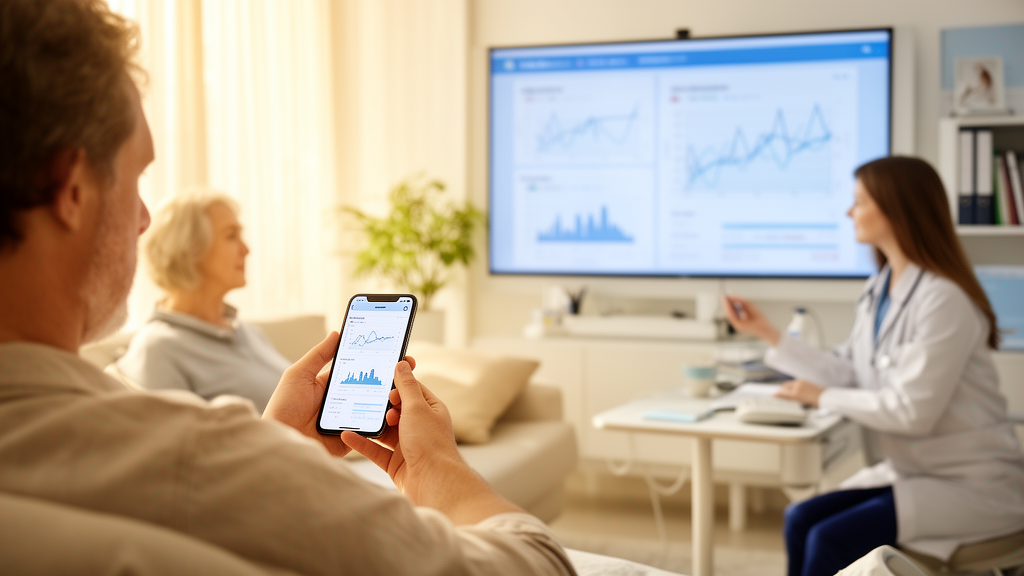
The days and weeks after a patient leaves the operating room are among the most precarious in modern medicine. Once the hospital doors close behind them, surgical patients enter a recovery phase with remarkably little direct supervision, relying on their own judgment about when a symptom is worth a phone call. A new analysis presented at the ANESTHESIOLOGY 2026 annual meeting in San Diego suggests that the smartphone in a patient’s pocket may help close that supervision gap, but only if a human being is paying attention to what the device collects.
Researchers led by Mouad Elganga, a medical student at the Temerty Faculty of Medicine at the University of Toronto, pooled evidence from 38 studies encompassing 7,507 patients to determine whether mobile app-based home monitoring improved recovery after surgery. The answer was nuanced. Patients enrolled in app-based monitoring programs had a 22 percent lower risk of major postoperative complications and a 22 percent lower risk of emergency room visits compared with those receiving standard postoperative care. Hospital readmissions fell by 15 percent. Yet the technology itself was not the active ingredient: readmissions dropped only in programs where a physician, surgeon or nurse actually reviewed the information patients submitted and could intervene when warning signs appeared. Programs that collected data without clinician review showed no reduction in readmissions at all.
The programs varied considerably in design, but most shared a common architecture. Patients completed daily check-ins on a smartphone or web portal, reporting symptoms such as pain, fever, nausea and the appearance of their surgical wounds. Some programs layered in wearable fitness trackers or Bluetooth-enabled devices, including blood pressure cuffs, thermometers and pulse oximeters that measure blood oxygen levels. This stream of patient-generated data, in principle, gives surgical teams a continuous window into recovery that traditional follow-up, typically a single office visit one to two weeks after discharge, simply cannot provide.
Elganga emphasized that the app alone is not a safety net. “Just using an app may not make recovery safer,” he said. “The biggest benefit occurs when a clinician is actually reviewing what patients send and can act on it. Patients should ask: ‘Who is looking at this information, how quickly will they respond and what happens if something looks wrong?'” The framing is a practical one for patients navigating an increasingly digital health care landscape, where remote monitoring offerings are proliferating faster than the evidence base can evaluate them.
One finding deserves particular scrutiny. The total number of complications did not significantly decline across the pooled studies, which suggests that app-based monitoring may not prevent postoperative problems from arising in the first place. What it appears to do is catch concerning symptoms before they escalate into major complications requiring emergency care, intensive care admission, readmission, an additional procedure or reoperation. In other words, the intervention seems to function less as a shield and more as an early warning system, converting problems that would have surfaced in the emergency department into issues that can be addressed with a phone call, a prescription adjustment or an earlier clinic visit.
The patient experience data adds an important dimension to the clinical outcomes. Patients in the monitoring programs reported less pain and anxiety, better physical function, improved quality of life and greater satisfaction with their care. That combination is notable because pain and anxiety after discharge are not merely comfort issues; uncontrolled pain can limit mobility, which in turn raises the risk of blood clots and pulmonary complications, while anxiety can deter patients from reporting symptoms that matter. A monitoring system that reassures patients while keeping clinicians informed may reinforce recovery along several pathways at once.
The vulnerable window the research targets is well understood in surgical care. Complications such as surgical site infections, bleeding, blood clots and opioid-related adverse events often emerge in the first days to weeks after discharge, precisely when the intensity of clinical oversight falls off sharply. Traditional postoperative care typically consists of discharge instructions, a phone number to call and a scheduled follow-up appointment, leaving patients and families to interpret symptoms on their own. Remote monitoring attempts to extend the hospital’s surveillance reach into the home, and the pooled evidence now suggests that this extension can measurably reduce serious outcomes when it is coupled with clinical responsiveness.
For health systems weighing an investment in app-based monitoring, the findings point to a clear implementation principle: the technology is only as valuable as the clinical workflow built around it. The authors suggest that systems considering such programs should focus not only on the software and devices but also on ensuring that clinicians review patient-submitted information and respond promptly to concerning symptoms. That means staffing, protocols and response-time commitments, not just an app download at discharge. Programs that treat monitoring as a data collection exercise, without a human loop that can act on the data, appear to deliver little measurable benefit.
Patients, too, have a role in making these programs work. The researchers recommend that patients ask who is monitoring the information they submit and what the protocol is if something looks wrong. When a clinician is actively reviewing the data, using the app consistently, completing daily check-ins even on good days, may help the care team identify problems before they become emergencies. Consistency matters because intermittent reporting creates blind spots in exactly the period when complications are most likely to develop.
The research was presented at the ANESTHESIOLOGY 2026 annual meeting, and the society notes that meeting news releases may contain updated data that was not originally available at the time abstracts were submitted. As with any pooled analysis presented at a scientific meeting, the findings await the full scrutiny of peer review and publication, and the heterogeneity of the 38 included programs, from simple symptom check-ins to multi-device remote monitoring, means the results should be interpreted as a broad signal rather than a prescription for any single app. Still, the central message is likely to shape how hospitals design postoperative care in the years ahead: remote monitoring can make the transition from hospital to home safer, but the clinician reviewing the data, not the technology collecting it, is what makes the difference.
Subject of Research: A pooled analysis of 38 studies presented at the ANESTHESIOLOGY 2026 annual meeting found that mobile app-based postoperative monitoring was associated with fewer serious complications, emergency room visits and readmissions, with benefits dependent on clinician review of patient-submitted data.
Article Title: Mobile app monitoring may reduce serious complications after surgery, new study finds
Article References: Mobile app monitoring may reduce serious complications after surgery, new study finds. Original publication (Bibliographic details unavailable.)
Image Credits: AI Generated
DOI: Not provided
Keywords: postoperative care, remote patient monitoring, mobile health apps, surgical complications, hospital readmission, ANESTHESIOLOGY 2026, patient safety, telemedicine, Mobile, monitoring, reduce, serious
News Source: Ophelia Keating. (October 18, 2026). App-Based Monitoring Cuts Post-Surgery Complications When Clinicians Review the Data. Scienmag.