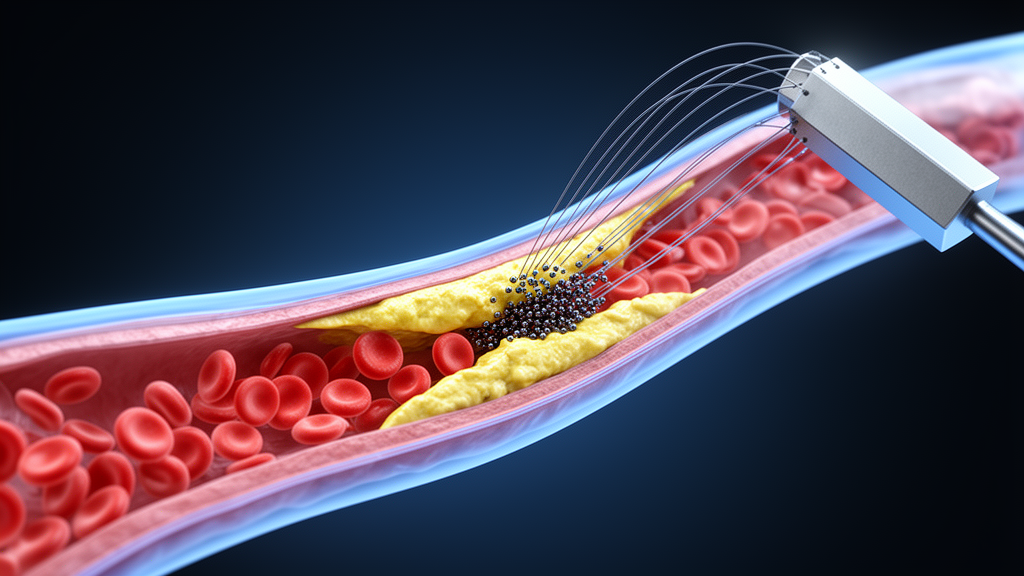
Every heartbeat sends a pulse of blood racing through a network of branching vessels, and when one of those vessels narrows — a condition known as stenosis — the entire choreography of flow changes in an instant. Blood accelerates through the constriction, pressure builds behind the blockage, and the arterial wall, far from being a rigid pipe, flexes and bulges under the shifting load. Now, a team of researchers has built one of the most complete computer simulations of this process to date, capturing not just the fluid mechanics of narrowed arteries but the deformation of the vessel walls, the transport of heat, and even the influence of magnetic damping — all within a single, fully coupled model. The work, published in the journal Results in Engineering, offers a new window into the hidden physics of cardiovascular disease.
The study, led by Arooj Tanveer with Jae Won Heo and Cheolwoo Park, tackles a problem that has long frustrated computational cardiologists: blood is not water. It is a non-Newtonian fluid, thickened by the presence, deformation, and aggregation of red blood cells, and its apparent viscosity changes depending on how hard it is being sheared. In healthy, fast-moving vessels this subtlety barely matters, but near a stenosis — where flow slows, recirculates, and separates — the assumption of constant viscosity breaks down. The team therefore modeled blood using the Casson constitutive relation, a formulation originally developed for printing inks that has become a standard for describing fluids with a yield stress, meaning fluids that behave like solids until enough force is applied to make them flow. Because the ideal Casson model becomes mathematically singular at zero shear rate, the researchers applied a Papanastasiou regularization, smoothing the transition so the equations could be solved stably across the entire flow field.
The simulated geometry is deliberately idealized: a two-dimensional parent vessel one centimeter in characteristic diameter, carrying a fifty percent stenotic constriction, followed by two daughter branches splitting away at thirty-seven degrees. The arterial walls are modeled as elastic solids with geometric nonlinearity enabled, so they can undergo large deformations rather than small perturbations. Crucially, the fluid and the wall are coupled in both directions — a two-way fluid-structure interaction, or FSI, formulation. The pressure and viscous stresses exerted by the flowing blood deform the wall, and the moving wall in turn reshapes the fluid domain, which is handled through an Arbitrary Lagrangian-Eulerian moving mesh that continuously adapts to the changing lumen. This bidirectional coupling is what separates the new work from simpler rigid-wall models, which previous studies have shown can mispredict pressure and shear-related quantities in stenotic vessels.
On top of this mechanical framework, the researchers layered two additional physical mechanisms. The first is conjugate heat transfer: temperature is solved simultaneously in both the flowing blood and the solid arterial wall, with continuity of temperature and heat flux enforced at the fluid-solid interface. The second is magnetic forcing, represented by a dimensionless control parameter labeled Ha, which imposes a resistive body force opposing the streamwise motion of the fluid. The authors are careful to note that Ha in this model is a prescribed dimensionless magnetic-resistance parameter, not a directly converted magnetic-field strength in Tesla — a distinction that matters for anyone hoping to read the results as a prescription for magnetotherapy. The purpose is parametric: to see, under controlled and identical conditions, how inertia, yield-stress behavior, and magnetic resistance each shape the coupled response of the system.
That parametric structure is the study’s real contribution. Three dimensionless numbers govern the simulation: the Reynolds number (Re), which measures the relative strength of fluid inertia; the Bingham number (Bn), which measures the strength of the yield-stress contribution in the Casson fluid; and the magnetic-control parameter (Ha). By varying each in turn while holding everything else constant, the team could isolate effects that previous studies had only examined in isolation or in different combinations. The pulsatile inlet condition — a Fourier-series waveform built from four harmonics — was kept identical across all runs, ensuring that differences in the results came from the parameters and not from changes in the driving heartbeat.
The velocity results follow intuitive lines at first glance. Increasing the Reynolds number from 100 to 500 raised the velocity magnitude through the stenotic throat, while increasing either the Bingham number or the magnetic parameter suppressed flow, with the damping effect of magnetic resistance growing particularly pronounced in the post-stenotic region and downstream branches. But the wall shear stress told a subtler story. In this nondimensional Casson formulation, the maximum wall shear stress actually decreased as the Reynolds number rose — from roughly 0.144 on the upper wall at Re=100 to about 0.032 at Re=500 — because the viscous contribution in the constitutive relation shrinks as Re grows, outweighing the increase in velocity. Wall shear stress is a quantity of genuine clinical interest, since elevated and oscillating shear stress is implicated in endothelial dysfunction and plaque progression, and the finding is a reminder that intuition built on Newtonian, rigid-wall thinking can mislead even experienced modelers.
The Bingham number pushed wall shear stress in the opposite direction, rising from approximately 0.026 to 0.062 on the lower wall as Bn increased from 4 to 15, reflecting the fluid’s growing resistance to deformation near the wall. The magnetic parameter reduced shear stress, but — and this is the result the authors flag as most notable — it simultaneously increased wall displacement and drove the pressure drop up dramatically. As Ha climbed from 0 to 20, the pressure difference between the upstream and downstream measurement points exploded from 0.086 to 4.734, a more than fifty-fold increase, because the resistive force grows quadratically with the parameter. Slower blood, in other words, does not mean a gentler load on the artery: the magnetic resistance reshapes the pressure distribution and transmits larger forces to the vessel wall, producing greater deformation even as the fluid itself decelerates. In a coupled system, velocity and structural stress are not the same currency.
The thermal results added a further layer of complexity. Heat from the prescribed wall temperature gradually penetrated the fluid over the pulsatile cycle, and the stenosis and bifurcation redistributed the temperature field in spatially non-uniform ways. The average Nusselt number — a measure of convective heat transfer at the wall — responded differently on the upper and lower walls, with the lower wall actually showing a slight decrease between Re=100 and Re=300 before both walls reached their highest values at Re=500. The asymmetry stems from the uneven flow redistribution created by the constriction and the branch split, and it underscores a broader lesson of the study: in a stenosed bifurcation, nothing responds uniformly, not even two walls of the same vessel experiencing the same heartbeat.
The authors are appropriately candid about the limits of what they have built. The geometry is two-dimensional and idealized; the wall stiffness is a prescribed computational parameter rather than a physiologically calibrated tissue property; and the magnetic parameter is dimensionless rather than a physical field strength in Tesla. The findings are therefore comparative numerical trends, not patient-specific predictions, and the team explicitly frames the work as a foundation for future extensions to three-dimensional geometries, calibrated material properties, and dimensional magnetic formulations. The model was validated against a published benchmark for conjugate heat transfer in a stenosed bifurcation, with close agreement in the average Nusselt number, and a mesh-independence assessment confirmed that the key monitored quantity changed by less than half a percent across refinement levels.
Even within those constraints, the significance of the work is hard to overstate. Cardiovascular disease remains the leading cause of death worldwide, and the local fluid dynamics inside a narrowed, branching artery — the recirculation zones, the shear gradients, the pressure spikes, the flexing wall — are invisible to clinicians and difficult to measure experimentally. Simulations like this one, which treat the artery as a living, deforming structure bathed in a genuinely non-Newtonian fluid under realistic pulsatile forcing, are how the field gradually builds the predictive understanding needed to interpret what those invisible forces are doing to real vessels. By systematically separating the effects of inertia, yield stress, and magnetic resistance under identical conditions, the study gives future researchers a controlled reference point — and a vivid demonstration that in the coupled physics of blood flow, slowing the river can raise the flood.
Subject of Research: Fluid-structure interaction simulation of non-Newtonian Casson blood flow through a stenosed bifurcating artery
Article Title: Fluid-structure interaction of non-Newtonian Casson fluid bifurcated stenosed artery using Eulerian-Lagrangian approach
Article References: Tanveer, A., Heo, J. W., & Park, C. (2026). Fluid-structure interaction of non-Newtonian Casson fluid bifurcated stenosed artery using Eulerian-Lagrangian approach. Results in Engineering, 32, Article 113477. https://doi.org/10.1016/j.rineng.2026.113477
Image Credits: AI Generated
DOI: 10.1016/j.rineng.2026.113477
Keywords: fluid-structure interaction, Casson fluid, arterial stenosis, hemodynamics, non-Newtonian blood flow, wall shear stress, bifurcating artery, magnetic damping, conjugate heat transfer, computational modeling, pulsatile flow, arterial wall deformation
News Source: Denise Maddox. (October 18, 2026). Scientists Simulate Blood Flow Through Clogged Arteries With Magnetic Control. Scienmag.