• HOME
  • NEWS
  • EXPLORE
    • CAREER
      • Companies
      • Jobs
    • EVENTS
    • iGEM
      • News
      • Team
    • PHOTOS
    • VIDEO
    • WIKI
  • BLOG
  • COMMUNITY
    • FACEBOOK
    • INSTAGRAM
    • TWITTER
Friday, May 1, 2026
BIOENGINEER.ORG
No Result
View All Result
  • Login
  • HOME
  • NEWS
  • EXPLORE
    • CAREER
      • Companies
      • Jobs
        • Lecturer
        • PhD Studentship
        • Postdoc
        • Research Assistant
    • EVENTS
    • iGEM
      • News
      • Team
    • PHOTOS
    • VIDEO
    • WIKI
  • BLOG
  • COMMUNITY
    • FACEBOOK
    • INSTAGRAM
    • TWITTER
  • HOME
  • NEWS
  • EXPLORE
    • CAREER
      • Companies
      • Jobs
        • Lecturer
        • PhD Studentship
        • Postdoc
        • Research Assistant
    • EVENTS
    • iGEM
      • News
      • Team
    • PHOTOS
    • VIDEO
    • WIKI
  • BLOG
  • COMMUNITY
    • FACEBOOK
    • INSTAGRAM
    • TWITTER
No Result
View All Result
Bioengineer.org
No Result
View All Result
Home NEWS Science News Chemistry

Apochromatic X-ray focusing

Bioengineer by Bioengineer
May 16, 2023
in Chemistry
Reading Time: 2 mins read
0
Photograph of the refractive X-ray lens (left bottom corner) compared to a head of matchstick.
Share on FacebookShare on TwitterShare on LinkedinShare on RedditShare on Telegram

Diffractive and refractive lenses are widely used in X-ray analysis and high-resolution X-ray microscopy with many scientific applications in materials science, energy sciences and biology. Nevertheless, both types of X-ray optics suffer from a strong chromatic aberration, meaning that they focus different X-ray energies/wavelengths at different distances along the optical axis. As a result, many high-resolution X-ray analysis techniques can only be implemented with monochromatic X-ray beams, meaning that in many cases a large portion of the X-ray intensity is sacrificed.
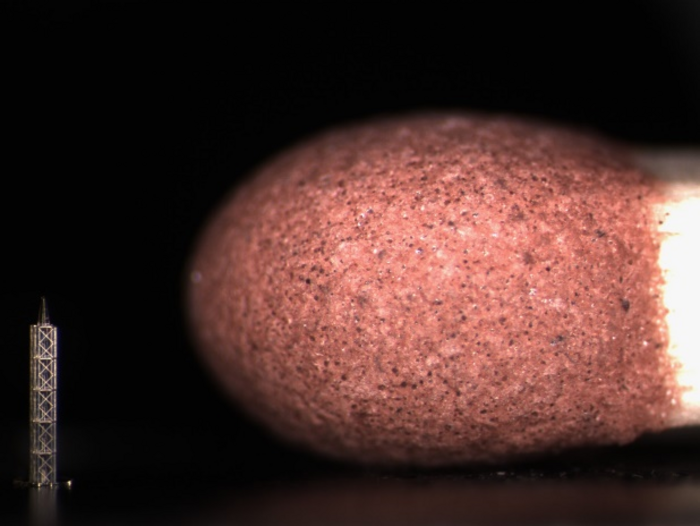
Photograph of the refractive X-ray lens (left bottom corner) compared to a head of matchstick.

Credit: by Umut T. Sanli and Joan Vila-Comamala from Paul Scherrer Institute

Diffractive and refractive lenses are widely used in X-ray analysis and high-resolution X-ray microscopy with many scientific applications in materials science, energy sciences and biology. Nevertheless, both types of X-ray optics suffer from a strong chromatic aberration, meaning that they focus different X-ray energies/wavelengths at different distances along the optical axis. As a result, many high-resolution X-ray analysis techniques can only be implemented with monochromatic X-ray beams, meaning that in many cases a large portion of the X-ray intensity is sacrificed.

The apochromatic X-ray optic consisted of two independent optical elements separated by a distance: a divergent refractive X-ray lens produced by state-of-the-art 3D printing with submicrometer accuracy and a Fresnel zone plate fabricated by electron beam lithography and gold electroplating. These elements were produced in-house using the cleanrooms and nanofabrication facilities at Paul Scherrer Institut. The apochromatic X-ray optics was characterized by scanning transmission X-ray microscopy and ptychographic X-ray imaging. Sub-micrometer apochromatic focusing was achieved for an X-ray energy range from 7 to 12 keV. The X-ray measurements were carried out at beamline P06 at PETRA III, DESY (Hamburg, Germany).

In the future, apochromatic X-ray lenses could emerge a cost-effective and compact alternative to mirror-based systems, with the further advantage of being on-axis imaging optics. They are likely to play an increasingly important role in the field of X-ray imaging and microscopy and for their scientific applications in both accelerator-based and laboratory X-ray sources.


Journal

Light Science & Applications

DOI

10.1038/s41377-023-01157-8

Share12Tweet8Share2ShareShareShare2

Related Posts

Saitama University Researchers Uncover Impact of Sulfur Oxidation States on Sugar-Based Surfactant Behavior — Chemistry

Saitama University Researchers Uncover Impact of Sulfur Oxidation States on Sugar-Based Surfactant Behavior

May 1, 2026
Key Additives Help Perovskite Solar Cells Bypass Yellow Phase and Enhance Longevity — Chemistry

Key Additives Help Perovskite Solar Cells Bypass Yellow Phase and Enhance Longevity

April 30, 2026

DAMPE Satellite Unveils New Insights into the Origins of Cosmic Rays

April 30, 2026

Unveiling the Hidden Framework of a Popular Class of Materials

April 30, 2026

POPULAR NEWS

  • Research Indicates Potential Connection Between Prenatal Medication Exposure and Elevated Autism Risk

    830 shares
    Share 332 Tweet 208
  • New Study Reveals Plants Can Detect the Sound of Rain

    712 shares
    Share 284 Tweet 178
  • Scientists Investigate Possible Connection Between COVID-19 and Increased Lung Cancer Risk

    67 shares
    Share 27 Tweet 17
  • Salmonella Haem Blocks Macrophages, Boosts Infection

    60 shares
    Share 24 Tweet 15

About

We bring you the latest biotechnology news from best research centers and universities around the world. Check our website.

Follow us

Recent News

Stroke Biomarkers: More Translational Research Needed

The Way Cells Replicate DNA Is More Crucial Than Previously Believed

Unlocking Selective Hydrogenation: The Synergistic Power of Ni and Fe

Subscribe to Blog via Email

Enter your email address to subscribe to this blog and receive notifications of new posts by email.

Join 82 other subscribers
  • Contact Us

Bioengineer.org © Copyright 2023 All Rights Reserved.

Welcome Back!

Login to your account below

Forgotten Password?

Retrieve your password

Please enter your username or email address to reset your password.

Log In
No Result
View All Result
  • Homepages
    • Home Page 1
    • Home Page 2
  • News
  • National
  • Business
  • Health
  • Lifestyle
  • Science

Bioengineer.org © Copyright 2023 All Rights Reserved.