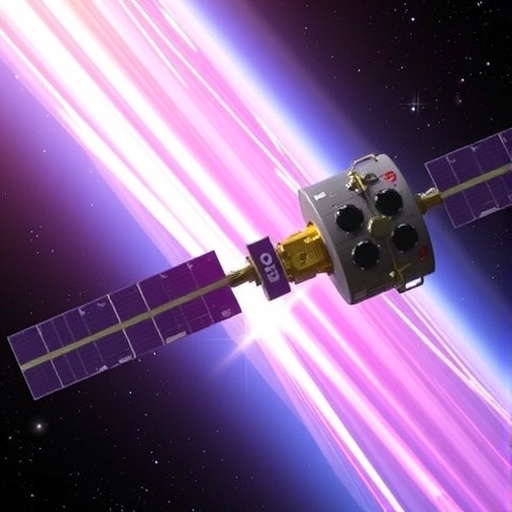
A Century of Cosmic Mysteries: DAMPE’s Breakthrough in Understanding Cosmic Ray Origins
Cosmic rays, a phenomenon that has intrigued scientists for over a hundred years, continue to unveil the mysteries of high-energy particles traveling across the universe. These particles, originating from the most extreme and energetic astrophysical events, bombard Earth incessantly, carrying within them clues about the distant cosmos. Yet, their precise origins and the mechanisms governing their propagation remain elusive. A major leap forward has now been achieved by the Dark Matter Particle Explorer (DAMPE) space telescope, an international collaboration notably including the University of Geneva (UNIGE). By scrutinizing the energy spectra of key cosmic ray nuclei, DAMPE has uncovered a remarkable universal feature, shedding new light on the nature and acceleration of these particles.
Cosmic rays are composed predominantly of protons, but also contain a variety of heavier nuclei such as helium, carbon, oxygen, and iron. These high-energy particles are classified by their energy levels, ranging from low (up to a few billion electron-volts) to intermediate (several billion to hundreds of billions of electron-volts), and extending into the ultra-high energy realm of thousands of billions of electron-volts and beyond. Despite intense study, the mechanisms behind their acceleration and journey through space have posed significant challenges, partly due to the limitations of terrestrial particle accelerators and observational technologies. DAMPE, launched in December 2015, is specifically designed to overcome these hurdles by operating in space, away from Earth’s atmospheric interference.
The core achievement of the DAMPE mission revolves around its detailed and precise measurement of cosmic ray nuclei energy spectra, revealing a universal “spectral softening” phenomenon at a particular rigidity threshold. Rigidity, defined as the resistance of a charged particle’s path to deflection by magnetic fields, is a critical parameter in cosmic ray physics. DAMPE’s observations demonstrate that at around 15 TV (teraelectron-volts) rigidity, the flux of cosmic ray nuclei—across the spectrum from protons to iron—experiences an enhanced rate of decline, more pronounced than previously observed. This consistent behavior across different types of nuclei decisively supports models in which cosmic ray acceleration and transport are governed by rigidity, thereby excluding alternative theories centered on energy per nucleon with extremely high confidence.
This discovery has profound implications for our understanding of both cosmic ray sources and interstellar propagation. The spectral softening suggests that particle acceleration processes in sources such as supernova remnants, pulsars, or black hole jets may be fundamentally limited by rigidity-dependent mechanisms, meaning that heavier nuclei follow similar physical laws but differ primarily because of their charge-to-mass ratio. Furthermore, it informs models of the interstellar medium’s magnetic environment, where cosmic rays diffuse and lose energy before arriving at Earth, thus offering a new lens through which to interpret galactic particle dynamics.
A key strength of the DAMPE project lies in its sophisticated technological instrumentation. The University of Geneva’s astrophysics group made crucial contributions, especially in developing the Silicon-Tungsten Tracker (STK), a sub-detector enabling the precise reconstruction of particle trajectories and accurate charge measurements. Advanced artificial intelligence algorithms were implemented to analyze the complex data stream from DAMPE, refining event reconstruction and distinguishing among particle types with unprecedented accuracy. Such innovation has not only enabled the detection of nuanced spectral features but has also set a new benchmark for cosmic ray observational capabilities.
The implications extend beyond cosmic ray physics into broader astrophysical and particle physics domains. By characterizing the universal rigidity-dependent spectral softening, DAMPE constrains theories about the nature of particle acceleration at cosmic ray sources, impacting models that attempt to link cosmic rays with dark matter signatures or exotic phenomena. As cosmic rays penetrate the galaxy, their energy-dependent journey carries rich information about magnetic turbulence, interstellar shock waves, and the interplay of galactic processes, all of which are now better accessible thanks to the new DAMPE results.
Moreover, DAMPE’s work importantly addresses the so-called “knee” of cosmic ray spectra—a well-known feature where the flux abruptly changes at energies of the order of a few petaelectron-volts (PeV). The detection of spectral softening below this knee offers a finer resolution on the transition in cosmic ray behavior, highlighting how different nuclei approach their acceleration and propagation limits. The insights garnered by DAMPE pave the way for future missions and ground-based experiments seeking to resolve the knee’s remaining puzzles and understand the highest-energy cosmic phenomena.
This breakthrough also exemplifies the increasing fondness for interdisciplinary and international collaboration in modern astrophysics. The multi-institutional partnership spanning countries and combining expertise in particle physics, astrophysics, detector technologies, and computational science has enabled DAMPE’s success. Through this synergy, new pathways open for leveraging machine learning in space-based particle detection and for integrating observational data with theoretical frameworks at a level not possible before.
Looking forward, the ongoing data analysis from DAMPE and complementary projects such as AMS-02 and the Cherenkov Telescope Array will deepen our grasp of cosmic ray origins. The universal spectral softening identified by DAMPE challenges existing models to incorporate rigidity-dependent acceleration and propagation with precise, quantitative accuracy. As these efforts continue, we anticipate transformative insights into the fundamental laws shaping the high-energy universe, potentially unveiling connections to dark matter physics or unknown aspects of interstellar medium structure.
In conclusion, the Dark Matter Particle Explorer’s revelations represent a landmark in cosmic ray research, firmly anchoring the critical role of particle rigidity in their behavior. Beyond confirming long-held theoretical ideas, DAMPE’s findings inspire fresh interpretations of cosmic phenomena, from individual particle acceleration sites to the galactic-scale distribution and interaction of energetic particles. This breakthrough, marked by precision measurement and clever instrumentation, brings us closer to decoding the cosmic messages riding the high-energy particles that ceaselessly traverse our galaxy and cosmos at large.
Subject of Research: Not applicable
Article Title: Charge-dependent spectral softenings of primary cosmic rays below the knee
News Publication Date: 29-Apr-2026
Web References: DOI: 10.1038/s41586-026-10472-0
Image Credits: © Chinese Academy of Science
Keywords
Cosmic Rays, DAMPE, Dark Matter Particle Explorer, rigidity, spectral softening, high-energy particles, cosmic ray origins, particle acceleration, astrophysics, Silicon-Tungsten Tracker, energy spectra, particle propagation
Tags: astrophysical particle accelerationcosmic ray acceleration mechanismscosmic ray nuclei energy spectracosmic ray propagation studiesDAMPE satellite cosmic ray discoveriesdark matter particle explorer findingsheavy nuclei in cosmic rayshigh-energy cosmic particles analysisorigins of cosmic rays researchspace-based cosmic ray observationsultra-high-energy cosmic raysUniversity of Geneva cosmic ray collaboration