


A team of researchers led by Osaka University find an overlap in the pathogenesis of cytokine release syndrome and COVID-19, and show that the symptoms of both can be alleviated by IL-6 signaling blockade
Credit: Osaka University
Osaka, Japan – As countries around the world race to develop a vaccine for SARS-CoV-2, the virus responsible for COVID-19, researchers are working to understand exactly how it causes the myriad of symptoms that seem to linger long after active viral infection. In a study published in scientific journal PNAS, researchers led by Osaka University identified an effective treatment for the deadly over-activation of the inflammatory response seen in many severe COVID-19 patients.
Cytokines are a group of small proteins that can either enhance or inhibit our body’s immune response to infection, trauma, and diseases such as cancer. One of their main roles is to stimulate inflammation, which initiates the healing process. The problem is, overstimulation of the inflammatory response has an array of harmful complications, ranging from asthma to severe autoimmune diseases. One such complication, called cytokine release syndrome (CRS), is seen in patients suffering a hyperimmune response to microbial infection or trauma and can lead to multiple organ failure and even death.
“Despite knowing which cytokines are involved, there is still no specific immunotherapy for CRS and treatment is limited to supportive care,” says study lead author Sujin Kang. “To better understand the molecular mechanisms of CRS pathogenesis, we first studied the cytokine profiles of 91 patients diagnosed with CRS associated with bacterial sepsis, acute respiratory distress syndrome, or burns.”
Strikingly, patients from all three groups had elevated levels of proinflammatory cytokines IL-6, IL-8, IL-10, and MCP-10, as well as a protein called PAI-1, which causes small blood clots in vessels throughout the body, including the lungs. Importantly, increased PAI-1 levels are associated with more severe cases of pneumonia, a common cause of death among COVID-19 patients.
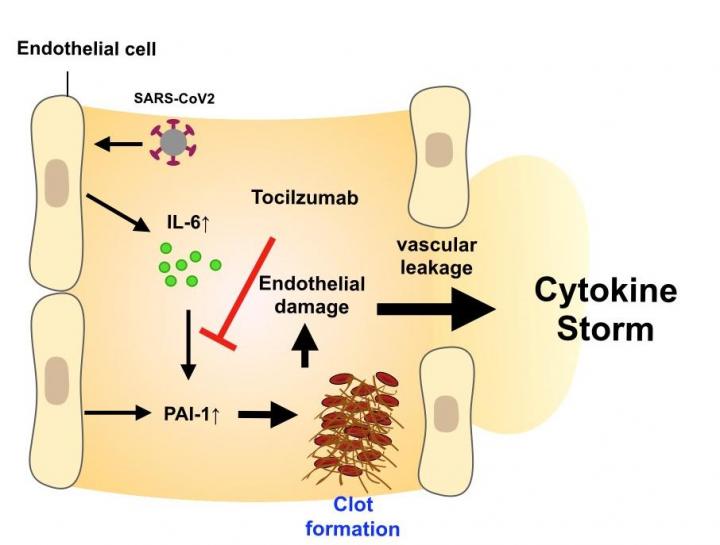
Because IL-6 was positively associated with the levels of the other cytokines and PAI-1, the researchers concluded that IL-6 signaling is crucial for the development of CRS following infection or trauma, and may play a role in the pathogenesis of COVID-19.
“Examination of cytokine profiles in severe COVID-19 patients revealed an increase in IL-6 early in the disease process, causing release of PAI-1 from blood vessels,” says study senior author Tadamitsu Kishimoto. “Interestingly, PAI-1 levels were significantly higher in COVID-19 patients with severe respiratory impediment.”
Most significantly though, when severe COVID-19 patients were treated with a human monoclonal antibody-based drug called Actemra®, which blocks IL-6 signaling, PAI-1 levels rapidly declined and severe disease symptoms were alleviated. IL-6 signaling blockade could therefore prove useful for the treatment of both CRS and the severe respiratory complications of COVID-19.
###
The article, “IL-6 trans-signaling induces plasminogen activator inhibitor-1 from vascular endothelial cells in cytokine release syndrome,” was published in Proceedings of the National Academy of Sciences of the United States of America at DOI: https:/
About Osaka University
Osaka University was founded in 1931 as one of the seven imperial universities of Japan and is now one of Japan’s leading comprehensive universities with a broad disciplinary spectrum. This strength is coupled with a singular drive for innovation that extends throughout the scientific process, from fundamental research to the creation of applied technology with positive economic impacts. Its commitment to innovation has been recognized in Japan and around the world, being named Japan’s most innovative university in 2015 (Reuters 2015 Top 100) and one of the most innovative institutions in the world in 2017 (Innovative Universities and the Nature Index Innovation 2017). Now, Osaka University is leveraging its role as a Designated National University Corporation selected by the Ministry of Education, Culture, Sports, Science and Technology to contribute to innovation for human welfare, sustainable development of society, and social transformation.
Website: https:/
Media Contact
Saori Obayashi
[email protected]
Original Source
https:/
Related Journal Article
http://dx.



