Countless studies have sought to quantify various aspects of human impacts on the planet, but sorting through that data to get answers about the effect we’re actually having can be a challenge for researchers, policymakers, and the public alike. A team of researchers has centralized over 300 key figures in the Human Impacts Database, hosted at Anthroponumbers.org. In a paper publishing in the journal Patterns on August 3, the authors outline the kinds of data they have gathered—and how they hope it helps people make sense of the climate crisis.
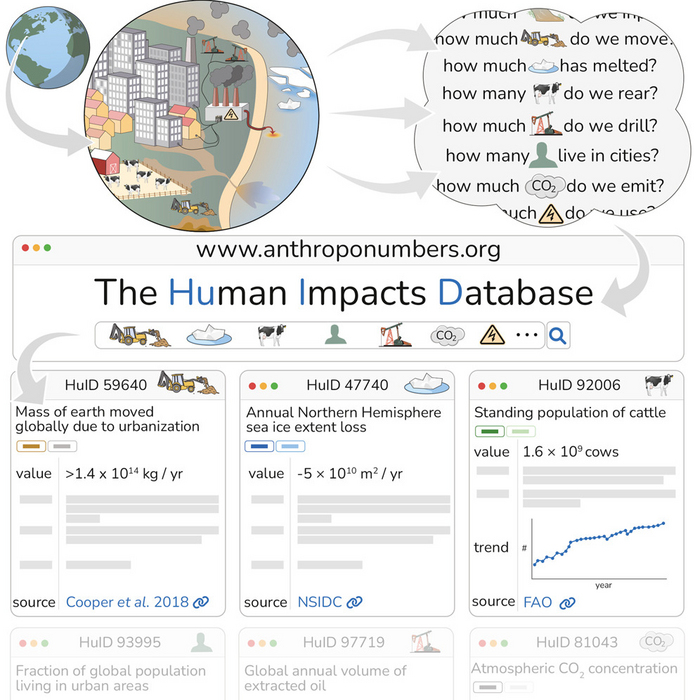
Credit: Patterns/Chure et al.
Countless studies have sought to quantify various aspects of human impacts on the planet, but sorting through that data to get answers about the effect we’re actually having can be a challenge for researchers, policymakers, and the public alike. A team of researchers has centralized over 300 key figures in the Human Impacts Database, hosted at Anthroponumbers.org. In a paper publishing in the journal Patterns on August 3, the authors outline the kinds of data they have gathered—and how they hope it helps people make sense of the climate crisis.
“Writing from California, as several of the authors are, where we now have a “wildfire season” and a multi-decadal drought, we wanted to develop a deeper understanding of the ways in which human activities might have produced such dramatic and consequential changes in our local and global environment,” say the authors, led by Griffin Chure, an NSF postdoctoral fellow at Stanford University. “In our search for answers…, we often encountered the same challenges: disparate technical studies written for expert audiences must be understood, evaluated, and synthesized just to answer simple questions. It seemed to us that a referenced compendium of ‘things we already know’… would be very useful for us and others.”
The Human Impacts Database provides information ranging from global plastic production (4 x 10¹¹ kg/year), to the total standing livestock population (4.6 x 10^10 animals), to global annual mean sea level rise (3.4 (-0.44, + 0.47) × 10-3 m/year). The data is broken into five main categories: water, energy, flora & fauna, atmospheric & biogeochemical cycles, and land, and then into 20 subcategories. When available, the database includes timeseries to help illustrate how these numbers have changed.
“We view this database as an accessory, rather than a replacement, for the myriad scientific databases that exist and are publicly available on the internet,” write the authors. “While these databases are invaluable resources for accessing scientific data, the Human Impacts Database is built from the ground-up with the intention of being broadly accessible to scientists and the curious general public alike to help build the collective quantitative literacy of the Anthropocene.”
###
Patterns, Chure et al. “Anthroponumbers.org: A Quantitative Database of Human Impacts on Planet Earth” https://www.cell.com/patterns/fulltext/S2666-3899(22)00157-X
Patterns (@Patterns_CP), published by Cell Press, is a data science journal publishing original research focusing on solutions to the cross-disciplinary problems that all researchers face when dealing with data, as well as articles about datasets, software code, algorithms, infrastructures, etc., with permanent links to these research outputs. Visit: https://www.cell.com/patterns. To receive Cell Press media alerts, please contact [email protected].
Journal
Patterns
DOI
10.1016/j.patter.2022.100552
Method of Research
Survey
Subject of Research
Not applicable
Article Title
Anthroponumbers.org: A Quantitative Database of Human Impacts on Planet Earth
Article Publication Date
3-Aug-2022